

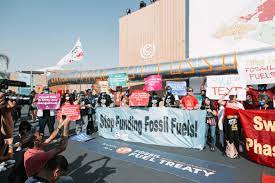

Oilwatch Africa and Health of Mother Earth Foundation (HOMEF) have advocated an end to expansions in fossil fuels exploration to check adverse effects of climate change.
The groups noted that curtailing fossil projects was fundamental to bring about the needed changes to reject false climate solutions and
ensure an inclusive solution.
A statement issued on Friday by Kome Odhomor, Media/Communication Lead at HOMEF said the groups made the advocacy at the sidelines of the just concluded COP 28.
According to the statement, the advocacy included the call for payment of ecological debt owed the global south,elimination of energy poverty, and a rejection of land grabbing or green colonialism.
It quoted the Executive Director of Kebetkache Women Development Center, Emem Okon, as highlighting the challenges and issues women face due to extractive activities.
“Grassroots women in the Niger Delta are very vulnerable to environmental degradation. Women contribute immensely to the local economy with a heavy reliance on environmental resources.
“This exposes them to the disruptive impacts of land grabs, gas flaring, and
oil spillages.” Okon said.
She also noted that women are excluded from decision-making processes thus complicating their dilemma.
She explained that as women face violence due to fossil fuel extraction and climate change, there is a need to integrate their roles, concerns, and
interests in decision-making.
The statement also noted that Project Officer in charge of the Youth Desk, Ukpono Bassey, called for youth involvement in the fight against environmental degradation.
Bassey said : “This the time for youth to be involved in leadership. After
28 COPs, it is evident that the elders have fallen short. The baton must be passed to the youth who are ready and compelled to take charge.
“The time for change is now – a change that ensures a sustainable future for
generations to come.”
In her contribution, Odudabasi Asuquo, Project officer, Oilwatch Africa
maintained that it was unacceptable to continue the climate debate without of phasing out fossil fuels.
She regretted that there is a mad rush of fossil investments in Africa, assaulting sensitive ecosystems and vulnerable communities and risks saddling them with toxic stranded assets.
She cited examples of communities in Uganda,
Senegal, Namibia, and Botswana that need global solidity to ensure
ecological justice.
Stephen Oduware, the coordinator of Fishnet Alliance, highlighted
the various challenges faced by fisher folks through diverse false
climate solutions.
The false solutions including the use of water bodies as carbon sinks or
for risky experimentation.
“Coastal communities across Africa are gradually disappearing due to coastal erosion. They are gravely impacted by the impacts from the mindless exploration and exploitation of crude oil and gas.
“These communities are predominantly fishing and farming
communities whose livelihoods, including their rights to a pollution-free environment, have been taken away by powerful corporations, with the complicity of governments”, Oduware said.
Oduware lamented that the COP has become a yearly ritual, and COP28 was no different.
“The space has largely become a space for making business
deals with no real action for the people.
“We need to unite to
overthrow this current system of oppression, suppression, and inaction,
until victory”.
The coordinator of Oilwatch International Kentebe Ebiaridor, lamented by
the fact that countries at COP28 continue negotiating with no clear
decision to phase out fossil fuel rapidly, firmly, and fairly.
He also regretted the undue influence of the fossil fuels lobby at the COP.
He noted that giving new permits for crude oil and gas violates any hope of
meeting the Paris Agreement target of 1.5°C above preindustrial levels.
The advocacy came up with an agreement that the world cannot afford
more sacrificial zones that present nothing but an unlivable future.
“Extractive crimes must cease immediately, and governments must enforce
and strengthen regulations to ensure proper accountability and
responsibility.
“The transitioning to cleaner energy must ensure that frontline communities are fully integrated in decision-making and have the right to reject destructive extractive activities just as the people of Ecuador did in August 2023 when they voted to stop the extraction of crude oil in Yasuni,” the groups stated..
The groupß noted that marginalized communities in Africa bear a disproportionate burden of environmental pollution, hazardous waste, and other negative impacts of extractive and other destructive activities.
They advocated the need to address the underlying systemic issues perpetuating the expansion of sacrifice zones on the continent..
According to them it is essential to bring about regulatory changes, community involvement, grassroots advocacy, and people-centered practices toward a just and equitable society.