


By Onu Okorie
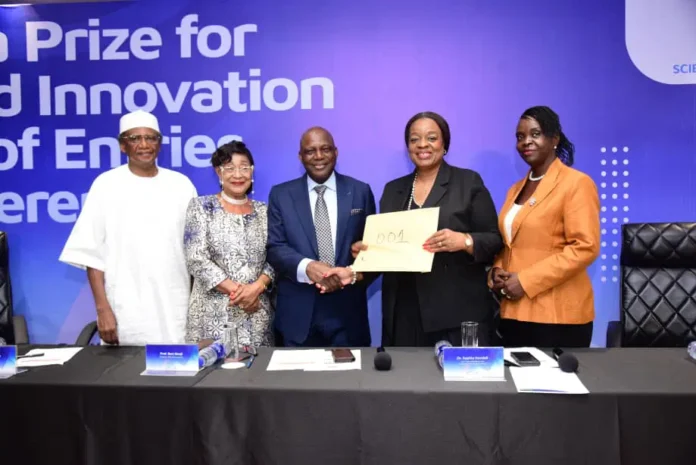
The 2026 edition of The Nigeria Prize for Science and Innovation has recorded an historic milestone, attracting a record-breaking 237 entries, the highest number of submissions since the Prize was established n in 2004. The submissions were formally handed over to the Prize’s Advisory Board at a press conference in Lagos on Thursday, marking the start of the adjudication process.The handover marks the beginning of the search for Nigeria’s most innovative scientific mind, under the theme “Innovations in ICT, Artificial Intelligence (AI), and Digital Technologies for Development.” The theme was a deliberate retention from the 2025 edition, which concluded without a winner after no entry met the required standard for selection.
Receiving the entries, Chairman of the Advisory Board, Barth Nnaji, described the handover as a decisive stage in the Prize’s selection process, emphasising that its credibility is anchored on strict standards of excellence. He reaffirmed that the Prize remains focused on identifying innovations that translate scientific insight into tangible socio-economic outcomes.“Our refusal to award the prize in 2025 was not a dismissal of the hard work of Nigerian innovators; rather, it reinforces that The Nigeria Prize for Science and Innovation holds a gold standard of excellence,” he stated.
Other members of the Board are Chief Dr. Nike Akande, a two-time former Minister of Industry, and Professor Baba Yusuf Abubakar, a professor of quantitative genetics and animal breeding.The Nigeria Prize for Science and Innovation, now in its 22nd year, is valued at $100,000 and remains arguably Africa’s most prestigious science award. The winning entry for the 2026 edition will be unveiled at a world press conference scheduled for September.
Speaking at the press conference, Sophia Horsfall, NLNG’s General Manager, External Relations and Sustainable Development, said the continued focus on digital technologies reflects both global trends and Nigeria’s development priorities. She noted that the Prize remains a platform for identifying solutions with real-world relevance.“