


By Valentine Obienyem
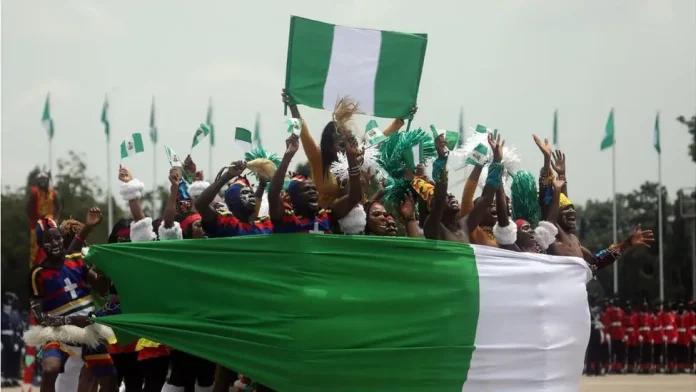
Sixty-six years ago today, the Union Jack was lowered and the Nigerian flag was raised over a free and sovereign nation. After decades of colonial rule, Nigerians became masters of their own political destiny. The decisions affecting our collective life were no longer to be made in London; they were to be made by Nigerians, for Nigerians, in Nigeria.
Independence was therefore much more than the changing of a flag. It was a promise. It was the promise that a people who had endured the indignities of colonial rule would use their freedom to build a nation in which dignity, opportunity, justice and prosperity would be available to all.
Our nationalists paid a price for that freedom. Many endured imprisonment, exile, political persecution and personal hardship. They participated in constitutional conferences and political struggles because they believed that self-government would give Nigerians the opportunity to determine their own destiny. They did not fight merely to replace the British at the helm of government. They fought for a better Nigeria.
Yet, 66 years later, one is compelled to ask a painful question: what have we done with the freedom for which they struggled? The question is particularly pertinent this year because the President, in his Independence Day address, has asked Nigerians to look forward with renewed hope. He says the country has passed through an “age of reform” and is now entering an “age of prosperity”. He speaks of an economy whose direction has been corrected and of a Nigeria in which farmers will produce more cheaply, factories will become more productive, young people will find productive work and vulnerable citizens will receive greater support.
These are worthy aspirations. Indeed, every Nigerian should desire such a country. But Independence Day should not be merely an occasion for repeating our aspirations. It should also be an occasion for asking whether the Nigeria we have built is worthy of the sacrifices that produced our independence.
In 1960, our greatest problem was that we were ruled by others. Today, nobody can plausibly make that argument. We are ruled by ourselves. The more uncomfortable question is whether we have learnt to govern ourselves well.
Our political history since independence has been a complicated mixture of achievement, disappointment, hope and failure. We have experienced civilian governments and military interventions, a civil war, coups and counter-coups, the annulment of an election, prolonged military rule and, eventually, the longest uninterrupted period of civilian government in our history.
Yet democracy has not automatically produced good governance. Elections have often been treated less as instruments for choosing the best ideas and more as contests for political power. Ethnicity, religion, patronage and personal ambition have frequently competed with competence, accountability and national interest.
The consequence is that independence has sometimes changed the identity of those who exercise power without sufficiently changing the quality of governance experienced by the ordinary citizen.
Economically, the contradiction is equally striking. At independence, Nigeria possessed enormous agricultural potential and an economy that produced substantial quantities of commodities for export. Over time, we allowed agriculture to decline, became excessively dependent on petroleum and repeatedly failed to transform our enormous natural resources into broad-based prosperity.
Today, the language has changed. We speak of economic reform, productivity, industrialisation, exports, infrastructure and shared prosperity. The President himself has acknowledged that millions of Nigerians still struggle with food, school fees, medical bills and the ordinary cost of living.
That admission is important because statistics, however impressive, do not constitute prosperity by themselves. A country is not prosperous merely because its economy grows. Prosperity becomes meaningful when the farmer can feed his family from the proceeds of his labour, when the graduate can find productive employment, when the entrepreneur can operate without crippling obstacles, when electricity is dependable, when roads connect producers to markets, and when an ordinary family can live without perpetual anxiety about tomorrow.
This is why Independence Day should be a day of both celebration and examination.
We have also paid a terrible price in human lives. Insecurity, terrorism, banditry, kidnapping, communal violence and other forms of criminality have made the preservation of life one of the central responsibilities of the Nigerian state. The President acknowledged the sacrifice of the Armed Forces and security services in his address. They deserve our gratitude. But gratitude cannot substitute for the creation of a society in which citizens can live, work, travel and worship without fear. In this s ore our president is a monumental failure.
We have witnessed the gradual normalisation of conduct that earlier generations would have regarded as unacceptable. Corruption has become so familiar that citizens sometimes discuss it as though it were an unavoidable feature of public life. Public office is too often viewed as an opportunity for private enrichment. Institutions that ought to protect the common good are weakened by personal interests. Truth is frequently sacrificed on the altar of political convenience.
This moral crisis is perhaps more dangerous than any economic crisis because institutions are ultimately operated by human beings. A good constitution cannot save a society whose citizens have lost their sense of responsibility; nor can a good economic policy survive indefinitely in an environment where public trust is continually betrayed, even by Mr. President.
And so, as we celebrate 66 years of independence, perhaps we should resist the temptation to congratulate ourselves. I am not suggesting that Nigeria has achieved nothing. That would be unfair to the millions of Nigerians who, through extraordinary resilience, have kept the country alive and moving forward. Nigerians have built businesses, universities, hospitals, industries, professions and communities of which we can be proud. Our writers, academics, scientists, entrepreneurs, farmers, artisans, religious leaders, civil servants and professionals have demonstrated repeatedly that the Nigerian is capable of excellence.
The problem is not the Nigerian capacity for greatness. The problem is our inability to consistently translate individual excellence into national excellence. This is why Independence Day should be more than ceremony. It should be an annual national audit of our journey.
We should ask ourselves what happened to the dreams of our founding generation. We should examine the choices that brought us here. We should identify the mistakes that must not be repeated. We should distinguish between the reforms that genuinely improve the productive capacity of the country and those that merely shift burdens from one generation to another. Above all, we should stop confusing optimism with achievement.
A nation does not become great because its leaders repeatedly declare that greatness is coming. It becomes great when institutions work, when citizens trust government, when public resources are used for public purposes, when human life is respected, when merit is rewarded and when the ordinary citizen can reasonably believe that tomorrow will be better than today.
At 66, Nigeria is no longer a young experiment in nationhood. We are old enough to know our history, old enough to recognise our recurring mistakes and old enough to understand that nobody is coming to rescue us from ourselves.The colonial masters are gone. The responsibility is now entirely ours. That is perhaps the most sobering meaning of independence.
We have the freedom to succeed, but we also possess the freedom to fail. We can blame colonialism for some of the foundations upon which our country was built, but after 66 years, we must increasingly accept responsibility for the house we have constructed upon them.
For 66 years, Nigeria has been free. The greater question now is whether we have learnt how to use that freedom. Until we do, our Independence Day celebrations will remain, in some measure, celebrations of an unfinished promise. And perhaps that is why, even at 66, Nigeria must celebrate with one hand raised in thanksgiving and the other placed firmly on her conscience.
Happy Independence Day, Nigeria.