

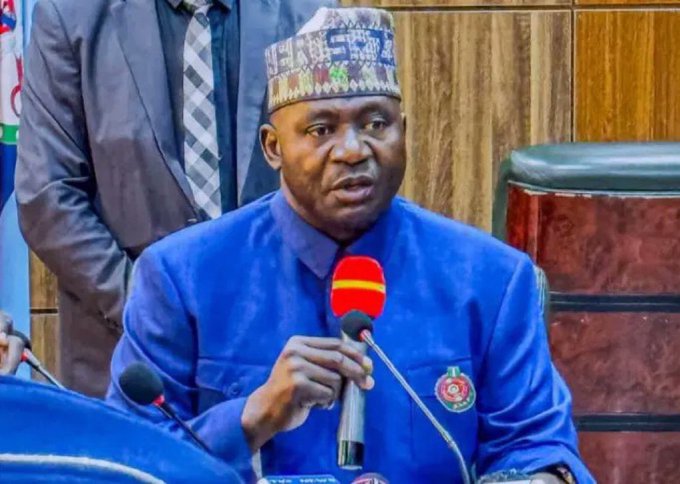

The Minister of Defence, General Christopher Musa (rtd), on Wednesday, July 8, 2026, warned security personnel deployed to fight terrorism and banditry against hesitating to engage terrorists, saying any officer who waits for an order before taking action would be treated as a terrorist.
He made the disclosure at the commissioning of 62 armoured vehicles and over 300 motorcycles procured by the Sokoto State Government for security agencies, directing troops to act decisively against criminal elements within the rules of engagement.
“Anybody who refuses to shoot a terrorist in the name of waiting for an order, we will treat him like a bandit,” he said.
This warning has generated serious debate about Nigeria’s security strategy, military discipline, and the quality of leadership in the country’s long battle against insecurity.
Musa’s argument, no doubt, was based on the need for courage, initiative, and commitment among security personnel who are expected to protect themselves and the citizens under dangerous circumstances.
There is logic in the minister’s position. Soldiers, police officers, and other security personnel are trained to respond quickly to threats. In counter-terrorism operations, hesitation can cost lives. A commander on the battlefield cannot always wait for approval from the headquarters before defending themselves and civilians, or neutralising the enemy. The realities of modern warfare require intelligence, speed, and independent decision-making.
However, the statement also raises important questions:
* Why has Nigeria’s security situation remained difficult despite years of military operations, billions of naira spent, international support, and the sacrifice of thousands of security personnel?
* Why did similar urgency not become a defining feature when Musa was the Chief of Army Staff between 2023 and 2024?
* If hesitation among troops is a major problem, what systems existed under previous military leadership to address it?
These questions are important because Nigeria’s security crisis is not simply a problem of individual soldiers lacking courage. It is a deeper institutional challenge involving leadership, intelligence failures, equipment gaps, corruption, weak coordination, and poor governance.
Musa’s experience as a military officer gives him a unique understanding of the battlefield. As the Chief of Army Staff (COAS), he inherited a long-running war against Boko Haram, Islamic State West Africa Province (ISWAP), bandits, and other armed groups. His tenure recorded some military successes, including operations that weakened terrorists’ networks and eliminated some commanders. But the broader insecurity challenge continued.
The argument that soldiers must act without waiting for orders naturally leads to the question: were soldiers previously restricted by excessive caution or unclear rules of engagement? If so, why were those reforms not fully implemented when he was the army chief?
The reality is that military operations are not driven only by the bravery of individual soldiers. Armies succeed because of strong institutions, clear command structures, reliable intelligence, effective logistics, and political commitment. A soldier may be courageous, but without proper equipment, information, and support, courage alone cannot win a war.
Nigeria’s terrorism crisis has lasted for more than a decade. The Boko Haram insurgency began in the early 2000s, but became a major national security threat after 2009. Since then, thousands of Nigerians have been killed, millions have been displaced, and several communities have been destroyed.
Successive governments have committed huge resources to fighting insecurity. Defence budgets have increased significantly, with additional emergency funding approved at different times for weapons, equipment, and operations. Nigeria has also received support from international partners, including the United States, United Kingdom, France, and regional allies.
Yet, despite these investments, terrorism and banditry have remained persistent. This raises concerns about whether Nigeria’s problem is simply a lack of resources or whether the country has deeper structural weaknesses.
We, at Daily NewsCraft, are of the position that, in as much as General Christopher Musa’s warning may serve as a necessary call for courage among security personnel, however, Nigeria’s security crisis cannot be solved by telling soldiers to be more aggressive alone. The country needs stronger institutions, better leadership, accountability, and a comprehensive strategy.
After more than a decade of fighting terrorism, Nigeria must move from emergency responses to sustainable solutions. The bravery of security personnel must be matched by the seriousness of political leadership. Only then can Nigeria overcome the insecurity that has threatened its stability and global image for too long.