


By Chijioke Iremeka
For families grieving the loss of loved ones in road crashes and other emergencies, the pain can be compounded by another distressing discovery that their personal belongings disappear in the chaotic moments following the accident.
One fateful morning in Oshodi, Lagos State, while sniffing around for unusual stories, our correspondent spotted a chaotic scene towards the bus terminal.
Curiosity nudged him to the scene, where he noticed several young boys being flogged and beaten by leaders of the local transport union in Oshodi beside the flyover.
A weighty slap was landed on one of the boys’ cheeks, capable of perforating his eardrum. This spurred the inquiry about their offence(s) and why they were being emasculated in such a manner.
However, the discovery was more emotionally disturbing than the resounding slap received by the boy.
“Just a few minutes ago, an unidentified woman was crossing the expressway and was knocked down by an oncoming vehicle. Instead of taking the woman out of danger, these boys abandoned her and were fighting over her handbag and phone,” one of the union workers, identified as Adeoti, said.
According to him, “while they were scrambling for the content of her handbag and phone, a speeding Toyota Sienna wagon ran over the woman, killing her on the spot.”
Adeoti explained that when this happened, sympathisers raised an alarm, and the union heard what happened and conducted their investigation, leading to the apprehension of the boys for interrogation.
“While they were being interrogated, three of them in question, accepted that they went after her belongings thinking that she was dead already,” he told our correspondent.
During their interrogation and punishment, they were beaten for stealing from a woman struggling to survive instead of giving her life-saving assistance.
One of the culprits who received the slap, identified as Segun Ahmmed, said they did not know the woman was still alive they way she was knocked by the vehicle, and he went after her phone.
“It was out of ignorance that we did what we did. I wanted to take her phone. I thought she was dead already; I didn’t know she was still alive. If I had known, I would have helped her,” the 19-year-old said while he was being interrogated and severely punished.
Asked about the need for the deceased’s belongings instead of showing empathy and seeking ways to contact her relatives, he said, “I wanted to sell the phone and make some money to feed myself. I don’t have what I am doing; I’m just carrying loads for a fee to feed myself.”
He and two other culprits appealed for pardon as they had learnt their lessons and all regretted their actions.
The scene and boys’ attitude left many sympathisers terrified, highlighting concerns about opportunistic theft at accident or disaster scenes across the country.
This calls for mind reorientation to protect victims in emergency situations and preserve their dignity by offering assistance that would improve the victims’ chances of survival and not looting them to their deaths.
The woman’s experience and unfortunate death mirror how first responders, especially those who should be committed to rescuing people from danger, choose to steal from the people they came to save, a total departure from the norms of rescue operations.
A celebrity photographer, Nnaemeka Ikerionwu, said he was left deeply traumatised after witnessing the horrific accident that claimed Michael Udoye’s life and watching people scramble for his money that had scattered around the crash scene.
It was gathered that the deceased, who worked as a money changer, had over N4 million in his car while returning from the club early in the morning before meeting his untimely death.
Still shaken by the incident, Ikerionwu said the images from the scene lingered in his mind throughout his journey that day.
“I was traumatised throughout that day while travelling to the South East,” he said.
Recounting the incident, he explained that shortly before 5 am, he had parked somewhere along Ago Palace Road while waiting for someone who was to join him for a trip when the tragic accident occurred.
“In less than two minutes, I heard a loud bang behind me. A blue Toyota Corolla or Camry, I’m not sure because it was still very dark, heading towards Apple Junction, had rammed into a truck with a container.
“The occupants, a male and a female, were probably returning from a club because there was so much money in the vehicle. The money littered the road as if it were a robbery scene.
“I refused to get closer because I knew they were gone, and I was about to embark on a very long journey. So, I wouldn’t want anything that would dampen my spirit; yet I was traumatised,” Ikerionwu recalled.
According to him, he immediately called 112, and the officer who received the distress call assured him that emergency responders would be dispatched without delay.
Ikerionwu, however, said he could not tell whether help arrived on time because the horrifying scene had already left him badly shaken.
Still traumatised by what he had witnessed, Ikerionwu said he abandoned plans to wait for the person he intended to pick up and continued his journey in distress.
“Here is what traumatised me. After a few minutes, a man got closer to the badly damaged vehicle and shouted that the occupants were a male and a female.
“‘Wọ́n ti kú ooo! Wọ́n ti kú ooo! See plenty money ooo!’ he kept shouting in Yoruba, signalling that they were dead. Others joined him and started scrambling for the money.
“When I saw this, I was heartbroken and left immediately. I didn’t wait for the person I wanted to pick up. Throughout my journey, I kept thinking: how can a human witness such a terrible fatal accident and all he could think about was the money? What exactly is wrong with some people? I couldn’t believe it,” Ikerionwu added.
Corroborating the witness’ account, the deceased’s brother-in-law, Somtoochukwu Ifedioranma, said that the deceased was a money changer and was driving home from a club where he plied his business before his sudden death.
He noted that this explained why he had too much cash, including naira and other foreign currencies, on him the morning he died.
“Before we could reach the scene of the crash, the first people who got to the scene (the first responders) had stolen all the money in his car, including his phones and every valuable in his car. We did not see any money in his car,” he said, confirming Ikerionwu’s earlier claim.
Theft from accident victims and disaster fatalities, allegedly by some first responders in different forms, especially when the grassroots first responders are involved, has become a recurring concern at emergency scenes in Nigeria.
Investigation revealed that there are cases where professional and grassroots first responders are implicated and prosecuted for stealing from accident victims and even dead accident or disaster victims.
First responders, for clarity, include all professional personnel, good Samaritans, transport workers, curious onlookers, and grassroots who first converge within minutes of the incident to save lives, but sometimes, create an environment in which confusion makes it difficult to determine exactly what happened to victims’ possessions.
According to a study authored by Selwyn Mahon, titled “Role of Bystanders in Disasters,” traditionally, police, fire, and emergency medical services personnel have been referred to as “first responders” because they are usually the first of professional responders to arrive at an incident.
However, the study emphasised that when a ‘sudden disaster’ occurs, bystanders witness the event and are among the first to respond to the situation.
“During the critical time between the occurrence of the emergency incident and the arrival of professional responders, those injured can deteriorate clinically and can die before the professional responders arrive.
“So, bystanders (grassroots volunteers) often step forward, initiating evacuation, scene control, haemorrhage control, search and rescue, cardiopulmonary resuscitation, popularly known as CPR, and many other roles,” the study noted.
The authors added that disaster managers and professional responders have recognised the value of grassroots volunteer rescuers, but concerns about liability and dependability have limited their utilisation.
“Bystanders also have no accountability and limited health protection,” the study added.
Meanwhile, data detailing direct statistics on stolen belongings specifically by rescue operators during disasters in Nigeria is limited, as the issue is typically classified under broader grievances of corruption and diversion of relief materials, as in the case of the National Emergency Management Agency probed for diversion of relief materials meant for flooding victims in the country.
However, checks showed that the 2025 Federal Road Safety Corps (l(FRSC) annual and festive-season road traffic statistics has a total of 10,446 road crashes in 2025. The agency successfully rescued 40,323 victims, while 5,289 fatalities were recorded.
Also, Lagos State reports that at least 133 human lives and N19.72 billion worth of property were lost to various fire incidents in 2025.
Fortunately, 473 victims rescued alive and N118.32bn worth of property saved.
Survivors and relatives of victims frequently report and protest the theft of their personal property by officials.
Sunday PUNCH reports that even Nigerian heavyweight boxer, Anthony Joshua’s phone was allegedly stolen at the scene of a road accident that left two of his close friends dead in Nigeria.
Joshua’s uncle, Adedamola Joshua, told our correspondent, “We even heard that Anthony Joshua’s phone was stolen during the accident. Some Nigerians act badly at accident scenes.
“The police and other emergency responders should get to the scene of an accident on time and cordon off the place. When they are supposed to help, you will see them bringing out their phones to make videos and even steal from the victims.”
He harped on the need to step up enlightenment across motor parks and for all Nigerians to recognise it as a national duty to immediately call emergency toll lines to inform appropriate agencies whenever they come across emergencies such as accidents and fire disasters, among others.
Findings continued to fuel public concern about accountability at emergency scenes.
In many cases, no official investigation has conclusively determined whether the losses resulted from theft, misplacement, or actions by opportunistic bystanders.
In another incident, a middle-aged man, Philip, was involved in a crash near the Toyota bus stop along the Oshodi–Mile 2 Road during the Easter period.
He was returning from work and tried to join the road when suddenly three trucks were moving across lanes.
According to him, in an attempt to manoeuvre through, one of the trucks lost controls and crashed heavily into his car.
Philip said that after everyone got out of the vehicle and moved to the roadside for safety, one of the first responders noticed the bags inside the car were being attempted to steal from him in that condition, but he ran out of luck.
“Apparently thinking the bags contained money, he attempted to steal them, taking advantage of the situation despite the victims’ distress.
“The incident occurred at about 10:00 p.m. However, he was quickly confronted. As he approached my motor in an apparent attempt to steal, bystanders noticed what he was doing and raised the alarm.
“Other people immediately chased after him, and he ran back toward the opposite side of the road, but failed to check for oncoming traffic before crossing. A speeding Lexus RX 350 struck him, and one leg of his shoes flew off, and no one could immediately see where his body had landed,” he said.
According to him, after spending about four hours at the scene resolving the aftermath of the crash, the damaged vehicle was taken to the police station.
“I joined a friend’s car, and we headed for home. Along the way, near Cele Bus Stop, Ijesha, we saw the body of the same individual. It appeared that after the Lexus hit him without stopping, his body had been carried some distance on the vehicle before ending up near Cele,” he added.
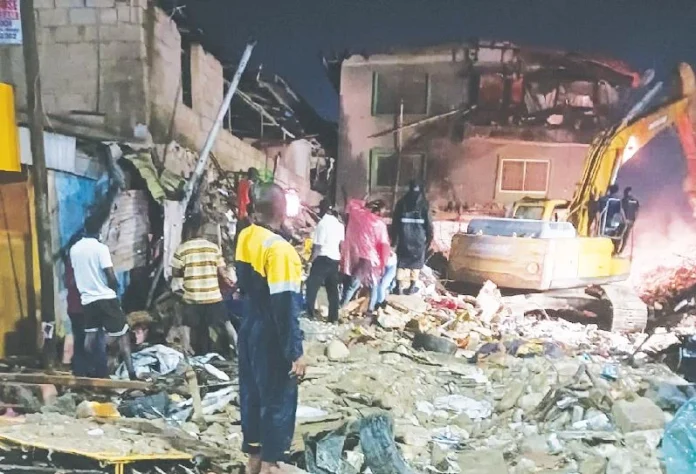
A businessman who suffered losses after the building housing his business collapsed, Kenneth Nwabueze, said that he lost property during the incident.
According to him, while the rubble destroyed part of it, others were lost to opportunistic emergency scene theft.
“They stole part of my equipment while they were searching and rescuing people from the scene,” he alleged.
He thanked God for his life and said he had to start from scratch as he had no other business left.
Corroborating his account, it was witnessed that a man left with only a solar inverter installed in one of the shops at the collapsed building site.
Another person was being beaten and was ordered out of the site for allegedly taking an iPhone belonging to one of the deceased at the scene.
Assistant Director of Search and Rescue at the National Emergency Management Agency, Adenike Busayo, said that the agency would not rule out the cases of looting of the victims or the dead by first responders.
Search and Rescue expert said apart from the professional rescue operators during the operations, there are grassroots volunteers who are now an integral part of rescue operations in the country.
According to her, they are the ones who get to the scene first before the professional first responders arrive.
While noting that those grassroots volunteers notify them whenever there is an emergency, she said NEMA works with police to ensure there is no looting at the scene, emphasising that looting of accident/disaster scenes by some first responders is a common place.
“Definitely, these grassroots volunteers will get there before us and start the operation. So, we train and retrain them on how to handle emergency situations so that they do better than harm.
“We teach them how to handle cases. They can improvise if a stretcher is not available. They can use a plank or any flat object to move an injured person safely in order not to cause more harm.
“On looting, we work with the Nigerian Police. But you can’t rule it out; it’s happening everywhere. However, I wouldn’t say that those claims do not happen, but I can tell you that the majority of the claims are not true. We also sensitise local volunteers that they are not there to loot; they are there to save lives,” she said.
She said that NEMA ensures these first responders do not engage in looting, saying that any suspected case is handed over to the police for prosecution.
“We work with the police to prevent crime. More often than not, some incidents of looting do occur, but we rely on the police to stop them. We cannot rule out cases of looting because they can happen even before we arrive at an incident scene,” Busayo added.
However, there are a few cases where the police have made several arrests in this regard, prosecuted offenders, and secured a number of convictions to deter others with such criminal propensity.
Recently, operatives of the Lagos State Police Command arrested three suspects for allegedly stealing phones from accident victims in Ikeja.
In a post on its X page, the command said the suspects were arrested a few metres away from the accident scene while trying to escape with the phones.
The command said men of the Rapid Response Squad (RSS) assisted the accident victims to the hospital.
“The agency arrested these suspects, Isaiah Adegbenro, 38; Edet Johnson, 30; and Efe Sowemimo, 28. The suspects were apprehended a few metres away from the accident point while trying to escape with the phones.
“The accident victims were heading towards Ikeja in a red Toyota Camry 2010 when the driver lost control of the vehicle and rammed into a road divider in front of Adeyemi Bero end of Governor Road, Alausa, Ikeja.
“The suspects, who were close to the scene when the accident happened, rather than assist the driver and the occupants out of the badly damaged vehicle, were ransacking the victims’ pockets and vehicle,” the post reads.
According to the police, stolen items included an iPhone 15 valued at N1,300,000 and an iPhone 12 worth N620,000.
The police added that the suspects made significant confessions and would face court charges as directed by Shola Jejeloye, the RRS commander.
Again, barely two years ago, two men were arraigned in a Magistrates’ Court in Badagry, Lagos State, for allegedly stealing N34,350 from dead victims of an accident along the Lagos-Badagry Expressway.
According to the News Agency of Nigeria (NAN), the police charged Babatunde Olatunji, 37, and Tunde Afolabi, 41, whose residential addresses were not provided, with conspiracy and theft. They pleaded not guilty.
The prosecution counsel, Inspector Ayodele Adeosun, told the court that the defendants committed the offence on July 9 at about 11 a.m. at the Muhammadu Buhari Bus Stop on the Lagos-Badagry Expressway, Age-Mowo, Lagos.
Adeosun said the defendants stole N34,350 from victims of an accident that claimed the lives of 18 passengers on the Lagos-Badagry Expressway.
The police said the defendants were apprehended by people at the scene of the accident and handed over to the police for prosecution.
The offence, he said, contravened sections 411 and 287 of the Criminal Law of Lagos State, 2015.
Magistrate T. A. Popoola admitted the defendants to bail in the sum of N200,000 each with two sureties in like sum, who must be gainfully employed.
In 2017, a Magistrate’s Court in Minna sentenced a 25-year-old security operative, Musa Isah, to three months’ imprisonment for stealing N500 from an accident victim.
Isah was arraigned on a one-count charge of theft, contrary to Section 287 of the Penal Code.
The police prosecutor, Gunduma Ibrahim, told the court that the convict, residing at M.I. Wushishi Estate in Minna, committed the offence on July 15 at about 4 p.m.
Ibrahim said the convict went to a fatal accident scene in Minna under the guise of rescuing the victims.
The prosecutor said that instead of assisting the accident victims, the convict searched the lifeless body of one of the victims and removed N500.
Ibrahim said that Isah was arrested on the spot and taken to a nearby police station for prosecution.
When the charge was read to him, he pleaded guilty and begged the court for leniency, but the prosecutor urged the court to sentence him.
The magistrate, Mariam Kings, sentenced Isah to three months’ imprisonment with a N20,000 fine option.
However, emergency management experts say preserving victims’ belongings should be an essential part of rescue operations.
Alongside efforts to save lives, they said responders are expected to safeguard personal effects, document recovered property, and ensure that valuables are handed over through a clear chain of custody whenever possible.
Lagos-based emergency medical officer, Esther Christian, told our correspondent that transparency and proper documentation not only protect victims and their families but also shield emergency workers from false accusations.
She recommended the use of detailed inventories, sealed property bags, incident reports, and, where feasible, body-worn cameras or dashboard cameras to improve accountability.
“Allegation of theft deserves careful investigation. Public confidence in emergency services depends not only on rapid response times but also on assurance that victims will be treated with dignity and that their property will be protected,” she added.
Legal practitioner and the Principal Partner, Lawrence Ndukwe and Co., Emeka Ndukwe said anyone found to have stolen from an injured or deceased person could face criminal prosecution under applicable laws.
He said that the accusations should be supported by credible evidence and investigated thoroughly before conclusions are drawn.
He called for stronger protocols governing accident scenes, recommending restriction of access to authorised personnel, improving crowd control, recording recovered items immediately, and ensuring that family members receive documented inventories of any property collected from victims.
“Public awareness is also considered important. Witnesses are encouraged to report suspicious conduct, preserve photographic or video evidence where it is safe and lawful to do so, and provide statements to investigators if they observe misconduct during rescue operations,” Ndukwe added.
A trained criminal psychologist, Fidel Okoye, said the debate extends beyond missing valuables, saying that it touches on public trust in institutions that people rely on during their most vulnerable moments.
“It would amount to double jeopardy for the bereaved families if they lost a loved one, and their property is not secured. In most cases, for the deceased member, they need those property like a phone to track what had happened.
“For others, those property might be a lifeline if recovered and given to the rightful owners. Families who have just suffered tragedy deserve confidence that every effort is being made not only to save lives but also to protect the dignity and property of victims,” he noted.
In moments of crisis, compassion, professionalism, and accountability are expected to go hand in hand for trust and confidence in the system, he added.
However, as calls for greater transparency grow, stakeholders in emergency management say the focus should remain on strengthening oversight while ensuring that allegations are investigated fairly and guilty prosecuted.
Reacting to growing cases of looting and stealing from disaster scenes and victims, the manager of the professional first responders, Dr Olufemi Oke-Osanyintolu, who is the Permanent Secretary of the Lagos State Emergency Management Agency, said anyone caught stealing at emergency or rescue operation scenes would be arrested and prosecuted.
“Concerning people who come into the disaster or accident scene as rescue operators and decide to loot the site or the victims, we are watching. The police are here, and anyone found guilty would be prosecuted.
“This is more reason we cordon off some areas and ensure that people do not go into the site to ensure the privacy, dignity and property of the victims are protected and secured. Anyone found stealing will be arrested and prosecuted,” he said.
Lending her voice, an instructor with the Nigerian Red Cross Society, Lagos Branch, Celestina Ekuma, told Sunday PUNCH that stealing from victims or scenes is common, especially when there is a mixed crowd during rescue operations.
Ekuma said it is wrong for anyone to come into an accident or disaster scene where people are fighting for their lives with the intention to steal from people struggling and battling to stay alive.
“We need to sensitise the public on the importance of this operation and encourage empathy towards victims because it could happen to anybody,” she added.