

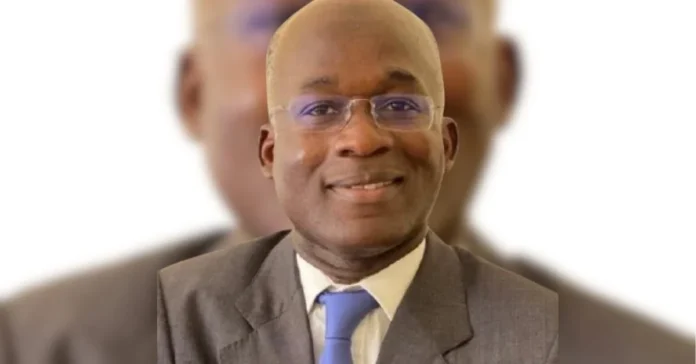

Engr. Lanre Babalola was recently appointed by President Bola Ahmed Tinubu, GCFR, as the Special Adviser To The President on Power and Chair of The Presidential Task Force on Power
He is a renowned Nigerian energy expert, economist, and former government official with extensive experience in the country’s electricity sector.
Indeed, he is widely regarded as a technocrat with deep institutional knowledge of Nigeria’s power sector, especially its reform history and structural challenges. Energy experts say that his recent appointment as Special Adviser on Power and head of a presidential task force reflects the government’s intention to rely on experienced insiders to tackle persistent electricity issues.
As one analyst recently stated, Babalola “ is not a newcomer, he is one of the architects of Nigeria’s earlier power sector reforms, now returning to help drive another phase of restructuring”.
His appointment was made public through a public statement issued by Mr. Bayo Onanuga, the Presidential Spokesperson on 30th April, 2026
The statement reads”President Bola Ahmed Tinubu, GCFR, has appointed Mr. Rilwan Lanre Babalola as Special Adviser to the President on Power and as Chairman of the Presidential Task Force on Power Sector Reset and Restoration.
“The President has also redesignated the Office of the Special Adviser (Energy) as the Special Adviser (Oil & Gas) to clarify roles and avoid duplication of functions within the energy governance framework.
“Mr Babalola, a former Minister for Power, brings deep sectoral expertise and a proven understanding of the structural and operational challenges within the electricity value chain.
“His appointment underscores the President’s determination to undertake a decisive and results-driven reset of Nigeria’s power sector.
“The Presidential Taskforce, which he heads, will operate under a direct presidential mandate as a high-level, delivery-focused vehicle to restore discipline, efficiency, and commercial viability across the power sector, while ensuring effective coordination among relevant ministries, departments, and agencies.
“The Task Force’s mandate includes driving a comprehensive system reset of the electricity sector; implementing a “Performance Before Expansion” framework; reducing technical, commercial, and collection losses; and strengthening cost discipline and tariff integrity.
“It will also enhance revenue assurance and sector liquidity; restore grid discipline and market integrity; promote productive use of power across key sectors; develop Electricity Growth Zones; reduce fiscal exposure; and deliver a 90-day implementation blueprint.
“The President expects Mr Babalola to bring urgency, discipline, and a strong execution focus to this assignment, in line with the Renewed Hope Agenda, to deliver measurable improvements in power supply and sector performance”. the statement ended.
Engr. Babalola is not new to the Nigerian power sector ecosystem. He had earlier served as the Minister of Power on 17 December 2008 after a cabinet reshuffling by President Umaru Yar’Adua. He left office in March 2010 when Acting President Goodluck Jonathan dissolved the cabinet
Babalola obtained a Doctor of Philosophy Degree (PhD) in Energy Economics from the University of Surrey, United Kingdom. He was an investment banker with Lead Bank in charge of the Public Sector and Infrastructure Department
He joined the Bureau of Public Enterprises (BPE) in November 2001 as head of the Power Sector Team. Under a program assisted by USAID and later the World Bank, he was responsible for reform measures including setting up the Nigerian Electricity Regulatory Commission, and unbundling the Power Holding Company of Nigeria (PHCN). After leaving the BPE, he was Deputy General Manager at the Nigerian Electricity Regulatory Commission for a short period. He then joined the Economic Advisory Team of President Umar Yar’adua.
Upon his appointment as the Honourable Minister of Power in December 2008, Babalola faced a challenging job, with severe lack of power generation and transmission facilities, tangled regulations and a highly ambitious program to expand capacity.
In February 2009 the minister suspended the Executive Chairman of the Nigerian Electricity Regulatory Commission, Ransome Owan, and six commissioners. They had been arrested by the Economic and Financial Crimes Commission (EFCC) on 3 February 2009 for allegedly misappropriating N1.54 billion in 2008. Babalola had initiated the action in March 2009, he said President Yar’Adua approved the removal of the Executive Vice chairman of PHCN, Bello Suleiman, and two executive directors, due to disagreements about how the massive investment in the power industry by the Federal Government should be allocated.
In September 2009 Babalola argued that delivering 6000MW of generating capacity was highly ambitious but attainable. In February 2010 it was revealed that power supply had in fact fallen to 2,700 mW from 3,710 mW at the end of the previous year. Babalola blamed the problem on inadequate natural gas supply for the new generators.
In January 2010 Babalola said that there would be a slow-down in the process of unbundling the Power Holding Company of Nigeria due to concerns about the viability of private power generation in the current tariff and regulatory structure, and the need to establish rules to ensure a level playing field in the competitive market. He announced plans that included construction of additional gas-fired generation stations near the source of supply in the Niger Delta, reducing vulnerability to pipeline disruptions, and major projects to build transmission and distribution facilities to eliminate bottlenecks in the grid. He also said the government was encouraging private-sector power generation projects.
Engr, Babalola left office on 17 March 2010 when Acting President Goodluck Jonathan dissolved his cabinet When a new cabinet was formed on 6 April 2010, President Jonathan took personal responsibility for the Ministry of Power, and did not name a minister.