

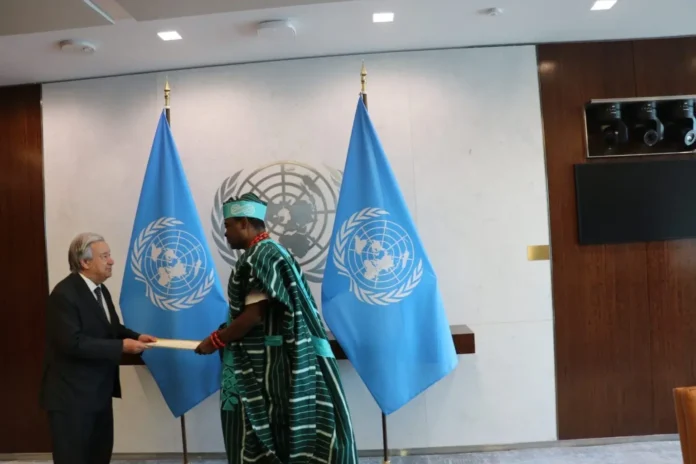

Nigeria’s new Permanent Representative to the United Nations (UN), Jimoh Ibrahim, has said President Bola Tinubu is determined to address the root causes of insecurity by resolving long-standing grievances across the country and the wider region.
Ibrahim stated this on Monday after presenting his Letter of Credence to the UN Secretary-General, António Guterres, at the United Nations headquarters in New York.
The envoy said the President recognises that many of Nigeria’s security challenges are driven by unresolved grievances, including religious conflicts and other long-standing disputes.
According to him, Tinubu is committed to addressing these underlying issues as a pathway to lasting peace.
He said, “President Tinubu is determined to address religious conflicts and other crises, which stem from long-standing grievances.”
Ibrahim added that resolving such concerns remains critical to “strengthen peace and safety for everyone.”
Nigeria Seeks Global Support On Security
The ambassador noted that Nigeria would intensify efforts to build international partnerships to tackle security challenges both domestically and regionally.
He said the President believes Nigeria’s active engagement at the United Nations would provide “essential support to address security concerns both locally and internationally.”
Ibrahim added that the country is also focused on threats emanating from the Sahel and the West African sub-region.
“Resolving domestic grievances and regional instability remains the foundation of security,” he said.
The envoy described his appointment as marking Nigeria’s return to full diplomatic engagement at the UN after more than two years without a substantive permanent representative.
“President Tinubu is confident that, as Nigeria’s ambassador and head of mission to the UN, I will work hand-in-hand with you to tackle the issues we share,” he said.
Ibrahim also reaffirmed Nigeria’s long-standing advocacy for reforms within the UN system, particularly the need for stronger African representation at the Security Council.
He said securing a permanent seat for Africa would be a landmark achievement.
“An African seat at the Council would be celebrated as a significant historical achievement and could greatly enhance our collective security,” he said.
Speaking on Nigeria’s economy, Ibrahim highlighted the reforms being implemented by the Tinubu administration, acknowledging their immediate challenges but expressing optimism about long-term gains.
“All reforms in the short run come with one form of pain or the other, but the results have been remarkable,” he said.
He added that Nigeria would continue to champion global initiatives on tax reforms, climate action, and multilateral cooperation aimed at promoting sustainable development and peace.
The envoy reiterated Nigeria’s commitment to playing a leading role in advancing the core objectives of the United Nations, particularly in Africa.
He also referenced the importance of global peace to economic stability, noting the strategic significance of critical trade routes such as the Strait of Hormuz.
At the event, Guterres emphasised Nigeria’s importance in strengthening multilateral cooperation within the global system.
Ibrahim also visited the UN Deputy Secretary-General, Amina Mohammed, who expressed delight at his assumption of duty, noting that Nigeria’s absence had been felt within the organisation.
The ambassador was accompanied to the presentation of his credentials by Amb. Syndoph Endoni, Amb. Bola Asaju, and Brig.-Gen. Edward Koleoso, Nigeria’s Defence Adviser to the UN.
Nigeria became the 99th member of the United Nations on October 7, 1960, just six days after gaining independence on October 1, 1960.
Since then, the country has played a prominent role in UN peacekeeping operations and has remained a strong advocate for reforms, particularly the push for a permanent African seat on the Security Council.