

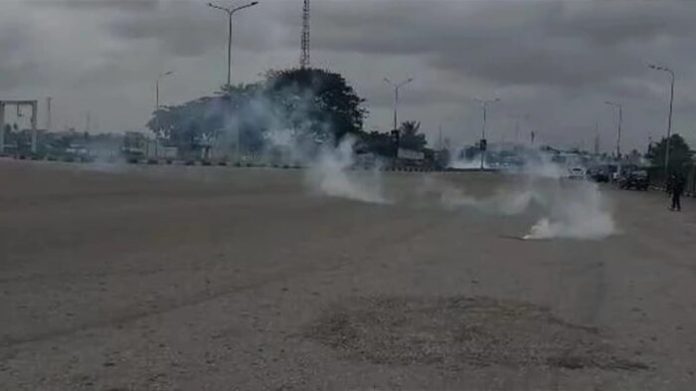

The repeated use of police force to disperse peaceful citizens commemorating the victims of the 20 October 2020 Lekki Toll Gate shootings raises a disturbing question: what are the police and government trying to suppress?
On the sixth anniversary of #EndSARS, armed police reportedly fired tear gas at activists and other citizens who assembled at the Toll Gate to honour the victims. A similar crackdown occurred during the 2024 memorial, when witnesses reported that police fired tear gas and assaulted participants. This is therefore not an isolated operational error; it is becoming an annual pattern of repression.
From every indication, the authorities appear to afraid of four things.
First, they fear public memory. Every wreath laid at Lekki rejects the attempt to erase, deny or minimise what happened on 20 October 2020. The Lagos Judicial Panel found that soldiers and police shot peaceful protesters at the Toll Gate. Amnesty International has also maintained that security forces killed protesters at Lekki and Alausa.
Second, they fear accountability. Six years later, the central questions remain unanswered: Who ordered the deployment? Who authorised the use of live ammunition? How many people were killed or injured? What happened to those reportedly taken away? Which officers have been prosecuted? Commemoration keeps these questions alive and exposes the government’s failure to provide truth, justice and reparations.
Third, they fear the political power of collective remembrance. Lekki Toll Gate is no longer merely a physical location. It has become a national symbol of police brutality, state violence, youth resistance and official impunity. Authorities apparently worry that even a wreath-laying ceremony could rekindle the solidarity and civic mobilisation witnessed in October 2020.
Fourth, they fear losing control of the official narrative. A peaceful memorial contradicts attempts to portray every gathering as a security threat and every protester as violent. The peaceful presence of citizens, survivors, families, journalists and political figures forces the country to confront the difference between legitimate public order management and the suppression of dissent.
The police may claim that they are preventing obstruction, violence or a breakdown of public order. But such concerns cannot justify indiscriminate dispersal. Sections 39 and 40 of the Nigerian Constitution protect freedom of expression and peaceful assembly. Any restriction must be lawful, necessary and proportionate to a real and demonstrable threat. A peaceful memorial cannot lawfully be dispersed simply because the government considers its message uncomfortable.
The police have a duty to facilitate and protect peaceful assemblies, regulate traffic and isolate anyone who commits an offence. They have no authority to treat every participant as a criminal or to deploy tear gas merely because citizens gather at a politically sensitive location.
Indeed, firing tear gas at people commemorating victims of police brutality painfully reproduces the very conduct that gave birth to #EndSARS. It confirms the argument that although SARS was formally disbanded, the institutional culture of intolerance, excessive force and impunity remains substantially unchanged.
A government confident in its democratic legitimacy should not be frightened by flowers, wreaths, prayers or moments of silence. It should protect the mourners, acknowledge the victims, publish a credible account of what happened, implement the judicial panel’s recommendations and prosecute everyone found responsible.
By violently dispersing memorial gatherings, the authorities do not erase the Lekki tragedy. They deepen the wounds, strengthen suspicions of a continuing cover-up and create fresh evidence that the demand for police reform remains unfinished.
It must be stated unequivocably that remembrance is not a crime. Mourning is not a threat to national security. And Lekki Toll Gate must not become an annual theatre of police repression.