

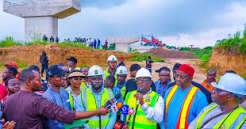

By Onu Okorie
Federal Government has begun positioning its major road projects not merely as transportation infrastructure, but as economic corridors intended to connect Nigeria’s regions, open new investment opportunities and improve the movement of people and goods across the country.
Minister of Works, Engr. David Umahi made the disclosure in Abuja while outlining the progress of major road projects under the administration of President Bola Ahmed Tinubu.
Umahi said the government’s four flagship legacy projects — the Lagos-Calabar Coastal Highway, Sokoto-Badagry Superhighway, Calabar-Ebonyi-Abuja Highway and the Akwanga-Jos-Bauchi-Gombe-Biu-Maiduguri Road — were conceived as long-term infrastructure corridors linking the six geopolitical zones.
Rather than treating the projects as isolated road construction schemes, the minister said the Federal Government was developing them as interconnected routes capable of supporting agriculture, manufacturing, trade, tourism and other economic activities.
“The legacy projects are not merely road construction schemes but long-term investments designed to transform Nigeria’s economic landscape,” Umahi said.
Coastal highway takes shape
The Lagos-Calabar Coastal Highway remains one of the administration’s most prominent infrastructure projects, with the minister reporting that the first 47-kilometre section has been completed.
Work is also advancing on the approximately 55-kilometre second section, where pavement construction is nearing completion alongside the development of flyovers, overpasses and underpasses.
Umahi said some sections of the alignment had undergone redesign because of the concentration of existing and planned infrastructure around the Lekki axis, including the Dangote Refinery and Lekki Deep Seaport.
The changes, he explained, were intended to ensure that the road functions as part of an integrated transportation network rather than operating independently of rail, port and industrial infrastructure.
Further south, difficult terrain and subsoil conditions in parts of Ondo State have also required changes to the alignment, with substantial filling and ground improvement works being undertaken.
The minister disclosed that President Tinubu had also directed that the coastal highway be integrated with portions of the existing East-West Road in the Niger Delta.
According to him, sections of the East-West Road would be raised in response to flooding and anticipated climate-related challenges, with the objective of keeping the corridor functional under changing environmental conditions.
The Benin City Bypass, alongside other sections of the coastal corridor, is also expected to provide alternative routes for traffic and ease congestion within the South-South region.
Northern corridor aimed at unlocking agriculture
The Sokoto-Badagry Superhighway is being developed as another major economic artery, stretching from Ilelah in Sokoto State to Badagry in Lagos State.
Umahi said construction was progressing at different stages across Sokoto, Kebbi, Oyo, Ogun and Badagry, while work in Niger and Kwara states was expected to commence soon.
The government’s stated objective extends beyond shortening travel time.
The minister said the corridor was expected to support agricultural production, industrial development, tourism and housing, with the government considering complementary investments along major infrastructure routes.
He argued that improved road connectivity could help connect production areas with markets while encouraging private investment along the corridors.
South-East, North-Central connection
The Calabar-Ebonyi-Abuja corridor, described by the minister as part of the ancient Trans-Saharan Route, is intended to provide a stronger link between the coastal axis and northern Nigeria.
Umahi said work had progressed on the initial sections, while additional sections had been approved to improve the corridor’s economic viability and attractiveness to potential financiers.
The route is expected to improve connections across the South-South, South-East and North-Central zones.
Meanwhile, the Akwanga-Jos-Bauchi-Gombe-Biu-Maiduguri route is being expanded from a single carriageway into a major northern connectivity corridor.
The scope, according to Umahi, has also been extended to include a Jos-Ibi spur in Taraba State, with design and procurement processes underway.
Government lists completed roads
Beyond the four legacy projects, the minister said the Works Ministry had completed or brought several other road and bridge projects to stages where they were ready for commissioning.
They include the Kwanar Danja-Hadejia Road, Kaduna-Pambeguwa Road, Lafia Bypass and Bodo-Bonny Road with bridges across the Opobo Channel.
Other projects cited were the Gombe-Potiskum rehabilitation, sections of the Azare road linking Jigawa and Bauchi, the five-span Ampoha Bridge, the 23-kilometre, 23-span flyover project on the Ekpoma-Benin axis and a three-span, 75-metre dualised bridge.
Umahi also said several sections of the Lagos-Badagry and Lagos-Ibadan and Lagos-Shagamu-Ore corridors had either been completed or were at advanced stages.
He said the ministry was updating its database of completed and ongoing projects and would make the compendium available to the public through its website.