


By Tony Okafor
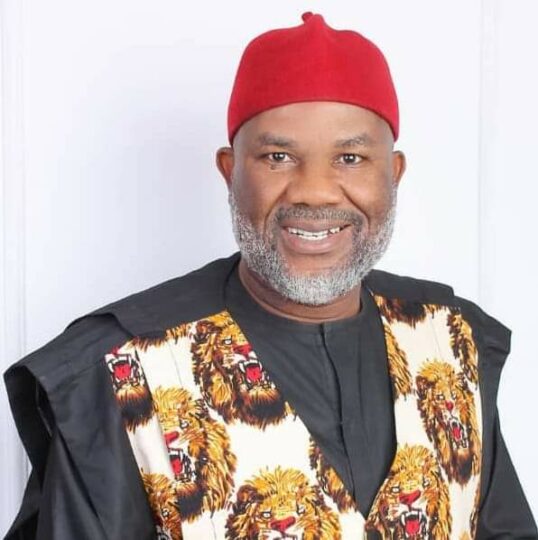
In an era when political figures are often accused of losing touch with their roots, the lawmaker representing Ogbaru Federal Constituency, Rt. Hon. Victor Afam Ogene, offers a different narrative.
Widely known by his traditional title, Akunnia, Ogene moved easily through the crowd—not as a visiting dignitary, but as a son of the soil.
This was during the Ulo Festival, a communal thanksgiving marking the end of the farming cycle. The people gather to pray to the gods of the land for bountiful harvests, fertility, and protection.
In Obeagwe, they put it simply: Ulo is more than Christmas.
Obeagwe is more than a constituency to Ogene. It is his ancestral home—the ground on which his identity and public service are firmly rooted.
The community carries a quiet pride, often referring to itself as the “Nazareth of Ogbaru”—a small place where great things happen. Though it comprises nine villages, it functions as one family.
The people attribute their resilience to three major deities stationed at the entrance, centre, and exit of the town—spiritual sentinels of protection and continuity.
This year’s Ulo Festival carried added weight. The rare appearance of the revered Onoli masquerade—an ancestral figure that emerges only once every two years—sent waves of excitement across the community.
Its presence is not merely symbolic; it is a spiritual and cultural high point, a reminder of the unbroken bond between the living and their forebears.
As the masquerade danced, the crowd surged. Youths cheered. Elders nodded in quiet approval. Visitors from far and near watched, many witnessing the spectacle for the first time.
Hospitality flowed freely. The drink of the day was Beanyi—a locally distilled dry gin proudly called “ours.” It passed from hand to hand, sealing bonds, renewing friendships, and welcoming strangers into communal warmth. Everyone drank from a common cup, evoking the solemn sharing of wine in Christian Holy Communion—only that here, culture consecrated the act.
Then there was the attire. Men, in a striking display of cultural pride and masculine elegance, tied loincloths around their waists. It was not mere fashion; it was identity—a visible assertion of heritage and what many described as majestic opulence.
In those moments, tradition was not in retreat; it was on full display.
Ogene embraced every aspect. He mingled with youths, exchanged pleasantries with elders, and joined the rhythms of the festival. Yet beyond the celebration, he carried a message.
“It is wrong to describe our indigenous festivals as fetish,” he said, his voice firm but reflective. “These are unique platforms for teaching our people, especially the young, their roots, their history, and their values.”
His words found eager listeners.
“He is one of us,” said elder Pa Eke, leaning on his staff. “When he comes here, he doesn’t come as a big man from Abuja. He comes home.”
Oduah,a youth ,echoed him: “We see him dance with us, laugh with us. It gives us confidence that our culture still matters. He carries us along.”
For a visiting journalist from Awka, the experience was unforgettable. “I came as a guest, but I’m leaving as family,” he said, smiling. “This place is small, but the spirit is big.”
For Ogene, Ulo is more than a cultural event; it is a living classroom where identity is preserved and passed on. He expressed optimism that the Obeagwe festival would one day gain international recognition.
Standing there, notebook in hand, it was hard to disagree. What unfolded in Obeagwe was not just a festival—it was a statement: that culture, when nurtured, can coexist with modernity; that leadership, when grounded, resonates more deeply; and that in communities like Obeagwe, the past is not forgotten—it is celebrated, embodied, and carried forward.
Community members say Ogene’s presence at such events fosters belonging and accessibility—qualities often missing in public office. Here, his participation is not symbolic; it is expected.
As the drums faded into the evening and the last of the Beanyi(local dry gin) was shared, one thing remained clear: in Obeagwe, culture is the compass. And for Victor Afam Ogene, it is also the path.