

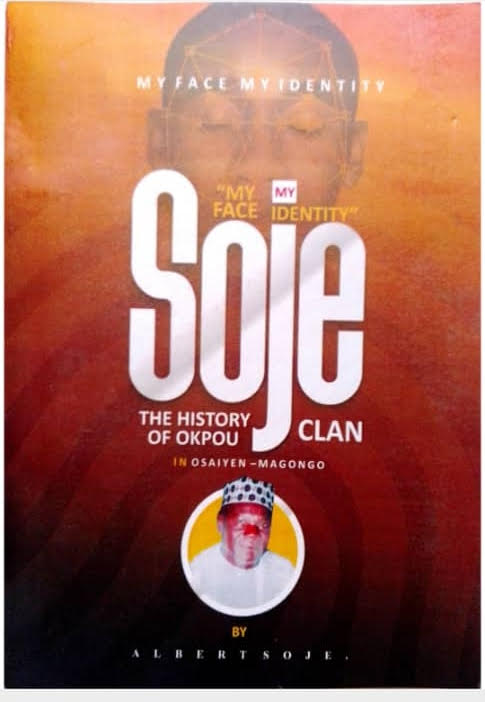

Author: Albert Soje
Printer: High Print Enterprise
Date of first publication: 2023
Number of chapters: Seven
Number of pages: 173
Price: Not stated
Reviewer: Tom Odi
From the onset of the book, the author revealed his aim for writing it. To him, “it is to put in correct perspective the true and authentic history of the Okpou Clan”, the author’s own clan. And, he added: ”to document human knowledge of our roots for posterity”. (Page xiii).
In Chapter 1 of the book, the author adverts his mind to the complexities of the attempt by various local griots or local historians to trace the origin of Magongo, since his Okpou clan is in Magongo.
But, while depending on historical resource materials, he noted that the history, particularly of his Okpou Clan, could no longer wait to be written, an adumbration that charity begins at home. As he noted, “if this narrative is read as the history of my people, then the aim of the author shall be deemed fulfilled,” (page XII) which correlates with the subtitle, ‘My face, my identity.’
Reading through the book, what is clearly themed in this literary enterprise is the imperative of knowing one’s roots and knowing it well. A book, like this one, reminds one of the book, ‘Roots’ by Alex
Haley, which is the story of his family from his ancestor, Kunta Kinte, who was captured in The Gambia in West Africa and taken as slave to Virginia. Just as Alex Haley was passionate about his roots, so was Albert Soje of his own roots.
One hallmark of an author is objectivity, stemming from facts. In that Chapter 1, although not of the Udu Clan, the author acknowledged the warrior-like bravery of the Udu Clan who, he said, fought most
of the wars for Magongo. (Page 10). In so doing, the author reminds us of the age-long dictum that, ”facts are sacred but comments are free.”
The author’s sense of history is deep. In pages 12 and 13, he makes readers to briefly glimpse lineages emanating from Unagogo, the eponymous progenitor after whom Magongo is named. From his lineage that branches out into an enlarged complex web of further lineages, we are awed and wowed by the interconnectedness of Magongo people. Plainly, that most, if not all Magongo people, are related one way or
another. This fact tallies with the family trees appendixed in Obin Anthony Alao’s book, ‘A Brief History of Magongo.’
Quite enlightening are the meanings and responsibilities affixed to title holders within the Okpou Clan in Chapter 2. (Page 23). For instance, not many of us knew the traditional meanings and responsibilities of Osemata as prime minister; Obaro as diviner; Oluoba as chief adviser; Obajeun as welfare officer and so on. (See pages 23 and 24).
In the same Chapter 2, the author captures the precursor right of Okpou in its cultural and traditional practices. To the author, “the culture and traditions of the present-day Osayin, Magongo, prominently wear the toga of the Okpouro.” (Page 25).
The author diligently takes the reader through capsule accounts of the various traditional festivals of Okpou Clan and, by extension, Magongo. There are stark similarities between his accounts and those of Biodun Fadipe in the Ebeben magazine, 2024 edition. In both accounts of the many cultural festivals of Magongo, the reader is mentally enriched by the information collated and is, therefore, culturally stimulated to want to witness those festivals. Worthy of note is the author’s claim of the originator status he conferred on the Okpou Clan as the “fons et origo” of some of Magongo’s cultural festivals like Ikperesime, known as Okpouro-ikpen and the Owiya-osese.
Still in Chapter 2, the author takes us through the dark era of history with reference to what he described as “internecine war”. Not many of us may have known about the Nupe invasion of Magongo known as the Ajilomo war, and the post-bellum effects on the town. The author’s paternal lineage was affected by the war due to Nupe’s brutish thralldom foisted on part of the town and the ultimate captivity of some Magongo elements including the author’s grandfather, Pa Otaru Ikumuse Soje. One of the effects of the Nupe raids was, according to the author, “the establishment of the Udu hegemony and the origins of chieftaincy in Osayin/Magongo till date”. (page 44)
The author, in Chapter 3, reflected pensively, but boldly, on the events that led his progenitor captive to Bida and his subsequent return home some 50 years after. Nobody can factually and effectively tell the story of another person other than the owner of the story themselves.
More captivating about his progenitor are the panegyrics (praise names) of PA Soje-Ikumuse. Some of them like, ‘Otaitie nama mofu bale na’; ‘Ekpopo ikeke’; Okpou namasha, emegben na’ are captivating orikis and some are, probably, adopted by some Magongo people. Do you know your family Oriki? I am going to learn my own immediately. As the author noted, “The Oriki of Soje serves as a signature tune announcing his importance in the society.” (Page 56).
Chapter 4 is larded with the genealogical trees of Soje Oludo lineage. The complex and elaborate family trees compel approbation for the author who, though was a soldier, had enough patience to probe deeply and extensively into his bloodlines. It is a rare feat. (see pages 68-104)
Flipping through the family trees, unthinkable names cropped up, again highlighting interconnectedness of the Magongo people as progenies of the same communal patriarch, Unagogo. In this chapter, we also catch a glimpse of Magongo’s social and blood wedlocks with Ogori, expressed in family lines connecting both communities. (See page 76).
All of these shows the author’s keen interest in his ancestry, challenging others to do so. In his words, ”Not many people are keen about their past records. But the past is our past”. (Page 81).
In Chapter 5, the author reflects on the vexed issue of land ownership in Magongo. He advised the people, “…for peace to continue to reign it will be in the interest of the people not to illegally tamper with the approved gazette.” (Page 107).
In this same Chapter, the vexed issue of majority-minority dichotomy in Ogori/Magongo LGA engages the author’s probing mind. He cheers the heart of Magongo that, “The Magongo experience has shown that there is no permanent majority or minority stand but interest”. (Page 116).
The author, who was the Obinokeke of Okpou Clan before he went the way of all flesh, bemoaned the de-pluming of traditional rulers’ administrative accoutrements which were taken over by political power holders. He envisaged a constitutional tinkering in which traditional rulers will be assigned clear and direct mandates in our collective efforts at nation-building. In page 120, he noted, “It is gladdening to note that efforts are being made to amend the constitution with the view to include the traditional roles of the chiefs in the next constitution”. (page 118)
Towards the tail end of this chapter, the author expressed worry about the insouciance of the people in the affairs of the Magongo Development Association. He noted: “It is also observed that there is declining interest exhibited by the people and the will power that was so pivotal to the successes of the past presidents of the association has also disappeared.” (Page 120). Daddy Albert Soje is no more with us but it behoves us to respect his observation and change for good. That is a good post-humous honour we can accord him. The chapter closes with the critical imperative for mutual co-operation between Ogori and Magongo.
Chapter 6 bemoaned the alleged usurpation of, and dynastic capture of the Magongo traditional chieftaincy stool by the Udu Clan…the clan, which he noted, came last to Magongo. He adduced this trend to the Nupe raids on Magongo and the appointment of the Udu Clan, by the Nupe hierarchy, as middlemen to collect taxes and revenues for the Nupe authorities.
The chapter also contains very detailed and wieldy inter-connected bloodlines of the Soje Dynasty. The author was a stickler for details and depth.
Also, he didn’t lose sight of the sensitiveness of landed properties. To this end, he maturely addressed the Oku land issue and the Uburu boundry issue between Ogori and Magongo.
Pa Albert Soje’s passion for Magongo was legendary. In the concluding part of Chapter Six, he briefly x-rayed the reasons for the stunted or sluggish development of Magongo, waxing lugubrious. He desired a better Magongo.
Like a diligent litterateur dotting his i’s and crossing his t’s, the author wrapped up his book with Chapter 7 by emphasising his identity as Okpouro, ennobling the Okpou Clan as “the people’s umbrella for all the clans in the community.” (Page 168).
Is the book a perfect piece of intellectual effort? Nobody is perfect. As they say, even Homer nods. The apparent mild weakness in the book is expressed in typographical and few grammatical errors, with orthographic muddles and incertitudes in certain native words. For instance, The inexplicable use of the words: ‘Otaru’ and ‘Otaro’ differently (page 22) excites the need for the clear orthography of the Magongo language. Also, the use of ‘Osaiyen’ in the front cover and in the blurb at the back page contrasts the variant, ‘Osayin’ in pages 1, 2, 3, 5, 8, 13 and elsewhere. The native variant of Magongo is being written in different ways: Osayin; Osaiyen (by this author); Osanyin (by Obin Anthony Alao in his book, ‘A Brief History of Magongo’); and in a group platform for Magongo language, Osayen is used, also reflected in Magongo anthem. This underscores the need for an urgent committee on the orthography of Magongo language to harmonise the differences in our pronunciations so we don’t become a
specimen of self-mockery to the world.
From available media information, It is heart-warming to know that a team from the department of linguistics, Federal University of Technology, Lokoja, led by Dr. Mayowa Oyinloye twinning with Mr. Emmanuel Ikpelemo of the department of theatre arts of the same university, have swung into action to partner with critical stakeholders in the community to develop the Mangongo language autography.
Also, the dates of some significant events mentioned in the book and their relevance or links with the evolution of the Okpou Clan should have been more explicit. (Page 18-19).
In all, the book, Soje: My Face, My Identity’, the History of Okpou Clan’, written by Albert Soje of blessed memory, challenges the reader to take interest in their in-group affairs, particularly, those of their roots and of their community. It’s a theme hinted throughout the book.
The book is facts-studded, information-loaded and moderately scholarship-underpinned.
Written in English, the language with the diction deployed by the author is simple and easy on the ear. The language is patently Achebesque in form and style, notwithstanding the minor grammatical, syntactical and typographical errors.
No doubt some of the contents will excite debates and elicit disagreements. The author wrote the book with awesome conviction, astounding boldness and courage like the soldier that he was and with unmistakable commitment to record-setting and record-keeping.
No one toys with their identity. The author had noted that the Okpou Clan did not fall from heaven. It has roots which must be known. And no one fell from the sky either. This book is a clarion call for all to identify with their roots and bloodlines. Your face is your identity and your identity is your face!
Finally, this book is a major valedictory salute to Okpou clan and Magongo, as a whole, by our exited retired Major, Chief Albert Soje. May his soul rest in peace.