


From Rhoda Godwin, Yenagoa
On paper, it is a policy designed for order, safety, and modernization. On the streets of Yenagoa, however, it feels like something else entirely—an added burden on already stretched lives.
The Bayelsa State Ministry of Transport recently issued a special announcement directing all intra-state and inter-state transport operators to restrict passenger loading strictly to designated terminals: the Ekeki Motor Park and the Igbogene Transport Terminal. The directive, signed by the Commissioner for Transport, Ayebaekipreye Brodrick, warned that violators would face sanctions as the government intensifies efforts to build a “safe, efficient, and modern transportation system.”
But for many residents, especially low-income earners who depend on daily movement for survival, the policy has not translated into convenience or order. Instead, it has introduced a new layer of difficulty into everyday life.
A morning that no longer moves smoothly
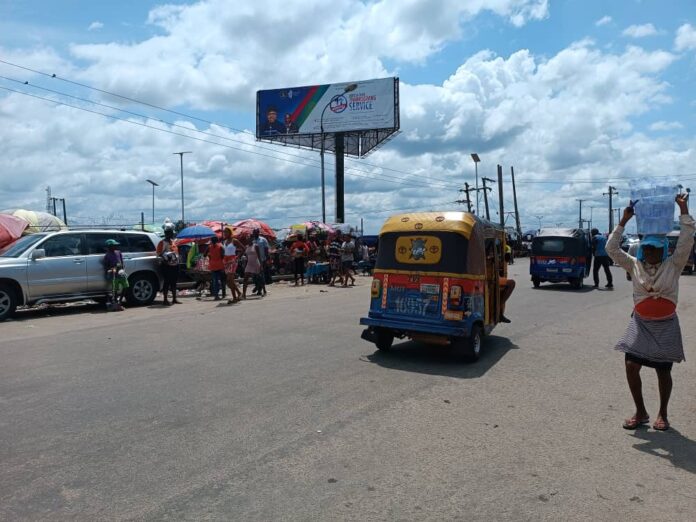
In Edepie, along the busy Tombia–Amassoma road, the day begins early with movement—market women heading to stalls, students rushing to lectures, and traders transporting goods to nearby communities. But what used to be a straightforward journey has now become a complex chain of transfers.
A vegetable seller, balancing baskets on her head while waiting for a vehicle, describes her frustration in simple terms.
“Before, I could just enter a keke or a bus close to my house, and go straight to Amassoma or Yenagoa town. Now, I must first go to Ekeki or Igbogene before continuing my journey. By the time I finish paying transport, there is almost nothing left from my sales,” she says.
Her voice carries the exhaustion of someone who has adjusted her entire livelihood to a policy she had no part in shaping. For many like her, transportation is not just movement—it is survival. Every extra stop is an extra cost. Every delay is lost time. Every transfer is uncertainty.
The Commissioner’s directive and the promise of order
When Commissioner Ayebaekipreye Brodrick announced the enforcement of the new transport structure, the message from the government was clear: Yenagoa needed an order.
According to the Ministry, the unchecked practice of picking up and dropping passengers along roads contributed to traffic congestion, safety risks, and inefficiency in the transport system. The government insists that centralizing operations at Ekeki Motor Park and the Igbogene Transport Terminal will help streamline movement, improve security monitoring, and support long-term urban planning.
Brodrick’s statement framed the policy as part of the Prosperity Government’s broader vision of urban renewal and modernisation. Yet, between policy intent and lived reality lies a widening gap.
Stranded after dark
For inter-state travellers, the experience can be even more unsettling.
A trader returning from Port Harcourt recounts arriving at Igbogene late in the evening only to discover that connecting transportation into Yenagoa town had become scarce.
“It was already dark. I had paid my fare from Port Harcourt thinking I would easily get a vehicle into town. But I waited for almost an hour. The few keke that came charged very high because they knew people were stranded,” he said.
Eventually, he paid double the normal fare just to get home. For many commuters, especially those arriving late at night, the Igbogene terminal feels less like a gateway and more like a checkpoint where journeys pause instead of continue.
The burden of extra fares
Across Yenagoa, residents describe a pattern that is becoming increasingly familiar: multiple fares for a single journey. A student travelling from a rural community into the city for lectures now often requires two or three separate transport payments. A civil servant heading to work must budget not just for distance, but for transfers. In a state where the cost of living is already rising, transport inflation is quietly reshaping household budgets.
A mother of four explains it in practical terms.
“Before, I used one transport and reached my destination. Now, I calculate at least two or three fares. Sometimes I reduce the money for food just to afford transport,” she said.
Transport operators caught in between
While passengers bear the visible burden, transport operators say they are also struggling to adapt. Mini-bus and tricycle operators complain that being confined to terminals has reduced flexibility and cut into daily earnings. Instead of picking passengers along busy routes, they must now wait at designated parks, sometimes for long hours before filling their vehicles.
Some drivers say this system increases congestion inside the parks while leaving major roads oddly empty of public transport.
Others worry about inconsistent enforcement. Questions continue to arise about how authorities distinguish between vehicles operating intra-city routes and those coming from outside the state capital.
A driver who plies the Sagbama–Yenagoa route puts it bluntly: “We are not against government rules. But sometimes the enforcement does not understand our work. One moment you are told to go to the park, another moment you are asked why you stopped somewhere. It creates confusion,” he said.
Voices of doubt and frustration
Among residents, criticism of the policy is not just about inconvenience—it is about priorities. Some argue that while the government focuses on regulating transport terminals, other pressing issues such as road conditions, rural accessibility, and security deserve more urgent attention.
A resident named Nengi expresses this sentiment sharply.
“Of what benefit has this change added to ordinary people? We are still struggling with high transport fares and bad roads. Government should focus on making life easier, not harder,” she urged.
Others question whether the policy truly reflects the realities of a growing city where people live, trade, and move across dispersed communities.
Between planning and people
Urban transport experts often argue that structured terminal systems can improve city planning when properly implemented. In theory, central parks reduce chaos, improve safety, and make regulation easier.
But in practice, success depends heavily on supporting infrastructure—feeder routes, affordable last-mile transport, and adequate vehicle availability. Without these, centralisation can unintentionally shift hardship rather than solve it.
In Yenagoa’s case, many residents say the missing link is not regulation itself, but the lack of smooth transition between terminals and neighbourhoods.
The human cost behind the policy
On the surface, the policy is administrative. On the ground, it is deeply personal. It is the trader who now carries fewer goods because transport eats into her profit. It is the student who arrives late to class after multiple transfers. It is the elderly passenger who struggles to navigate crowded terminals. It is the night traveller who stands under dim lights waiting for a vehicle that may or may not come quickly. Each story is different, but the frustration is shared.
Government’s stand, public’s plea
The Bayelsa State Government maintains that the policy is necessary for long-term development. Officials insist that creating structured transport hubs is part of building a modern capital city that meets global standards.
Commissioner Ayebaekipreye Brodrick has continued to emphasise compliance, warning that enforcement agencies will ensure strict adherence to the directive. Yet, residents are calling for something else—not rejection of reform, but reconsideration of its impact. They want dialogue. They want flexibility. They want a system that recognises that transportation is not just about order, but about access.
A city still finding its balance
Yenagoa is growing, and with growth comes the challenge of structure. But as enforcement tightens, the question many residents quietly ask is simple: can order and comfort exist together?
For now, every journey across the city tells the same quiet story—a system trying to organise movement, an
d a population trying to move within it. And somewhere between Ekeki and Igbogene, between policy and pavement, Bayelsa is still searching for balance.