

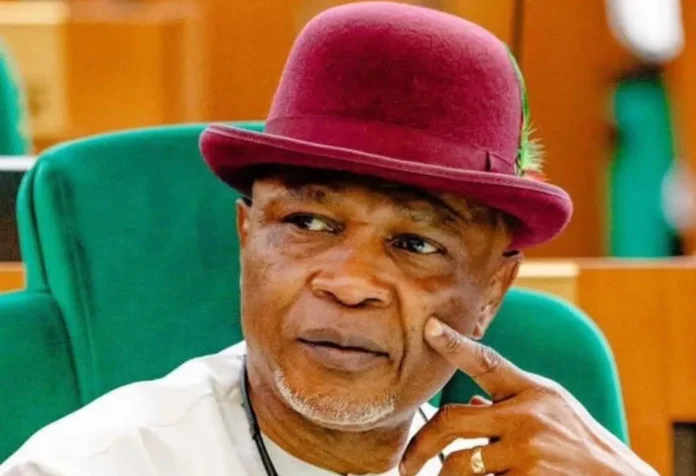

By Obinna .F. Nwachukwu
A fresh constitutional and electoral contest has emerged in Rivers State politics as a coalition of legal practitioners has instituted an action before the Federal High Court, Abuja Division, seeking to restrain Hon. Kingsley Chinda from participating in the 2027 Rivers State gubernatorial election on the platform of the All Progressives Congress (APC).
The Plaintiffs contend that Hon. Chinda, who recently emerged as the APC’s gubernatorial candidate following the withdrawal of other aspirants, remains constitutionally and procedurally tied to the People’s Democratic Party (PDP), where he currently serves as Minority Leader of the House of Representatives.
Reliefs sought before the Court:
- An order of the Court nullifying Hon Chinda’s nomination as APC governorship candidate for Rivers State.
- A declaratory judgment that his continued membership of the PDP, evidenced by his status as Minority Leader, renders his defection to the APC constitutionally invalid.
- An order directing the Independent National Electoral Commission (INEC) to withhold recognition of his APC candidacy pending the determination of the substantive suit.
- An order removing him as Minority Leader and declaring his seat in the House of Representatives vacant, on the ground that any cross-carpeting must comply strictly with Sections 68(1)(g) and 109(1)(g)_ of the 1999 Constitution of the Federal Republic of Nigeria [AS AMENDED], which require defection to be predicated on division, merger, or crisis within the political party.
POLITICAL CONTEXT:
This litigation injects additional complexity into the already volatile pre-2027 political terrain in Rivers State. Observers have linked Hon Chinda’s emergence as APC candidate to realignments associated with allies of His Excellency, Barr Nyesom Wike, FCT Minister and former Governor of Rivers State.
The suit, therefore raises fundamental questions on party loyalty, constitutional compliance in political cross-carpeting, and the role of the judiciary in shaping electoral eligibility.
Legal and political analysis and follow-up questions for public discourse
- Jurisprudential Test:
Given existing Supreme Court and Court of Appeal precedents on defection, can the Federal High Court invalidate a candidacy based on alleged non-compliance with Section 68/109, or will it treat the matter as a pre-election internal party affair?
- Electoral Management:
Should INEC disqualify a candidate at nomination stage based on an interlocutory order, or is it bound to accept and list candidates presented by political parties until a final court judgment?
- Legislative Implications:
If the Court declares Hon Chinda’s seat vacant, what are the constitutional consequences for the composition and leadership of the Minority Caucus in the House of Representatives?
- Political Strategy:
Is this suit a genuine pursuit of constitutional fidelity, or is it another manifestation of strategic litigation and political brinkmanship aimed at reshaping the Rivers APC/PDP balance ahead of 2027?
- Stakeholder Impact:
There are still arguments on how this battle will affect grassroots mobilization, voter confidence, and inter-party negotiations within Rivers State as the election cycle approaches?
Indeed, the APC situation in Rivers State is a delicate one and might be argued both ways. But first, I want to put you in a better perspective of explanation so that you can understand how it started.
Sometime ago, APC wanted to conduct its State and Local Government Executives Congress in Rivers. Not because there was no existing leadership in place, but because a faction within the APC felt that the existing leadership was not loyal to the national structure headed by Alhaji Ganduje as the National APC Chairman.
Their mission was simple: Conduct a fresh congress in Rivers State and flush out every element they considered disloyal. But the existing executives were not ready to surrender their rights without a fight.
So, they headed to court and asked the court to stop the conduct of the congress. Their argument was straightforward. They told the court that their tenure had not expired and that the manner in which they were being hurried out of office was unfair, contrary to the party constitution, and a clear violation of due process.
They further argued that if the court failed to intervene, they would be illegally pushed out through a congress that had no legal foundation. That faction is known as the Emeka Beke faction.
There is a backend story that links this faction to Rotimi Amaechi, but that is a story for another day.
On the 21st day of November 2024, the court heard their case and granted their prayers, ordering that no congress should be held until it fully determined whether the tenure of Emeka Beke and his executives had actually elapsed.
Ordinarily, that order of the court ought to have been obeyed diligently. But because those who wanted to conduct the State Congress were determined to push Emeka Beke out. To them, his loyalty trajectory was tied to Rotimi Amaechi and, since Rotimi was no longer an APC man at heart, every political seed still speaking his name had to be uprooted.
At that point, the battle was no longer about procedure. It had become a battle of political loyalty. Eventually, despite the subsisting order of the court, they went ahead on the 24th and 30th of November 2024 to conduct the congresses that produced Tony Okocha as State Chairman.
The Emeka Beke executives, seeing what they considered a blatant injustice, rushed back to court.
Their complaint this time was different but simple:
“Court, these people ignored your order. They have gone ahead to conduct a kangaroo congress. Please nullify the exercise because it was conducted in defiance of your authority.” The High Court again agreed with them because you know if there is one thing the court hates the most, it will be to flout its orders.
Consequently, on the 20th of December 2024, the court nullified the congress that produced Tony Okocha and his executives.
Ordinarily, that should have settled the matter. But it did not. Since that judgment was delivered, Tony Okocha and his executives have continued to function. For about two years now, the National Executives of APC have continued to recognize and work with them, including during the recent APC primary elections.
Then came another twist. Few days ago, the Court of Appeal affirmed the decision of the trial court that had earlier nullified the congress in December 2024.
That is the development currently sending shockwaves across the camp of Tony Okocha and everyone who may have had political dealings with him over the years.
The fear is understandable. Once an appellate court affirms a judgment, the legal implications become more serious and the political consequences become more difficult to ignore.
There is also the very important aspect of the argument as to whether the primaries that Tony Okocha and his executives participated in; are still valid in the eyes of the law. But that is a conversation for another episode. For now, all eyes are on the Supreme Court and INEC to know who laughs last between the two contending APC camps.