

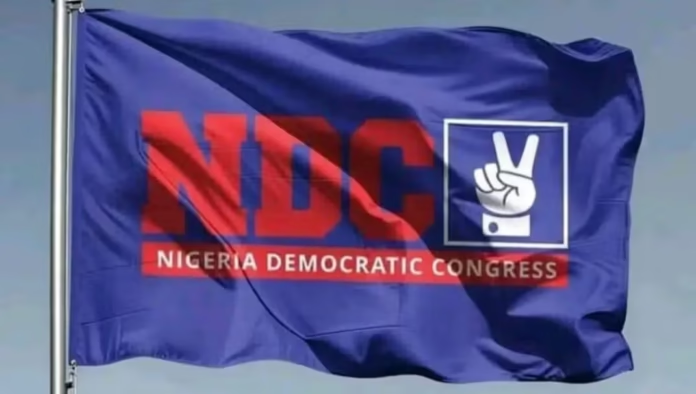

By Rhoda Godwin
For many Nigerians, it was just another court ruling.
But for members of the Nigeria Democratic Congress (NDC), Friday morning felt like a punch to the stomach.
The party had spent months building structures across the country. Volunteers had moved from community to community registering members. Aspirants had emerged through congresses and primaries. Campaign plans for the 2027 elections were gradually taking shape.
Then came the Federal High Court order from Lokoja.
Within hours, phones rang endlessly among party leaders. Candidates sought clarification. Supporters flooded social media with questions. Was the party still legal? Had it been deregistered? What would happen to those who had invested their time, money and political future in the new political platform?
Among the first to respond was former Bayelsa State Governor and leader of the party, Senator Henry Seriake Dickson.
Rather than hide his disappointment, Dickson admitted he was “jolted” by the court’s decision.
His reaction was emotional but deliberate.
He described the order as lacking legal merit and accused unnamed forces of attempting to undermine the progress the party had made within five months of its registration.
For Dickson, however, the issue goes beyond the fate of one political party.
It is about the future of Nigeria’s democracy.
The senator argues that the ruling is part of a wider attempt to shrink the country’s democratic space by making it more difficult for alternative political platforms to thrive.
Whether that claim is ultimately upheld by the courts remains to be seen. The NDC has already announced that it will challenge the ruling at the Court of Appeal.
Yet the controversy has once again placed the judiciary at the centre of Nigeria’s political conversation.
For years, Nigerians have watched election seasons become as much about courtrooms as polling units.
Candidates are nominated, disqualified and reinstated through judicial pronouncements. Elections are conducted, but many of the biggest political battles are settled long after votes have been counted.
Increasingly, judges are being asked to decide issues that shape the nation’s democratic future.
That reality places enormous pressure on the judiciary.
Every politically sensitive judgment is scrutinised not only by lawyers but also by ordinary Nigerians, many of whom are less interested in legal technicalities than in whether justice is seen to be fair and impartial.
Public confidence matters.
When citizens begin to question judicial independence, democracy itself suffers.
That is why the NDC insists the Lokoja ruling raises serious constitutional questions.
The party maintains that it was lawfully registered by the Independent National Electoral Commission (INEC) after obtaining a favourable court judgment. Since then, it says it has participated fully in political activities, conducted congresses, nominated candidates and even contested recent by-elections.
Its leaders argue that reopening the matter through an application by an association they describe as unregistered creates uncertainty for political parties and democratic participation.
Dickson was particularly critical of the legal basis of the application.
According to him, the association behind the suit neither participated in the recent registration exercise nor possessed any exclusive legal claim over the disputed party logo.
Those are legal arguments that the appellate court will ultimately consider.
But outside the courtroom, another story is unfolding.
Supporters of the NDC say the ruling has strengthened rather than weakened their resolve.
Dickson claimed that thousands of Nigerians registered as members of the party shortly after news of the judgment became public, interpreting the development as a show of solidarity.
While that claim has not been independently verified, it reflects a common feature of Nigerian politics: perceived political adversity often becomes a rallying point for supporters.
History shows that political movements frequently grow stronger when their members believe they are facing unfair obstacles.
Perhaps that explains why Dickson reached for one of his favourite quotations: “First they ignore you, then they laugh at you, then they attack you, then you win.”
To his supporters, the quote represents resilience.
To critics, it may simply be political rhetoric.
Either way, it illustrates the mindset with which the party intends to approach the legal battle ahead.
Still, beyond political speeches lies a bigger national concern.
Nigeria is preparing for another election cycle.
Citizens expect more political choices, stronger institutions and a level playing field for all parties.
The judiciary will inevitably play a crucial role in protecting those expectations.
Its decisions must not only be legally sound but must also inspire public confidence.
That is perhaps the greatest lesson from the Lokoja controversy.
Whether the Court of Appeal upholds or overturns the ruling, Nigerians will be watching closely—not simply because of what it means for the NDC, but because of what it says about the health of the country’s democratic institutions.
For now, the NDC remains defiant.
Its leaders insist they will pursue every legal avenue available.
Its candidates have been urged to continue their campaigns.
Its supporters have been asked to remain calm.
The courtroom battle has only just begun.
But beyond the legal arguments, one question lingers in the minds of many Nigerians: Should the future of political parties be decided primarily in the courtroom, or should it ultimately rest in the hands of the electorate?
The answer to that question may define not only the fate of one political party but also the future direction of democracy in Nigeria