
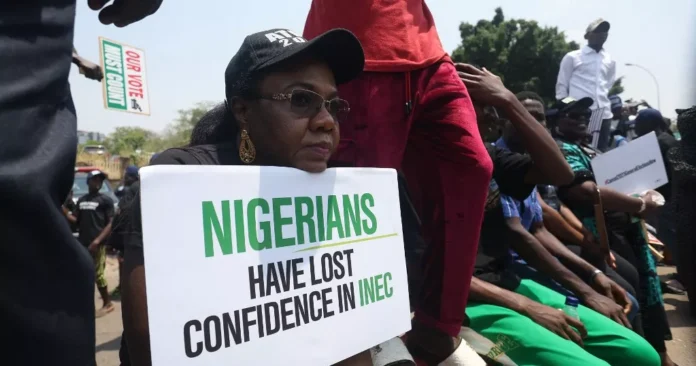

Straight Talk By Obinna F. Nwachukwu
Since the advent of democracy in Nigeria, challenging or overturning a presidential election in Nigeria’s Supreme Court is extremely difficult, and no presidential election result has ever been overturned by the judiciary since the return to democracy in 1999.
One of the funniest things about our Electoral Act and judicial precedent is that once you are rigged out of a presidential election, just forget about it, because you will most likely never be able to prove it in court.
Although Section 138 of the Electoral Act recognizes electoral irregularities as one of the grounds upon which an election petition can be brought before a court, the same Electoral Act goes further to state that it is not enough to merely alleged irregularities. To succeed, you must prove substantial irregularities.
That is where the real challenge begins.
Over time, the Supreme Court has amplified this position by holding that it is not even enough to prove substantial irregularities in an election. You must also go further to prove how those irregularities affected the credibility and outcome of the election.
In simple terms, the Supreme Court of Nigeria has consistently maintained that a petitioner who claims he was rigged out cannot succeed by merely showcasing evidence that irregularities occurred.
The petitioner must first establish that substantial irregularities or non-compliance actually took place. After that, he must further demonstrate how those irregularities directly altered the final mathematics of the election and turned victory in favour of the person declared winner by INEC.
You know what that means?
Nigeria currently has over 176,846 polling units for presidential elections. Now imagine a petitioner who lost a presidential election alleging widespread irregularities in just 10 percent of the country. Theoretically, such a petitioner would need to call more than 17,000 polling unit agents to testify that irregularities occurred in their various polling units and that those irregularities affected the election in such a way that, if the votes from those affected areas were removed, the person declared winner by INEC would no longer enjoy that victory.
And mark you, the petitioner is expected to do all these within the strict 180-day lifespan allocated to the Presidential Election Petition Tribunal. Think about that for a moment.
When the 2023 cases of Peter Obi v. INEC & Tinubu and Atiku v. INEC came before the seven-man panel of the Supreme Court led by Justice John Inyang Okoro, the apex court made its position very clear. The court held that even if a petitioner proves widespread irregularities, the election will not be voided unless it is further demonstrated that the non-compliance substantially disrupted the overall outcome of the election.
Justice John Inyang Okoro went even further. He stated that the burden rests squarely on the person alleging that he was rigged out of an election to establish that the electoral malpractices were of such magnitude that they completely hijacked the true will of the electorate. And in doing so, the petitioner must call witnesses from those affected polling units across the nation.
Now tell me, how do you even hope to achieve that as a presidential candidate who has just lost an election?
In summary, it could be rightly said that the difficulty in overturning presidential election result at the supreme court stems from a combination of constitutional, legal, and procedural hurdles, namely;
The Burden of Proof is Unusually High
Under the Electoral Act, petitioners must prove that electoral fraud, substantial non-compliance with the law, or irregularities took place on a scale massive enough to mathematically alter the outcome of the election. To put the magnitude into perspective, a Supreme Court judge in a past election petition noted that a petitioner would need over 250,000 witnesses to prove widespread non-compliance across polling units. Gathering and submitting this volume of evidence within strict legal timeframes is practically prohibitive
Strict Constitutional Interpretation
The Supreme Court holds rigid interpretations of electoral rules. For instance, in the 2023 petitions, the court clarified strict applications of the law—such as ruling that the Federal Capital Territory (FCT) does not hold a “special status” regarding the constitutional threshold of 25% of votes, and dismissing attempts to tender newly uncovered foreign documents at the apex court level.
Exhausting Timeline and Incumbency Advantage
Election petitions follow a strict constitutional timeline: they begin at the Presidential Election Petition Tribunal (at the Court of Appeal) and terminate at the Supreme Court, which has a 60-day limit to hear and deliver final verdicts. Because the process can take months, the incumbent is usually sworn in and governing well before the final legal challenge is decided, which embeds the status quo.
The Supreme Court Precedents
Historically, the apex court has been highly reluctant to nullify the declared will of the electorate, even in the face of recognized flaws. The court operates on the principle that the Independent National Electoral Commission (INEC) is the statutory body responsible for conducting elections, and the threshold required to strip INEC of its declared winner is immense.
For example, when major opposition candidates (Atiku Abubakar and Peter Obi) challenged the 2023 election results, the Supreme Court delivered unanimous dismissals, citing a lack of credible, substantial evidence and an inability to prove that the alleged irregularities were fatal to the election’s outcome.
This is exactly why you must never allow anyone to rig you or your candidate out in 2027. And once that happens, you may have no option but to wait until 2031. Not because you do not have a case, but because proving it within the framework created by our Electoral Act and judicial precedents is almost impossible.
And when all is said and done, no Supreme Court will readily upturn such a victory unless the burden imposed by law is fully discharged.