
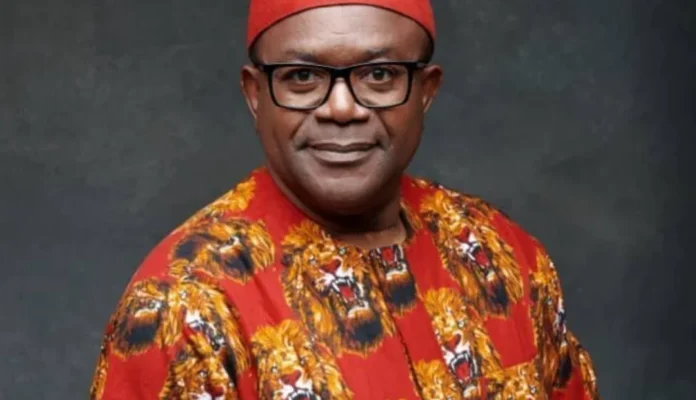

Valentine Obienyem
One of the few deaths that truly devastated me was that of Hon. Harry Oranezi. Before his final bow, he was still very clear and composed on the phone. He called me and said he had tried to reach HE, but his call was not picked. He asked me to inform Oga that he was battling cancer. I immediately relayed the message to HE, who in turn called him right away and continued to check on him from time to time.
When he eventually passed, we were all devastated. Indeed, there was hardly anyone who knew Harry who was not shaken by his death.
He was buried today. Because of unavoidable engagements in Abuja, HE called me and said he wanted maximum representation at the funeral. I therefore joined Prof. Patrick Obi, who led Barr. Okoli Akirika and myself to the ceremony.
The funeral service was led by Bishop Ephraim Ikeakor, alongside other priests. Harry was a man of truth – truthful, factual, and deeply dedicated to good causes. Then came the sermon of Bishop Ikeakor, who acknowledged that he usually speaks to the living during burial sermons, but, considering the kind of man Harry was, he would say a few words about him before addressing the living. Those who know Bishop Ikeakor understand that he is a bishop who does not indulge in insincere talk.
“I do not usually preach about the dead, but about the living,” he began. He reflected that Harry’s life was about service – service to God and service to humanity. Harry’s life, he also noted, revolved around humanity and the Church. “We are celebrating a man who lived for God and served humanity,” he said, while also thanking the committee of friends who stood by and supported him.
Being in the Easter season, his sermon naturally drew from it. He reflected on Matthew 27, focusing on Joseph of Arimathea. Money, he said, is not everything; if you rely on wealth and connections without God, they will ultimately fail you. The Bible presents Joseph as a rich man, but, as the Bishop emphasized, what truly mattered was what he did with his riches – something that will be judged on the day of reckoning. Joseph was not only wealthy; he was also a disciple of Christ. He used his position and resources rightly, even as a member of the highest Jewish council, the Sanhedrin, where he stood alone against the decision to crucify Christ. He did not say, “I concur.” Instead, he later requested the body of Christ for burial, remaining faithful to Christ in both life and death. From this, the Bishop posed a piercing question: You, who do you follow? And further: “What are you doing with your capacity, as Joseph used his to request the body of Christ? For him, capacity is not meant for causing confusion in society, but for serving God through service to humanity.”
In his characteristic bluntness, the Bishop connected these reflections to present realities. He recalled an incident at the inauguration of Prof. Charles Soludo, where a General Overseer sat beside him and had someone attend to him with a handkerchief each time he sweated. The Bishop described this conduct as a display of “egocentrism and egomania.” He used this to illustrate how far society has degenerated—the tendency to use position as a platform for display rather than for service, and authority as a tool for self-aggrandizement instead of selfless service to others.
Speaking on discipleship, he insisted that it is not about being crowned with all manner of titles by the Church, but about the outward expression of Christlike virtues. “I am a bishop; we do this to get money,” he said pointedly, underscoring his disdain for superficial religiosity. A true disciple, he stressed, is one whose life is transformed and wholly given to Christ.
He did not spare public office holders, especially members of the National Assembly, who, he said, often sing praises to power – such as “On your mandate we shall stand” – while neglecting their responsibilities. Tailoring his message to his audience, he outlined the virtues of Joseph: discipleship, fidelity to Christ, the right use of wealth and position, and commitment to justice – and challenged all present to examine themselves.
He lamented that many wealthy people fail to use their riches for higher purposes and, in a striking phrase, described APC as “Amalgamated Progressive Criminals.” He urged that political support should be based on tangible outcomes that directly affect the lives of the people—such as improved security, stable and affordable electricity, functional infrastructure, access to quality healthcare and education, and overall economic well-being. Support, he emphasized, should be guided by visible performance, accountability, and the genuine welfare of citizens, not by personal gain, patronage, or partisan loyalty. Leaders and political platforms, he argued, must be judged by their impact on everyday life, and citizens must learn to demand results rather than settle for rhetoric.
He also touched on culture, defining it as the acceptable mode of living of a people, which is distinct from the unchecked promotion of idolatry now visible in society.
At the end, he revealed the deeper burden behind his message: “I am telling you all (mostly National Assembly members) this because I may not see you again. On the last day, I will only tell God, ‘I did my part.’”
He concluded, like John the Baptist, by calling the people to repentance. Indeed, death is imminent. What one owes oneself is to surrender to God, for His judgment admits no appeal. Each person must work on his life – because “ na mmiri dọ na eju, ọ dọru nwa nkịta.”
Not even the rainfall distracted from the comeliness of the service.