

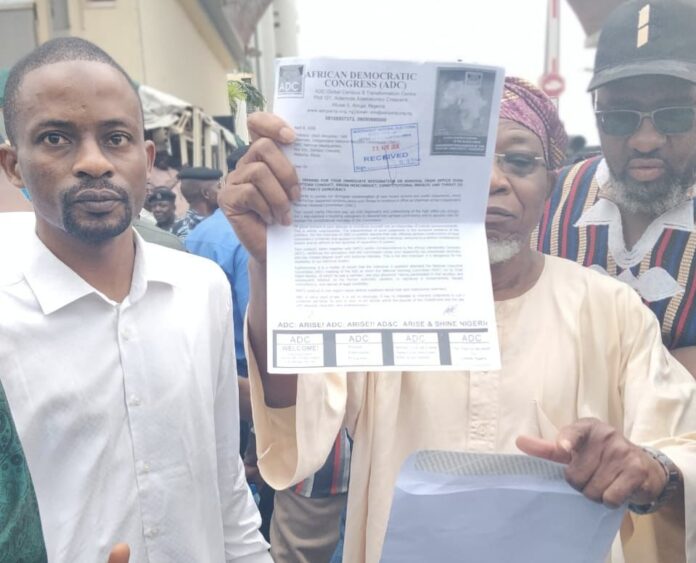

The African Democratic Congress (ADC) has escalated its confrontation with the Independent National Electoral Commission (INEC), following a high-profile protest held today in Abuja.
The protest drew the full weight of the party’s leadership, including its National Chairman, Senator David Mark; National Secretary, Ogbeni Rauf Aregbesola; former Vice-President Atiku Abubakar; Peter Obi; Rotimi Amaechi; and Rabiu Musa Kwankwaso, leader of the Kwankwasiya movement.
In a symbolic act of defiance, the party opened the protest by singing Nigeria’s old national anthem, “Arise, O Compatriots.”
Shortly after, the party marched to the INEC headquarters in Abuja, where it delivered a strongly-worded letter to the INEC Chairman, Professor Joseph Amupitan, demanding his immediate resignation or removal from office.
In the letter dated April 8, 2026, the party laid out a series of grave allegations, legal and constitutional arguments, and political warnings.
Here are the seven strongest points the ADC made:
1. Call for Immediate Resignation or Removal of Amupitan
The ADC did not hedge its position. It made a direct and unequivocal demand: the INEC Chairman must either resign immediately or be removed.
The party framed this not as a political disagreement, but as a matter of institutional integrity, citing what it described as gross misconduct, abuse of office, and clear violations of constitutional boundaries. In its view, the credibility of INEC itself is now at stake.
2. Accusation of Partisan Conduct of INEC Chairman
At the heart of the letter is a serious allegation, that INEC, under Amupitan’s leadership, is no longer acting as a neutral umpire.
The ADC argued that the Commission’s actions and correspondence suggest alignment with factional interests within the party. This, it warned, undermines public trust in the electoral process and raises fears about the fairness of future elections.
3. Overstepping INEC’s Constitutional Boundaries
The party took particular issue with what it described as the Chairman’s attempt to interpret court rulings in public.
According to the ADC, this crosses a constitutional line. It stressed that only the judiciary has the authority to interpret its judgments, and that any attempt by INEC to do so, especially in a way that appears partisan, amounts to a breach of the doctrine of separation of powers.
4. Undermining Multi-Party Democracy
Beyond the immediate dispute, the ADC placed INEC’s actions in a broader democratic context.
It warned that interference in the internal affairs of political parties, or the elevation of factional actors, threatens the foundation of Nigeria’s multi-party system. The party described this as not just improper, but dangerous to democratic pluralism itself.
5. Rejection of Rival Leadership Claims
The ADC firmly rejected the legitimacy of individuals claiming leadership outside its recognized structure.
It pointed out that such individuals had previously participated in party processes that dissolved the former leadership. As a result, the party argued, any attempt to now rely on that same authority is contradictory and legally untenable.
6. Detailed Timeline to Assert Legitimacy
To strengthen its case, the ADC laid out a detailed and methodical timeline of its internal decisions in 2025.
It highlighted NEC and NWC meetings that were attended by INEC officials, properly documented, and formally communicated to the Commission. The party emphasized that INEC itself had acknowledged these processes and even reflected the new leadership on its official portal, reinforcing its claim to legitimacy.
7. Warning of Legal and Civic Action
The letter concluded with a clear escalation pathway.
The ADC warned that failure to meet its demands would trigger a coordinated response, including judicial proceedings and broader civic action. This signals that the party is prepared to take the battle beyond correspondence and into both legal and public arenas.

ADC National Secretary, Rauf Aregbesola, shows a letter submitted to INEC during a protest at the electoral commission’s headquarters on Wednesday, April 8th, 2026


