

From Onoriode Etatsemi, Asaba
The Delta State Solicitor-General and Permanent Secretary, Ministry of Justice, Omamuzo Erebe (SAN), has described the disability inclusion policy for lawyers and law students by the Nigerian Bar Association (NBA) as a landmark development that is long overdue.
Erebe said the policy represents a significant shift from treating persons living with disabilities as objects of pity and charity to recognising them as citizens with rights, abilities, and equal opportunities.
He stated this while speaking with journalists in his office in Asaba on the NBA’s new disability inclusion policy.
According to him, the initiative reflects a move from sympathy-based approaches to a rights-driven system backed by law.
“The inclusion is long overdue because we have moved from a situation where we are dealing with pity to a situation where we are governed by laws,” he said.
Erebe noted that advocates have consistently maintained that lawyers living with disabilities should be treated equally within the profession, adding that the Delta State Ministry of Justice has continued to provide the necessary support and facilities to enable all lawyers to carry out their responsibilities effectively.
He identified accessibility to court facilities as one of the major challenges faced by lawyers with disabilities, stressing that the policy would encourage proper planning and ensure that legal infrastructure accommodates everyone.
“Accessibility to court halls in the country has been a difficult issue, but with this inclusion policy by the NBA, advocacy will ensure that when court halls are being built, provisions are made for lawyers living with disabilities to access them,” he said.
The Solicitor-General expressed satisfaction with accessibility measures in some court facilities in Delta State, noting that they demonstrate that persons living with disabilities can fully participate in the justice system when the right structures are provided.
Speaking on disability protection in Delta State, Erebe highlighted the importance of the state’s disability law, describing it as a groundbreaking legislation that provides protection against discrimination and creates avenues for enforcement of rights.
He explained that persons who experience discrimination because of their disability can approach the Office of the Public Defender in the Ministry of Justice to seek legal support and enforce their rights.
He added that the law requires public and private buildings in the state to comply with accessibility standards to ensure that persons living with disabilities can access such facilities.
“Whether private or public buildings, they must conform with the building codes, which means that persons living with disabilities have a right to access those facilities,” Erebe said.
He further explained that the law also protects tenants living with disabilities by allowing them to request reasonable modifications to buildings to improve accessibility, provided the property is restored to its original state when they leave.
On education, Erebe stated that the Delta State disability law guarantees free and compulsory education for children living with disabilities up to secondary school level, adding that the legislation has helped to change negative perceptions surrounding disability.
He condemned the practice of hiding children living with disabilities, describing it as unacceptable and unlawful.
“Living with disability has been removed from a thing of pity to a thing of enforcement. It is a right every Nigerian is entitled to, the right to have a good life,” he added
Erebe identified the lack of awareness and unwillingness of victims to enforce their rights as major challenges in the past, but expressed optimism that stronger legal frameworks and institutions would encourage more persons to seek justice.
According to him, the policy would ensure that professional events, conferences, and other activities organised by the association are designed with accessibility in mind.
Erebe urged members of the public not to conceal disabilities or accept discrimination, stressing that persons living with disabilities are entitled to the same rights and dignity as every other citizen.
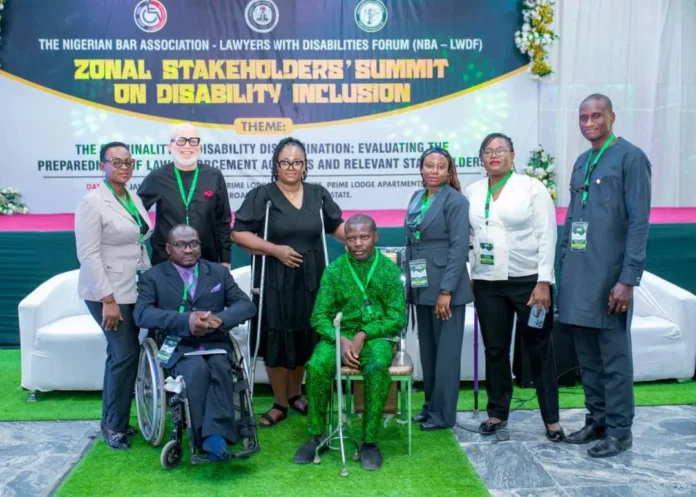
Meanwhile, the Chairperson of the NBA Lawyers with Disabilities Forum, Ms. Patience Etumudon, described the policy as a historic milestone for the legal profession.
Etumudon said she was excited to be part of the development, noting that it was the first time such a disability inclusion policy was being adopted not only by the NBA but by any bar association in Africa.
She said the policy would guarantee zero tolerance for discrimination against lawyers with disabilities and enable them to aspire to the highest positions within the legal profession.
“It means that lawyers with disabilities in Nigeria can aspire even to the highest position in the Bar. It also means that at NBA conferences and every event, disability inclusion will be at the forefront,” she said.
She commended the NBA President, Mazi Afam Osigwe (SAN), for championing the initiative, describing it as a bold step towards recognising lawyers with disabilities as an important part of the association.
Etumudon called on other professional bodies and government institutions to adopt similar inclusion policies, adding that although Nigeria already has legislation protecting persons with disabilities, effective implementation remains a major challenge.