


By Onu Okorie
The Comptroller-General of Customs Mr Adewale Adeniyi has reaffirmed the Service’s commitment to strengthening Post Clearance Audit as a modern control mechanism for promoting voluntary compliance, facilitating legitimate trade, and safeguarding government revenue.
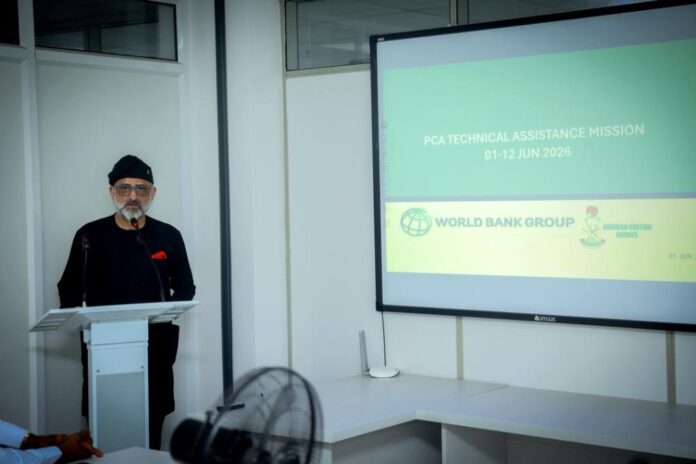
He stated this at the closing ceremony of a two-week Technical Assistance Mission on Post Clearance Audit PCA with the World Bank.
Adeniyi who was represented by the Deputy Comptroller-General of Customs in charge of Human Resource Development, Tijjani Abe noted that effective customs administration requires intelligence-driven, risk-based, and internationally compliant PCA systems.
Acccording to him, “the true measure of success will not be the completion of this programme, but the extent to which the knowledge acquired translates into improved performance, stronger compliance outcomes and enhanced service delivery.”
While reaffirming the Service’s commitment to continued collaboration with the World Bank Group, the World Customs Organisation WCO and other development partners, the Customs boss said that the programme focused on strengthening compliance management, revenue assurance, and trade facilitation through modern audit practices.
Earlier, the Assistant Comptroller-General of Customs in charge of PCA, Babatunde Olomu, expressed optimism about PCA’s future within the Service. He said the technical deliberations, practical problem-solving sessions, and assessments conducted during the mission had laid a solid foundation for institutional and operational reforms.
“The experiences exchanged and outputs developed during this mission will undoubtedly serve as catalysts for a new era of PCA modernisation and development in the NCS. These are not mere administrative instruments; they are the building blocks of a risk-intelligent and internationally compliant PCA system,” he stated.
Participants presented key deliverables developed during the mission, including draft Standard Operating Procedures, a Case File Management System, trader segmentation logic, audit checklists, registry management systems, and quality assurance frameworks. An annual audit plan covering 30 audit cases across Headquarters and three operational zones was also unveiled, with implementation structured within a 45-day timeline.
Speaking on behalf of the World Bank Group, Task Team Lead Moses Kajubi expressed satisfaction with the mission’s outcomes and underscored the importance of institutional support and continuous capacity building.
“For PCA to deliver value, we do not only need tools and processes; institutional support and continuous capacity building are equally important,” he stated, reaffirming the World Bank’s commitment to supporting capability development and implementation efforts within the NCS. The NCS in collaboration with the World Bank Group under the Accelerated Revenue Mobilisation Reform ARMOR Programme, concluded the two-week Technical Assistance Mission on Post Clearance Audit PCA this week.