

By Eculaw Group
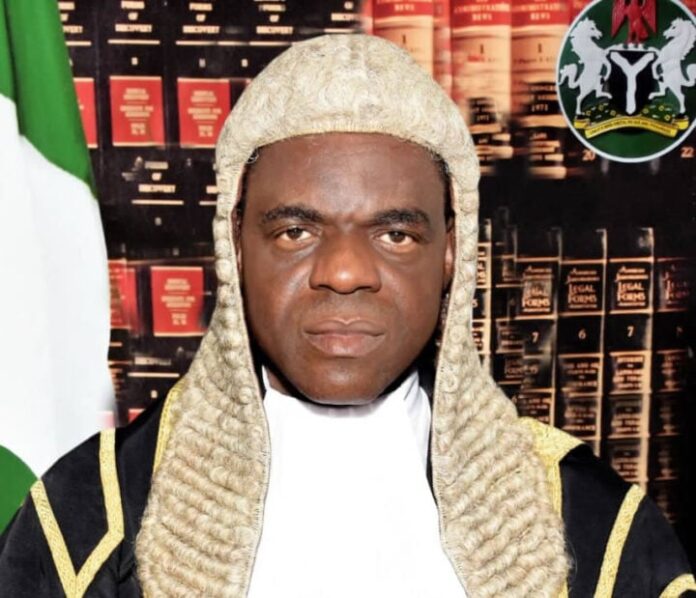
The situation surrounding Chief Judge John Tsoho is indeed a high-stakes crisis for Nigeria’s judiciary. The recent interception of his wife with a large sum of cash is a dramatic escalation of an ongoing probe. Here’s a breakdown of what this means for Justice Tsoho personally and for the Nigerian judicial system as a whole.
What This Means for Justice Tsoho:
(1) A Dramatic Escalation: The investigation began with the Code of Conduct Bureau (CCB) probing Justice Tsoho over an alleged failure to declare several bank accounts in his asset declaration form. The interception of his wife, Mrs. Tsoho, at the airport with $160,000 in cash transforms this from an administrative query into a major criminal investigation with serious implications.
(2) Personal and Legal Jeopardy: The EFCC suspects the cash was being moved to “layer” or hide funds . This directly links his household to the financial allegations against him. If the funds are traced back to him or are found to be proceeds of corruption, he could face:
(3) Referral to the Code of Conduct Tribunal, which has the power to remove him from office, disqualify him from public office for up to 10 years, and order forfeiture of assets.
(4) Criminal charges, as the EFCC now has a tangible piece of evidence to pursue.
(5) A Test of Due Process: The Nigerian Bar Association (NBA) has already faulted the CCB’s initial invitation, arguing that only the National Judicial Council (NJC) has the constitutional authority to investigate a sitting judge. Justice Tsoho’s legal team, led by a Senior Advocate of Nigeria (SAN), has indicated his willingness to cooperate but insists on following proper procedure. How the authorities navigate this—balancing aggressive investigation with respect for judicial independence—will be critical.
What This Means for the Nigerian Judicial System:
(1) Amplifies a Pre-existing Integrity Crisis: This scandal strikes at the very top of the Federal High Court, the arena for Nigeria’s most sensitive corruption cases. It feeds a long-standing public perception of deep-seated corruption within the judiciary, a problem highlighted by academic studies and reports on the justice system’s integrity. The situation is a “tipping point” that severely damages public trust.
(2) Deepens the Executive-Judiciary Tension: The case is a flashpoint in the ongoing struggle between the executive branch (through the EFCC and CCB) and the judiciary. The NBA has explicitly compared this to the controversial 2019 prosecution of former Chief Justice Walter Onnoghen, which was widely seen as an executive overreach. For many, this looks like the presidency using anti-corruption agencies to remove a judge it finds inconvenient.
(3) Creates a Paradox: The system is simultaneously showing signs of both aggressive action and paralysis.
(a) Action: The EFCC is emboldened by a recent Supreme Court ruling validating its powers, and the NJC is conducting broad investigations into senior judges.
(b) Paralysis: The entire saga could further stall judicial work and distract from other necessary reforms, such as technology integration and better funding, which the Attorney General himself has identified as critical for improving justice delivery.
This situation places Justice Tsoho’s career in grave jeopardy while pushing Nigeria’s judicial independence to its limit. The coming weeks—specifically how the NJC, the CCB, and the EFCC coordinate (or clash)—will determine whether this is seen as a landmark anti-corruption success or a politically motivated crisis that further weakens the rule of law.
© Eculaw Group 2026
This analysis is provided for informational purposes and does not constitute legal advice. Eculaw Group specializes in governance, regulatory compliance, and public policy engagement across Nigerian jurisdictions.