

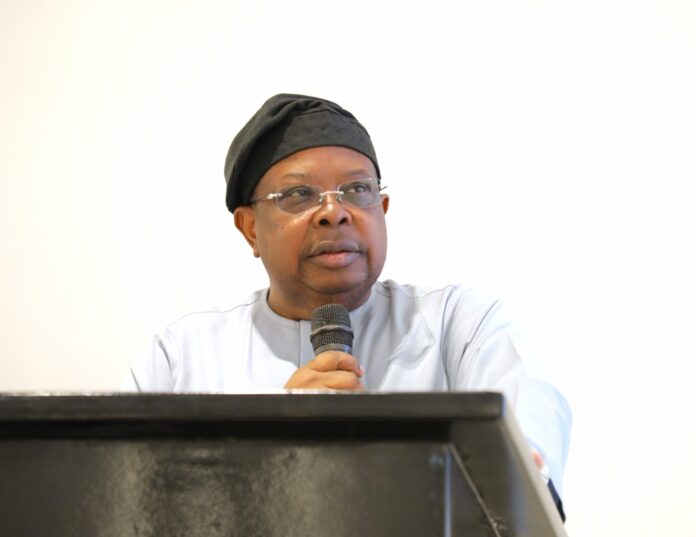

The Federal Government has constituted a nine-member inter-agency committee to address implementation challenges arising from the decentralisation of Nigeria’s electricity market, in a move aimed at accelerating the operationalisation of the Electricity Act, 2023 and ensuring a seamless transition to the country’s new electricity governance framework.
The committee was inaugurated by the Minister of Power Mr Joseph Trgbe at the close of a high-level stakeholders’ workshop convened by the Nigerian Electricity Regulatory Commission (NERC) on Wednesday.
According to the Minister, the committee is expected to review issues identified during the NERC workshop, engage relevant stakeholders across the power sector and submit its recommendations within four weeks.
Tegbe who chaired the Power Sector Inter- Agency Committee, said the body was established to drive sustained collaboration among institutions, resolve emerging implementation issues and support the effective rollout of the Electricity Act, 2023.
The Electricity Act, signed into law in 2023, fundamentally reshaped Nigeria’s electricity industry by allowing states to establish and regulate their own electricity markets, ending decades of exclusive federal control and paving the way for a decentralised electricity sector.
Addressing participants at the workshop, the minister described the ongoing transition as one of the most significant reforms undertaken in Nigeria’s power sector in decades, stressing that its success would depend on collaboration rather than institutional rivalry.
“Nigeria’s transition to a decentralised electricity market is one of the most significant reforms in the power sector in decades. Its success will depend not on institutional competition, but on collaboration, regulatory certainty, and our shared commitment to delivering better outcomes for Nigerians,” he said.
He urged all stakeholders to remain focused on strengthening the Nigerian Electricity Supply Industry (NESI), describing reliable electricity as the backbone of national development.
“Electricity remains the single most important enabler of economic growth, industrialisation, job creation, digital transformation and improved quality of life. Every sector of our economy depends upon it, including manufacturing, agriculture, mining, financial services, telecommunications and information technology,” he stated.
According to him, the Federal Government’s broader economic aspirations under the Renewed Hope Agenda are closely tied to the availability of reliable and sustainable electricity supply.
“Indeed, every national aspiration under the Renewed Hope Agenda rests upon the availability of reliable electricity. The responsibility before us, therefore, extends beyond institutional mandates. It is a national obligation,” the minister added.
He also clarified that the decentralisation of the electricity market should not be interpreted as a fragmentation of the national power system but as a strategic redistribution of responsibilities designed to improve efficiency while maintaining an integrated electricity ecosystem.
“The decentralisation of the electricity market should not be viewed as fragmentation. It should rather be understood as the intelligent distribution of responsibilities within one integrated national electricity ecosystem,” he said.
The minister expressed satisfaction with the level of engagement among federal and state institutions, regulators and other industry stakeholders during the workshop, noting that participants had agreed to deepen consultations as implementation of the new electricity framework progresses.
He said the collaborative approach would help build a modern, reliable and investor- friendly electricity market capable of attracting new investments, improving service delivery and supporting Nigeria’s economic growth. “I am encouraged by the constructive engagement of all stakeholders, including the decision to deepen consultations as we continue to strengthen the implementation framework.
“Together, we are laying the foundation for a modern, reliable and investor-friendly electricity market that delivers improved service, attracts investment and powers Nigeria’s economic growth,” he said.
The establishment of the committee comes as more states move to establish independent electricity regulatory commissions and develop state electricity markets under the powers granted by the Electricity Act, a development widely regarded as a major milestone in the ongoing reform of the country’