

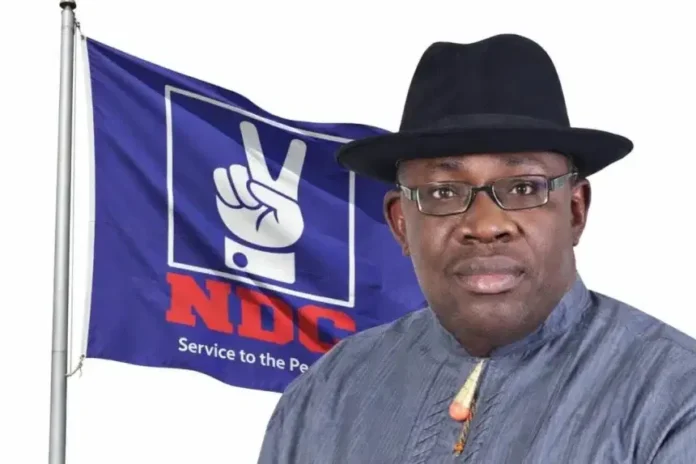

In every election season, rumours become powerful political weapons. They spread quickly, shape public opinions, and sometimes, create distrust — even before the truth emerges. The latest allegation making the rounds is that a huge sum of $300 million has allegedly been set aside to influence the leadership of the Nigeria Democratic Congress (NDC) to remove its presidential candidate, Peter Obi, before the 2027 general elections.
The allegation is explosive, even as it is capable of clinically upturning the 2027 political applecart. It mentions President Bola Ahmed Tinubu, former Bayelsa State Governor and NDC leader, Senator Henry Seriake Dickson, and an alleged plan to orchestrate a vote of no confidence against Obi. Yet, beyond the social media posts and anonymous claims, no credible evidence has been presented to support the story.
One issue, however, deserves attention. Why has Seriake Dickson not directly addressed this particular rumour? Silence in politics is often interpreted in many ways. It may be a deliberate refusal to dignify an unfounded allegation. It may also be a legal strategy, especially when a party is already fighting court cases. Whatever the reason, silence leaves room for speculation, and speculation thrives where an official communication is absent.
To be fair, Dickson has repeatedly denied claims that neither he nor the NDC is working for President Tinubu or the ruling All Progressives Congress (APC). He has consistently maintained that the party is independent, and committed to providing an alternative political platform.
Those statements directly contradict the current rumour, although they do not specifically address the alleged $300 million story.
The controversy is unfolding at a difficult moment for the NDC. Justice Isa Dashen of the Federal High Court, Kogi State, in a ruling on Friday, June 26, 2026, questioned the legal foundation of the party’s registration. The NDC leadership has rejected the judgment, describing it as politically motivated, and promised to challenge it on appeal, even as party officials insist the judgment does not automatically remove the party from the political scene, and that the legal process is far from over.
The legal battle has broader implications than the future of one political party. Democracy depends on political competition. A healthy democracy allows citizens to choose from multiple parties and competing ideas. Whenever court actions, administrative decisions, or political manoeuvres appear capable of reducing electoral competition, public confidence inevitably suffers. This does not mean that every court decision is politically motivated. Courts have the constitutional duty to interpret the law. But they must also ensure that justice is seen to be impartial, and based solely on evidence and law.
The Tinubu administration also has an interest in ensuring that the democratic process remains credible. If allegations of political interference are left unanswered, suspicion will continue to grow, regardless of whether the allegations are true. The government should continue to demonstrate respect for judicial independence, and avoid actions that could reinforce public distrust.
Opposition parties equally have responsibilities. They must avoid turning every political setback into evidence of conspiracy without substantiating their claims. Doing so weakens public confidence in democratic institutions, and distracts attention from the genuine legal and political issues that deserve scrutiny.
Social media has changed Nigerian politics. Information now travels faster than verification. Many citizens receive political news through forwarded messages rather than credible journalism. This reality places a greater burden on political leaders, journalists, and civil society to separate facts from propaganda.
For now, there is no verified evidence supporting the allegation that President Tinubu has set aside $300 million to remove Peter Obi as the NDC candidate. Until such evidence emerges, the claim remains an unverified rumour rather than an established fact.
Ultimately, the greatest threat to Nigeria’s democracy is not merely rumours, but the erosion of public trust. That trust can only be strengthened through transparent institutions, independent courts, responsible political leadership, and a vigilant media committed to facts rather than speculation.
We, at DAILY NEWSCRAFT, caution that as the 2027 general elections draw nearer, Nigerians deserve open political competition, fair judicial processes, and evidence-based public discourse. Democracy is strongest when elections are decided by the votes of citizens — not by rumours, unproven allegations, or political intrigue.
And as for the grave allegation of Seriaki Dickson’s collusive plot with the ruling APC party to stop Peter Gregory Obi from contesting the 2027 presidential election, hangs loosely on hearsay. But, in the Nigerian parlance: “There is no smoke without fire.” Time will tell!