


By Hosea Parah
Nigeria has reaffirmed its ambition to emerge as a leading force in the global natural gas industry.
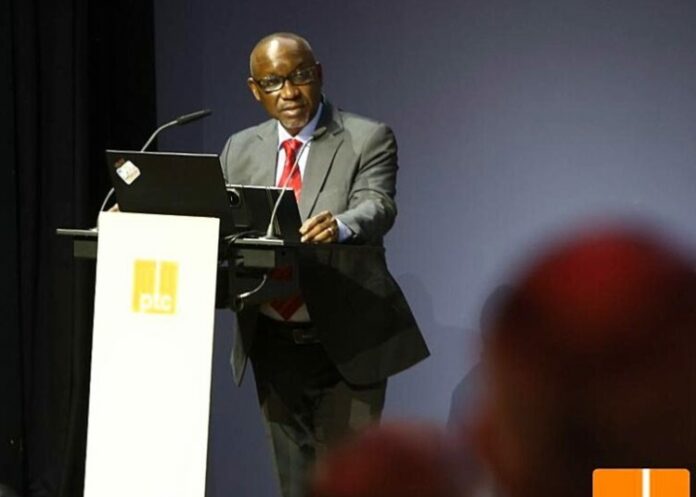
Speaking at the Nigerian Oil and Gas (NOG) Energy Week 2026 during his ministerial address themed, ‘Advancing energy ambitions for competitive & resilient economies,’ the Minister of State for Petroleum Resources (Gas), Ekperikpe Ekpo, said the Federal Government is implementing far-reaching reforms, expanding critical gas infrastructure and strengthening the investment climate to unlock the country’s vast gas resources.
He declared that the country is shifting from being merely a gas-rich nation to one driven by gas-powered industrialisation and sustainable economic growth.
Ekpo described natural gas as the bridge between energy security and environmental sustainability, noting that rising global demand for cleaner and more reliable energy presents Nigeria with a unique opportunity to drive domestic industrial growth while contributing to global energy security.
He said Nigeria possesses 215 trillion cubic feet of proven natural gas reserves, the largest in Africa and among the world’s top ten but stressed that the government’s vision goes beyond exporting the resource to creating value through local industrial development.
According to the minister, “the enactment of the Petroleum Industry Act and subsequent executive orders signed by Bola Ahmed Tinubu have transformed the energy sector by improving regulatory certainty, simplifying contracting processes, introducing fiscal incentives for gas investments and removing bureaucratic bottlenecks.”
He said the reforms have restored investor confidence, resulting in major Final Investment Decisions across the gas value chain.
”Our message to the global investment community is clear: Nigeria is open for business and has established a stable, competitive and highly predictable investment environment,” he said.
Ekpo also highlighted Nigeria’s growing influence in global energy diplomacy, citing the country’s assumption of the presidency of the 2026 Gas Exporting Countries Forum Ministerial Meeting and the election of Philip Mshelbila as Secretary-General of the forum.
He further disclosed that Nigeria recently became the newest association country of the International Energy Agency, making it the first member of the Organisation of the Petroleum Exporting Countries (OPEC) to attain the status.
The minister said the Federal Government’s Decade of Gas initiative is focused on accelerating industrialisation by supplying gas to manufacturing industries, fertiliser and petrochemical plants, electricity generation, clean cooking programmes and the transportation sector through compressed natural gas.
He identified the Ajaokuta–Kaduna–Kano Gas Pipeline and the OB3 Gas Pipeline as strategic projects that will integrate Nigeria’s gas network, improve domestic energy supply, reduce gas flaring and increase the availability of liquefied petroleum gas for local industries.
On the international front, Ekpo said the expansion of Nigeria LNG Limited through its Train 7 project will increase production capacity from 22 million tonnes per annum to 30 million tonnes upon completion, and that will strengthen Nigeria’s position in the global LNG market.
He added that the National Clean Cooking Programme aims to transition five million households to LPG by 2030. Also the nationwide rollout of compressed natural gas conversion centres and refuelling stations is expected to reduce transportation costs by up to 50 per cent.