

By Onu Okorie
A trade policy expert has raised the alarm over what he describes as a decades-long illegal practice by foreign shipping companies operating in Nigeria, warning that the Federal Government may have lost over $375 million in unpaid duties and taxes from the unlawful sale of empty shipping containers — money that experts say could have funded critical public infrastructure.
Mr. Okey Ibeke, Principal Consultant at International Trade Advisory Services and Editor-in-Chief of Business and Maritime West Africa, made the disclosure on Monday before the Shipping Correspondents Association of Nigeria, using the recent actions of Grimaldi Agency Nigeria as a flashpoint to expose what he called a systemic violation spanning three decades.
The Grimaldi Case
According to Ibeke, Grimaldi Agency Nigeria is planning to sell over 2,500 empty shipping containers directly to the Nigerian public, pricing 40-foot units at $2,000 and 20-foot units at $1,600. Payments are reportedly invoiced exclusively in U.S. dollars and settled through domiciliary accounts — with container release withheld until dollar payment is confirmed.
The problem, Ibeke argued, is not merely the dollar-denominated pricing. It is that these containers entered Nigeria under Temporary Import status — a customs arrangement that permits goods to enter the country for a limited period and specific purpose without full duty payment, strictly on the condition that they will be re-exported.
“Grimaldi is skipping straight to the sale without completing a single mandatory customs conversion step,” Ibeke said. “That is not a technicality — it is an offense under Nigerian law.”
Under the Nigeria Customs Service Act 2023, converting a temporarily imported item to permanent home use requires a formal application to the Nigeria Customs Service, a valuation assessment, payment of all applicable duties and taxes into the Federal Government’s account, and an official release order — none of which, Ibeke alleges, has occurred in this transaction.
Grimaldi has not publicly refuted the reports.
The Revenue Loss
The financial implications are significant. Applying the 2026 customs tariff under HS Code 86.09 — which attracts import duty of 5%, VAT of 7.5%, an ECOWAS levy of 0.5%, and other charges — Ibeke estimates that each container sold without proper conversion costs the government between $350 and $400 in lost revenue. Across 2,500 units, that amounts to between $875,000 and $1 million in unpaid taxes from a single company in a single transaction.
But Ibeke was quick to frame this as far bigger than one company.
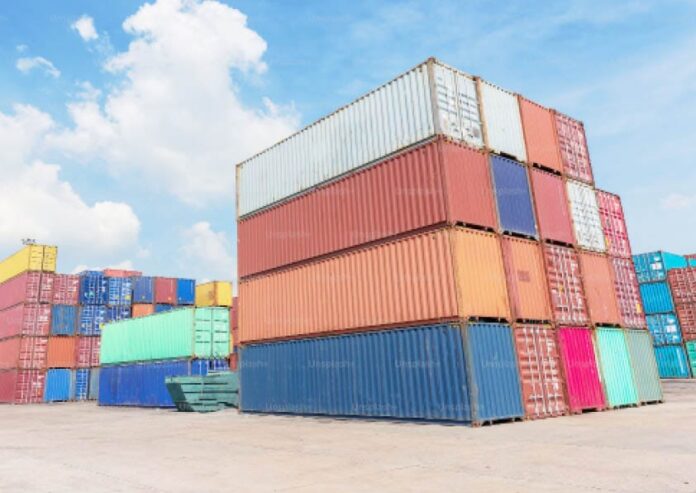
“Grimaldi is not alone,” he said. “For 30 years, Maersk, MSC, CMA CGM, Hapag-Lloyd, COSCO, ONE, Evergreen, PIL and others have operated here. Walk through any Nigerian city and you will find converted shipping containers serving as shops, cold rooms, security posts, farm storage, and building materials.”
Industry estimates, he noted, suggest that if 250,000 containers were sold across those three decades without duty conversion at an average value of $1,500, Nigeria would have forfeited over $375 million in duties and VAT — equivalent to more than ₦600 billion at today’s exchange rate. Revenue he said could have gone toward roads, schools, hospitals, and debt servicing.
Dollar Transactions in a Naira Economy
Beyond the customs violations, the dollar-only payment structure drew sharp criticism. The Central Bank of Nigeria’s Foreign Exchange Manual (2018) explicitly requires all domestic transactions to be conducted in Naira unless a specific CBN exemption is granted. A 2016 CBN circular further clarifies that domiciliary accounts are intended for foreign inflows, not local payments between parties operating within Nigeria.