
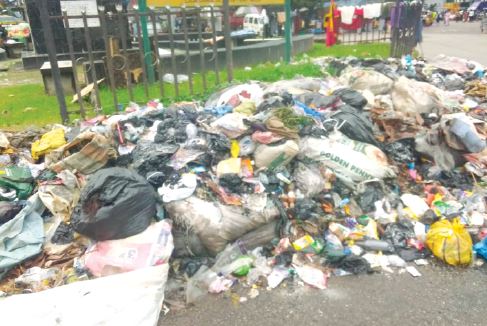

Private Sector Participants operating refuse trucks in Lagos say the city’s worsening waste crisis is being driven by congestion and long queues at the Olusosun dumpsite in Ojota, which they blame on poor maintenance of the facility by the Lagos Waste Management Authority.
For about six months from August 2025 into early 2026, residents across the state complained of heaps of refuse on road medians, streets and highways. While some wastes were cleared temporarily, piles later remained for months in areas including Oshodi, Isolo, Ajao Estate, Ilasamaja, Mushin, Idi Araba and parts of Alimosho Local Government Area.
Operators said refuse trucks have been stranded at the dumpsite due to damaged access roads and insufficient space to offload.
Also, a long queue of trucks was observed waiting to enter, with some vehicles stuck in mud or unable to navigate the deteriorated internal roads.
“It is not that there are no trucks. There are enough trucks, but there is nowhere to offload the refuse,” one operator said. “My three trucks are currently at the dumpsite, and they have not returned for us to work.”
Drivers said delays have stretched from hours to several days.
Some reported spending up to four days in the queue before offloading, while others said breakdowns on the bad roads had led to engine damage and costly repairs.
Operators also cited inadequate and poorly maintained caterpillar machines as a factor slowing operations. “Before now, if a truck got there by 2pm, by 6pm it would have finished offloading and left. Aside from the bad road, the caterpillars are not strong enough to push the refuse properly,” said an operator who gave his name as Olamide.
Some operators alleged irregularities in the queue system, claiming that drivers with connections bypassed the line while others remained stranded.
Alternative dumpsites in Epe and Badagry were described as too costly due to higher diesel consumption and poor road conditions that increase breakdowns and tyre damage.
The operators called on the state government to urgently rehabilitate access roads, improve facilities and engage directly with PSP operators to resolve the bottlenecks.
“PSP operators are the ones keeping Lagos clean, so their concerns should be taken seriously,” one operator said. “If necessary, the government can partner with the private sector to handle maintenance work more effectively.”