

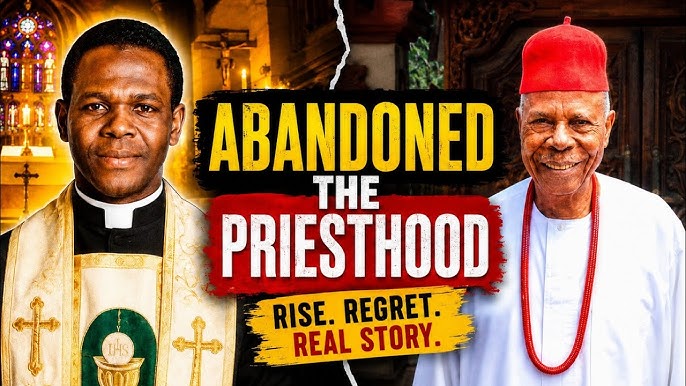

The history of the Catholic Church in Igbo land cannot be fully told without mentioning the name of HRH Eze Dr. Bede Enyeribe Onuoha, a gifted priest, scholar, composer, and traditional ruler whose life journey remains one of the most discussed and emotional chapters in the history of the Church in Eastern Nigeria.
Ordained a Catholic priest in 1960 for the then Catholic Diocese of Owerri, Fr. Bede Onuoha distinguished himself as a brilliant intellectual and committed missionary priest. He was deeply involved in the growth of the local Church and contributed immensely to the inculturation of Catholic worship among the Igbo people. Following the reforms of the Second Vatican Council, he became the first Igbo priest to translate the Latin Missal into the Igbo language, thereby helping many local faithful to participate more actively and meaningfully in the Holy Mass.
Beyond liturgical translation, Fr. Onuoha also enriched Catholic worship through music. Many Catholic hymns still sung in churches today are credited to him, including the popular hymn: “Onwere ihunanya di ka nke a na Chukwu biara n’uwa…” His contributions to Igbo Catholic spirituality and worship remain enduring legacies within the Church.
As at 1971, he was serving as the Parish Priest of St. Bridget Catholic Church, Nnarambia. However, after his transfer to Enugu in 1972, he eventually left the active priesthood the same year. Later in life, he got married, raised a family with children and grandchildren, and eventually became the traditional ruler of Umuchieze, Ihitteafoukwu in Ahiazu Mbaise Local Government Area of Imo State.
Years after leaving the priesthood, Eze Bede Onuoha made a profound statement that continued to provoke reflection among many Catholics. According to him, “I did not leave the priesthood to marry; I married because I left the priesthood.” He further admitted with deep emotion that he regretted leaving the priesthood, describing it as “incidental.” Those words reveal the emotional and spiritual struggles that sometimes accompany human decisions and life transitions.
There have also been unconfirmed narratives linking his frustration to events surrounding the appointment of a bishop for Owerri Diocese after the Nigerian Civil War. According to such accounts, tensions emerged when some two priests from Mbaise, including Rev. Fr. Ignatius Okoroanyanwu (Vicar) and Rev. Fr. Theophilus Nwalor (Secretary ) who had served prominently during the difficult period following the deportation of Bishop Joseph B. Whelan by the military government of General Yakubu Gowon, were bypassed in the eventual appointment of Late Bishop Mark Unegbu 18 months after the Diocese had no bishop. While these claims remain largely historical opinions and unofficial accounts, they continue to form part of discussions surrounding that era in the Church.
However, beyond controversies and speculations, the life of Eze Dr. Bede Onuoha remains a sober reminder of the complexity of human experiences, even within sacred vocations. Priests are human beings with emotions, struggles, disappointments, and personal battles. The Church therefore must continue to support, encourage, and pray for her priests, while priests themselves must continually rely on the grace of God to remain faithful to their calling.
At the same time, the faithful should learn not to mock or condemn those who stumble in life. As Scripture reminds us, “Let him who thinks he stands take heed lest he fall” (1 Corinthians 10:12). The story of Fr. Bede Onuoha is not merely a story of departure from priesthood; it is also the story of a man who contributed immensely to the spiritual and cultural life of the Church and whose legacy still lives on in Igbo Catholicism today.
Kindly follow my page for updates, prayers and homilies
@ Fada Ben Amuchie
Wrote