
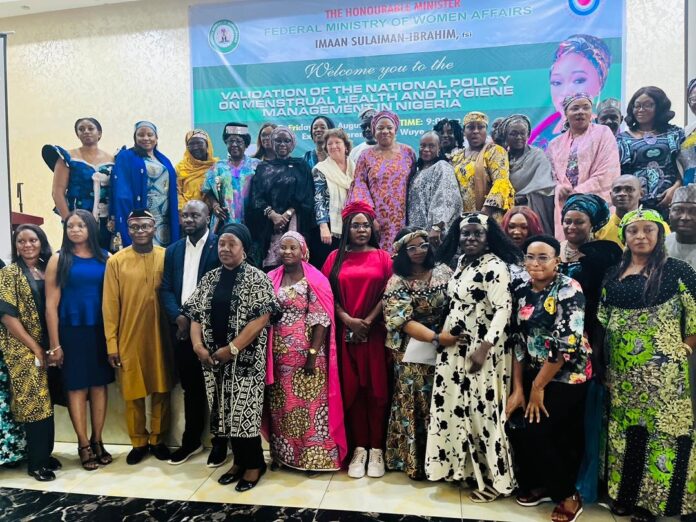

Nigeria has taken what officials describe as a historic step in advancing women’s health and dignity with the validation of its first-ever National Policy on Menstrual Health and Hygiene Management (MHHM).
The policy was formally endorsed at a high-level meeting on Friday, August 15, at Exclusive Serene Hotel in Abuja. The gathering brought together state commissioners, development partners, civil society groups, and other stakeholders.
The Minister of Women Affairs, Hajiya Imaan Sulaiman-Ibrahim, was represented by the ministry’s Permanent Secretary, Dr. Maryam Ismaila Keshinro, who underscored menstrual health as a national development priority. She stressed the importance of federal–state collaboration to ensure the policy delivers practical results.
The minister applauded President Bola Ahmed Tinubu for approving tax waivers on sanitary towels under the newly signed Tax Reform Act. She described the measure as a landmark intervention to ease the financial burden on women and girls.
“By 2030, no girl in Nigeria should have to choose between managing her menstruation and pursuing her education,” the minister said in her address.
Development partners at the event also pledged support for the policy’s rollout. Evelyn Mere, Country Director of WaterAid Nigeria, highlighted the lack of basic water, sanitation, and hygiene facilities in schools—only 11 percent currently have them, according to her. She said the new framework, which tackles products, infrastructure, education, and stigma, has the potential to be “transformative.”
Mrs. Fifi Ogbondeminu, Acting Country Representative of Population Services International (PSI) Nigeria, pointed to her organisation’s Menstrual Health No Wahala (MH-NoW) programme and promised collaboration with government to expand access to affordable products, integrate menstrual health into the school system, and confront stigma.
Participants closed the session with a call for action, stressing that while the validation marks a major milestone, the true test will be implementation in communities across the country—from cities to rural areas and camps for internally displaced people.
The National Policy on Menstrual Health and Hygiene Management (2025–2030) sets a five-year framework to guarantee women and girls in Nigeria can manage menstruation safely, hygienically, and with dignity. It covers menstrual products, WASH facilities, education, and eliminating discrimination tied to menstruation.