

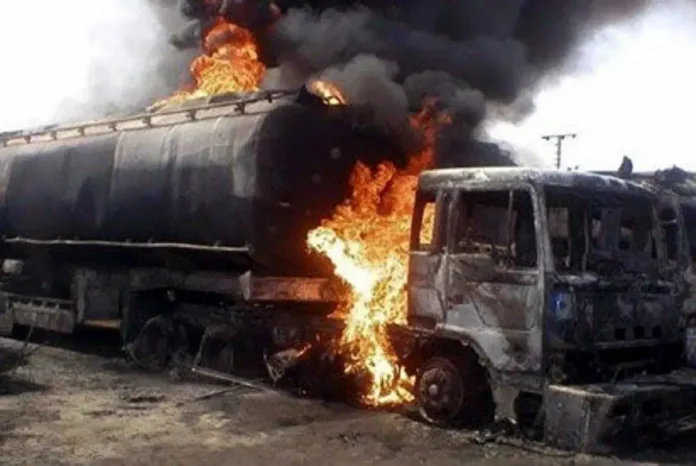

Regarding the plan to prohibit petroleum trucks with a 60,000-liter capacity from using federal highways, the Nigerian government and the National Association of Road Transport Owners are at odds.
In order to stop the constant tanker explosions that have killed 493 people in the past three years, the Nigerian Midstream and Downstream Petroleum Regulatory Authority on Wednesday suggested banning vehicles with 60,000-liter capacities during a stakeholders conference in Abuja.
Therefore, as part of a request to reduce the number of fatalities from petroleum tanker accidents to zero, the Nigerian government wants tankers limited to a maximum of 45,000 liters.
This idea was presented at the stakeholders’ meeting on Wednesday by Farouk Ahmed, the NMDPRA’s chief executive officer.
Ahmed claims that the number of fatalities from the petroleum truck explosion has been rising, rising from seven in 2022 to 24 in 2023 and 341 in 2024. The tragedy has already reached 121 in 2025, just two months after it started.
“We have already reported five road tanker incidents this year, resulting in 79 injuries and 121 fatalities. These occurrences are unacceptable and needless. They have to be stopped and eliminated.
He stated, “Considering the detrimental effect on the roads, a suitable truck carrying capacity of 60,000 versus 45,000 liters should be determined.”
He also warned downstream operators must respect to safety requirements to prevent incessant tanker explosions.
As a result, he continued, “any operator who conducts business in violation of established protocols and safety requirements is unacceptable.”
The National Association of Road Transport Owners’ president, Yusuf Othman, stated that the decision to prohibit gasoline trucks with 60,000 liters would result in a possible loss of more than N300 billion in investment.
“Transporters are investors, and these investments are enormous,” I would like to remind everyone present.
Any truck that can carry 60,000 liters needs to have a sturdy engine and cost N150 million on average.
“By our estimation, we have 2,000 of them. We are talking about N300 billion investments, some of which were financed by banks and other lenders,” he declared.