


* ‘None of them can match Tinubu,’ boasts APC
* Pro-Tinubu group says division could hurt Atiku, Obi, Kwankwaso
By Ahmed Akanbi
Ahead of the 2027 general elections, the opposition parties have intensified moves to challenge President Bola Tinubu and the ruling All Progressives Congress (APC), and wrestle power from them.
This was even as the APC has boasted that no candidate for the opposition is capable of standing toe-to-toe with Tinubu in the Presidential election next year.
In what looks like leaked advice to the opposition, a pro-Tinubu group has hinted that any attempt to divide the opposition will spell nothing but doom for the parties contesting against the APC.
In their bid to wrestle power from Tinubu and the ruling APC, the leaders of the six political parties are holding consultations on the possibility of fielding a common presidential candidate.
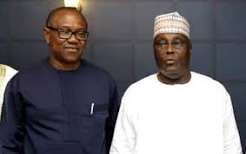
The consultations involved former Vice President, Atiku Abubakar; former Labour Party presidential candidate, Peter Obi; and the Oyo State Governor, Seyi Makinde, alongside other presidential hopefuls.
This was disclosed by the G-100 in a statement issued by Salihu Lukman, saying the talks were part of efforts to implement resolutions of a recent opposition summit.
The summit had urged opposition parties to strengthen cooperation and explore a united front ahead of the general election.
According to the statement, national chairmen and national secretaries of the African Democratic Congress (ADC), Allied Peoples Movement (APM), Nigeria Democratic Congress (NDC), Social Democratic Party (SDP), Peoples Democratic Party (PDP) and Peoples Redemption Party (PRP) participated in the consultations.
The presidential candidates involved were: Atiku of ADC, Obi of NDC, Makinde of APM, Adewole Adebayo of SDP, and Donald Duke of PRP.
Lukman said the meetings were to allow opposition leaders discuss areas of common interest and develop a workable framework for cooperation.
He said the initiative was designed to move the summit’s resolutions beyond declarations into practical steps toward a more coordinated opposition.
The G-100 said the discussions would also examine how the parties could work together in defence of multiparty democracy and the interests of Nigerians.
Lukman noted that the country’s challenges require leaders to look beyond party differences and put citizens’ welfare and the future of the country first.
”The consultations remain ongoing,” he said, adding that further meetings would build on the summit’s resolutions and the commitment to an opposition capable of working together in the national interest.
Although aimed at a joint ticket, the statement did not indicate that parties had agreed on who would fly the common flag, a decision that could shape opposition strategy to avoid vote-splitting against the ruling APC.
In a subtle advice, the Grassroots Mobilisation Initiative (GMI), a group supporting President Bola Tinubu’s re-election bid, has warned that opposition divisions could hurt Atiku, Obi, and Kwankwaso in 2027.
GMI predicted that divisions among opposition parties and the distribution of votes across Nigeria’s six geopolitical zones could shape the outcome of the 2027 presidential election.
The group argued that the opposition’s failure to form a united coalition could weaken its chances against Tinubu, whose supporters say his political alliances across the country could give the ruling party an advantage.
GMI’s National Coordinator, Samaila Musa, stated this in a political assessment of the emerging electoral landscape, identifying former Vice-President Atiku Abubakar, former Anambra State Governor Peter Obi and former Kano State Governor Rabiu Kwankwaso as key figures in the opposition landscape.
Musa claimed that Atiku would struggle to secure significant support in the southern states, arguing that political alignments in the South East and South West could favour Tinubu.
He also projected that Kwankwaso could attract votes in Kano and Jigawa states, as well as make gains in Katsina, potentially splitting votes that might otherwise go to Atiku in the North West.
“The North West vote split. It would weaken the opposition’s chances,” Musa argued, adding that the North East and North Central regions would also be critical battlegrounds.
He said divisions among opposition candidates across the regions could prevent them from building the national voting bloc needed to defeat the incumbent.
Musa further argued that a presidential candidate could not rely solely on northern votes to win the election, citing former President Muhammadu Buhari’s eventual victory in 2015 after building an alliance with Tinubu and securing support beyond the North.
However, GMI’s projections reflect the group’s political assessment and support for Tinubu, rather than an independently established forecast of the 2027 election outcome.
The group said it supported the participation of all candidates, including Obi and Kwankwaso, arguing that voters should have the opportunity to assess their policies and records.
Musa also disclosed that GMI had activated its grassroots structures across the country’s 774 local government areas to mobilise support for Tinubu’s re-election.
He attributed the president’s electoral prospects to what he described as his economic reforms and broad political alliances.
“President Bola Ahmed Tinubu is set to secure a decisive victory in the coming election,” Musa said, adding that the opposition’s internal divisions could undermine its ability to challenge the ruling party.
He maintained that Tinubu’s nationwide political coalition remained strong, while opposition figures risked losing support to competing candidates.
The 2027 presidential election is expected to feature intense competition among political parties as they seek to build alliances and secure support across the country’s six geopolitical zones.
Meanwhile, the APC National Chairman, Prof Nentawe Yilwatda, has boasted that none of Atiku Abubakar, Peter Obi, Donald Duke, and Seyi Makinde are no match for President Bola Tinubu in the 2027 general elections.
The quartet are presidential candidates of: African Democratic Congress (ADC), Nigeria Democratic Congress (NDC), Peoples Redemption Party (PRP) and Allied Peoples Movement (APM) respectively.
Yilwatda made the declaration Thursday while receiving the Forum of APC House of Representatives Aspirants, led by Hon. Danjuma Mohammed, at the party’s national secretariat in Abuja.
”No political party, as it stands today, has a more credible candidate than President Bola Ahmed Tinubu. We have facts; we have records that if we put them vis-à-vis any other candidate that is on this ballot, none (matches) our own candidate. None. I mean, none. None,” he said.
He said the opposition cannot survive side-by-side comparison of records, challenging them to show scorecards of their past administrations against Tinubu’s.
On roads, Yilwatda said Nigerians could not point to anything built when N300 billion was released for roads when Obasanjo was president and Atiku was vice president.
”We were here live. When the president gave road projects of over N300 billion, when another person was the Minister of Works, we couldn’t find even the road that was patched with that budget,” he said.
He listed Tinubu’s projects, including the Abuja-Kaduna-Kano highway of over 441km nearing completion, the Trans-Saharan Superhighway of over 1,400km where 30-40 per ncent has been done, and the Lagos-Calabar Coastal Highway.
He also cited the Ajaokuta-Kaduna-Kano gas pipeline, saying the gas will be used for fertilizer, CNG, homes and to fire turbines for electricity.
Yilwatda criticised Atiku’s plan to scrap the student loan scheme, describing critics who dismiss the N20,000 monthly upkeep as out of touch with ordinary Nigerians.
”I know how many students dropped out because they could not afford school fees. I taught them,” the former lecturer said, recounting how a student used part of the N20,000 to buy a second-hand refrigerator to sell iced fish.
He accused opposition figures who own private universities charging millions in fees of hypocrisy, noting that even students in those institutions benefit from the loan scheme.
Earlier, Mohammed said the forum was formed in 2022 under the PDP to unite aspirants who lost primaries and mobilise for Atiku and Ifeanyi Okowa, but many members have now joined APC to support Tinubu and Vice President Kashim Shettima for second term.