

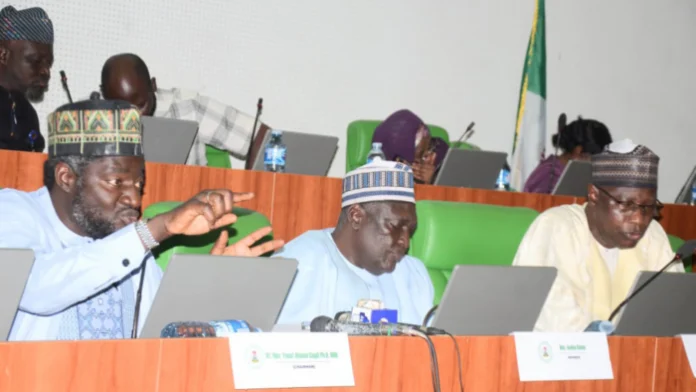

The duty of a legislature is not merely to hold public hearings. It is to uncover the truth, hold the guilty accountable and reassure citizens that no one is above the law. That is why the recent investigation by the House of Representatives into the phantom Presidential Foreign Investment Promotion Council (PFIPC) has left many Nigerians deeply disappointed.
What should have been a defining moment in the fight against impunity ended up looking like an elaborate performance with little substance. There was drama, there were witnesses, there were headlines—but at the end of the exercise, Nigerians were still left asking the same questions that existed before the investigation began.
The PFIPC scandal is one of the most embarrassing governance failures in recent years. A body that the Presidency later said did not exist reportedly operated as though it were an official government institution. It allegedly had a Director-General, official correspondence, an office, interactions with public institutions and other trappings of legitimacy. Such a development should shake every serious government because it exposes dangerous weaknesses in the country’s administrative system.
Recognising the gravity of the matter, the House of Representatives constituted an ad hoc committee to investigate how such an organisation came into existence and who enabled it. Nigerians expected a painstaking probe that would expose the entire chain of responsibility.
Sadly, that expectation was not met.
One of the biggest disappointments was the inability of the police to produce the alleged Director-General, Adeniyi Adeyemi, before the committee despite a directive from lawmakers. If a key figure in the investigation could not be brought before Parliament, then one must ask whether the institutions charged with enforcing accountability are truly working together or merely protecting the system from scrutiny.
The police owe Nigerians a convincing explanation. Was the failure due to legal constraints, administrative incompetence or something more disturbing? Some reports said the reason is that a court declined their request to produce Adeyemi. That is totally weak and unacceptable. As far as Nigerians are concerned they did not give any reason, and silence only fuels suspicion.
Equally troubling was the testimony of the Head of the Civil Service of the Federation, who admitted that there were administrative lapses. That admission should not be dismissed as routine bureaucracy. Administrative lapses are not harmless paperwork errors. They are the cracks through which corruption, forgery and abuse of public trust flourish.
No phantom agency can acquire official recognition without failures within the civil service. Documents do not authenticate themselves. Files do not move on their own. Access is granted by human beings. Approvals are processed by public officers. Somewhere, someone failed in a duty—or deliberately ignored it.
That is why many Nigerians have called for accountability at the highest administrative levels, including demands that those responsible should step aside. Whether resignation ultimately becomes necessary is a matter for the relevant authorities, but leadership cannot celebrate success and disown failure. Public office carries responsibility, especially when systems under one’s supervision collapse so spectacularly.
Another issue that continues to cast a shadow over the investigation is the widespread perception that some powerful figures escaped the rigorous scrutiny expected in such a high-profile matter. Because documents linked to the controversy reportedly bore the purported signature or name of the President’s Chief of Staff, Femi Gbajabiamila, many expected every relevant question to be asked and every necessary clarification to be sought.
Instead, the investigation concluded without dispelling public doubts.
This is unfortunate.
In matters of public accountability, perception matters almost as much as reality. A legislative inquiry must not only be fair; it must also be seen to be fair. Any impression that influential personalities enjoy a different standard of treatment weakens confidence in Parliament and strengthens the public belief that Nigeria still operates a system where power determines justice.
Perhaps the greatest weakness of the entire exercise is that it ended without providing concrete answers to the questions that matter most.
Who conceived the phantom council?
Who authorised its operations?
Who processed its documents?
Who enabled its access to government institutions?
Who benefited from its activities?
What sanctions will follow?
On these critical questions, Nigerians expected certainty. Instead, they were left with ambiguity.
Investigations that produce no clear findings serve little purpose. They consume public resources, attract media attention and create expectations, only to end without meaningful consequences. That is not oversight. That is institutional fatigue disguised as accountability.
The House of Representatives must appreciate that public confidence is earned not through lengthy hearings but through courageous conclusions. Democracy demands more than microphones and television cameras. It demands the political will to follow evidence wherever it leads, regardless of whose interests are affected.
Nigeria cannot continue to normalise unfinished investigations. Every inconclusive inquiry sends a dangerous signal that scandal will eventually fade, public outrage will subside and those responsible will quietly move on.
That culture must end.
The PFIPC scandal offered the National Assembly an opportunity to demonstrate that no office is too powerful to answer questions and no individual too influential to be investigated. Instead, the proceedings have left many Nigerians wondering whether the country witnessed a genuine search for the truth or merely another carefully choreographed performance.