
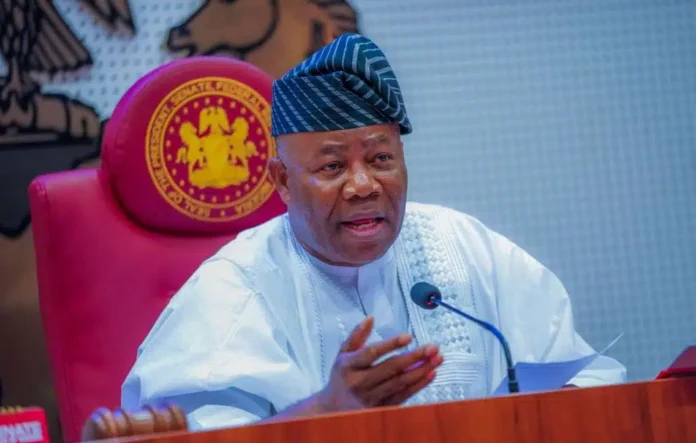

The President of the Senate, Godswill Akpabio, has defended the National Assembly’s decision to remove mandatory electronic transmission of election results from the amended Electoral Act ahead of the 2027 general elections.
The Senate had last week sparked nationwide debate after dropping the provision for compulsory electronic transmission of results, a move that drew criticism from opposition parties, civil society groups and the Nigerian Bar Association.
Many Nigerians had called on lawmakers to reverse the decision, warning that it could undermine transparency and credibility in future elections.
But speaking at the public presentation of a book by a former senator, Effiong Bob, titled The Burdens of Legislators in Nigeria, Akpabio dismissed the criticisms and insisted that the responsibility for election modalities lies with the Independent National Electoral Commission.
Akpabio said lawmakers only make laws, while INEC is constitutionally empowered to determine how elections are conducted and what technology to deploy.
He urged Nigerians to direct their concerns to the electoral body rather than the National Assembly.
“The Senate does not conduct elections, we don’t deploy technology, we only make laws. And INEC must apply the law,” he said.
He added that, “The timing, scope and modality rests with INEC, acting within the framework of the law enacted by the parliament and interpreted by the Supreme Court.”
The Senate President also cited infrastructure and security challenges as reasons mandatory electronic transmission may not be feasible across the country.
According to him, several states still lack stable network coverage, which could affect real-time transmission of election results.
“Real-time transmission means that in over nine states where networks are not working because of insecurity, there will be no election results. Nationally, it means that if the national grid collapses and no network is working, no election results will be valid,” Akpabio said.
Akpabio also took a swipe at some of those criticising the Senate’s action, accusing them of lacking understanding of the legislative process.
“But you see them talking. We even have a young man from Akwa Ibom who is publicity secretary to one of the parties. When you see him talking you will think he knows it all.
“He doesn’t know anything about lawmaking, and he would talk and talk and talk. But what can I say? I can’t answer,” he said.