
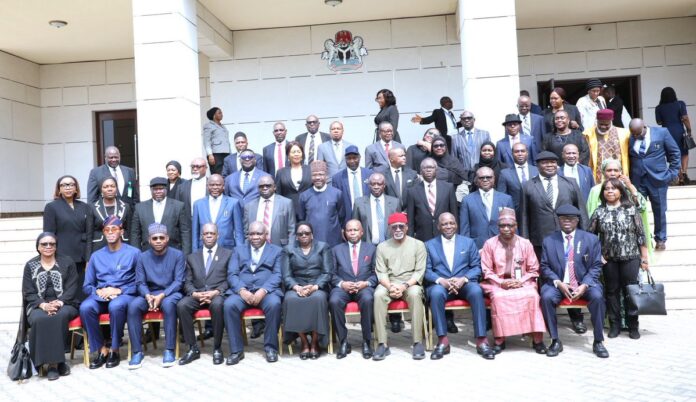

The Nigerian Electricity Regulatory Commission (NERC) is holding the sixth Seminar on the Nigerian Electricity Supply Industry (NESI) for Judicial Officers. The theme for this year’s seminar is: ‘Nigeria’s Electricity Market in Transition: Law, Regulation and the Courts.’
The three-day seminar is being held in collaboration with the National Judicial Institute (NJI) at the NJI Complex, Abuja.
The Commission hosted the Seminar in collaboration with NJI and led by the Chairman, Dr Musiliu Oseni; Commissioner, Legal, Licencing and Compliance, Mr Dafe Akpeneye; Commissioner, Corporate Services, Mr Nathan Shatti; Commissioner, Stakeholder Management, Mrs Aisha Mahmud; and Commissioner, Research and Data Analytics, Dr Fouad Animashaun.
At the opening ceremony of the seminar, NERC Chairman, Dr Musiliu Oseni, in his address, said that the event provides a strong platform for meaningful engagement with the judiciary on the progress and challenges within the Nigerian power sector. The seminar aims to stimulate discourse on emerging legal issues relevant to the Nigerian Electricity Supply Industry (NESI).
Dr Oseni announced key milestones of the power sector reforms within the last year, including the creation of the Nigerian Independent System Operator (NISO) Ltd from the Transmission Company of Nigeria (TCN) Plc to ensure transparency in grid management and operation. With this, Nigeria achieved a successful test synchronisation of the national grid with other West African countries through the West African Power Pool (WAPP).
“I am glad to report that the free distribution of prepaid meters to unmetered customers has fully commenced, in fulfilment of the promise made by Mr President,” Dr Oseni announced.
Other strategic actions include intensified oversight on the implementation of the SCADA project to reduce grid collapses, creating regulatory frameworks to attract private investments in transmission, and establishing customer care clinics across all distribution companies (DisCos) to enhance service delivery.
Providing an update on the ongoing transition to a multi-tier electricity market, the NERC Chairman noted that NERC has already issued Transfer Orders to 16 states, noting that, “we are moving from a regime where My Lords only deal with matters involving utilities and NERC as the sole regulator, to matters involving multiple regulators. Without doubt, effective adjudication on such matters will require the familiarisation of my lords with not only the federal laws and NERC regulations but also different states’ laws and regulatory instruments.”
Dr Oseni expressed appreciation to the CJN, President of the Court of Appeal, Chief Judge of the Federal High Court, and the Attorney General of the Federation for the recently approved Practice Direction for the NESI. He also noted that this will provide essential legal clarity for resolving industry matters.
The Minister of Justice and Attorney General of the Federation, Prince Lateef Fagbemi, stated that the judiciary occupies a vital position in this reform journey as guardian of the law. He noted that the decentralization of electricity regulation has introduced new areas of adjudication in electricity sector jurisprudence. Furthermore, he emphasised that this seminar is a crucial step that aligns fully with the vision of the CJN toward improving case resolutions within the sector.
Earlier in his welcome address, the Administrator of the National Judicial Institute (NJI), Hon. Justice Babatunde Adejumo (Rtd.), stated that given the technical and policy-driven nature of the sector, Judges are increasingly required to navigate the complex intersection of law, economics, and engineering. He emphasized that bridging this knowledge gap is a primary objective that this seminar seeks to support, ensuring the Judiciary remains equipped to handle the evolving needs of the Nigerian Electricity Supply Industry (NESI).
The Chairman, Senate Committee on Power, Sen. Enyinnaya Abaribe, delivered a goodwill message at the NERC 2026 Seminar for Judges at the NJI Complex in Abuja.
He stated that lawmakers have a mandate to foster reforms through legislative interventions, such as the recent Constitutional Amendments, enactment of the Electricity Act, 2023, and the proposed amendments to the Act. “These specific sector reforms will boost our electricity supply, integrate renewable energy, promote competition, increase access to affordable electricity, and mitigate disputes between State, Federal, and private entities in the electricity sector,” he said.
The lawmaker commended NERC and NJI for initiating this vital dialogue between electricity regulators and the Bench, focused on Law, Regulation, and the Courts. Sen. Abaribe further noted: “It will also enhance dispute resolution on electricity matters, reduce regulatory uncertainty, and contribute to a more robust electricity market that can meet the developmental needs of our nation.”
The Minister of Power, Chief Adebayo Adelabu, represented by the Director, Distribution Services at the Federal Ministry of Power, Engr. Baba Umara Mustapha, commended NERC and NJI for sustaining the seminar.
“This seminar is a potent platform for constructive engagement between the judiciary and power-sector officials to discuss the legal, commercial, and regulatory dynamics of the power sector,” the Minister stated.
He further noted that with a clear understanding of the judiciary’s role, reforms in the electricity sector will be more successful. He urged judicial officers to continue collaborating with power sector stakeholders to ensure shared success for the industry.
In her keynote address, the Chief Justice of Nigeria, Hon. Justice Kudirat Kekere-Ekun, commended the NERC-NJI collaboration, noting that through programmes such as this seminar, the NJI continues to reaffirm its commitment to strengthening judicial capacity, promoting professional excellence, and enhancing public confidence in the Courts.
“I am confident that the deliberations and insights generated during this Seminar will have a lasting and positive impact on judicial practice and the development of sound electricity-sector jurisprudence,” said the CJN.
There were presentations during the technical session: The first technical session was led by the Commissioner, Legal, Licencing and Compliance at NERC, Mr Dafe Akpeneye. His paper, titled “The Electricity Act 2023 in Practice: Implementation Gaps, Regulatory Friction and the Case for Legislative Amendment.” Provided a roadmap for the sector’s current transition.
The next paper was delivered by the Chairman of Geometric Power, Prof. Barth Nnaji, titled “The Investors’ Perspective: Investment Opportunities and Challenges in the Nigerian Power Sector.”
In a presentation, NERC Vice Chairman, Dr Yusuf Ali (represented by the Director, Economic Regulation, Mr Abba Terab), discussed, ‘Regulating Electricity Tariffs in a Decentralised Market Structure.’