
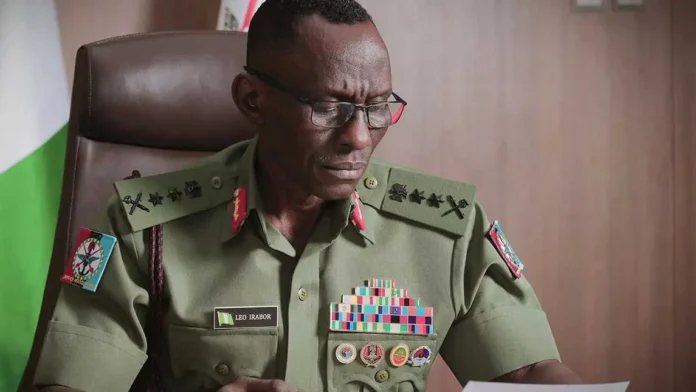

Former Chief of Defence Staff, General Lucky Irabor, has traced current rampart insecurity ravaging the country to prolonged governance failures at all levels, noting that Nigerian leaders have for too long neglected citizens and taken them for granted.
Irabor, who spoke on Channels Television’s Politics Today, on Monday, said years of weak governance structures, particularly at the local government level, have created an administrative void that allows crises to fester unchecked.
Citing his service experience, Irabor said he discovered that most local government areas had no functional governance presence, as some local government areas exist in name only. He said most communities are left without officials to manage conflicts or respond to emergencies.
He maintained that in most cases, leaders were largely negligent of the rural population, remembering them often during election cycles.
Irabor said that it is this prolonged neglect that has fuelled various forms of crises often labelled as religious, ethnic or tribal conflicts, stressing that these are symptoms of deeper governance problems.
According to him, Nigeria’s current economic hardship has further pushed citizens to the edge with many now resorting to crimes and criminal activities as a means of survival.
He maintained that the current insecurity stems from a combination of governance failure and economic pressures.
“Now, first and foremost, over the years, we have had governance failures and it’s across levels. In fact, my experience, especially from it, was quite mind blowing for me, learning that some local governments have no representation of governance.
“So, sometimes you see that all this local government is just by name so you don’t have the government officials at that level to mitigate the crisis, completely absent. So, meaning that over a long period of time we actually may have perhaps taken the people for granted. And I think that it is something that everybody in Nigeria must understand and come to grips with, not to apportion blame, not to point fingers, because pointing fingers will certainly not solve a problem.
“But then for you to know the problem, because a problem that you do not know is a problem you can never solve. So, if you have that life back in mind, the next question to ask is, what then do we do? And then getting to know what you would do is to now begin to talk about what resources that are necessary to be able to do that.
“So, for me, it’s failure of governance over a long period now, because even what we also term as religious crises, what we also term as tribal and ethnic crisis, is also a result of governance failures. So, it’s the aggregate of all this that has given rise to it.
“And then, of course, with the economic crisis, the economic situation that we find ourselves in currently, has also made it such that people now look for different avenues to make a living, and some have taken up the criminal enterprise as a means of meeting that need. So, a mix of factors, if you like, has given rise to this,” he said.