

Valentine Obienyem
When Mr. Peter Obi informed me yesterday that I should join Prof. Patrick Obi to represent him today at the 60th priestly jubilee of Fr. Damian Akpunonu, I was overjoyed. Mr. Obi had already visited Fr. Akpunonu yesterday, as he would not be available today, so this assignment was both an honour and a privilege. Attending events that involve masters is always a joyful experience, much like attending a special course in a school where the masters take you through lessons that broaden your understanding.
I was reminded, for instance, of the funeral Mass of the late Dim Odumegwu Ojukwu, where one of the masters, Monsignor Theophilus Okere, masterfully sang the ancient Dies Irae. I had the privilege of learning this chant myself under the guidance of Fr. Collins Okeke, the director of our theatre group, as part of a classical performance of Murder in the Cathedral. Experiences like these are deeply enriching, for one must constantly learn new things; our knowledge is never complete and is but an expanding mirage in the vast desert of ignorance.
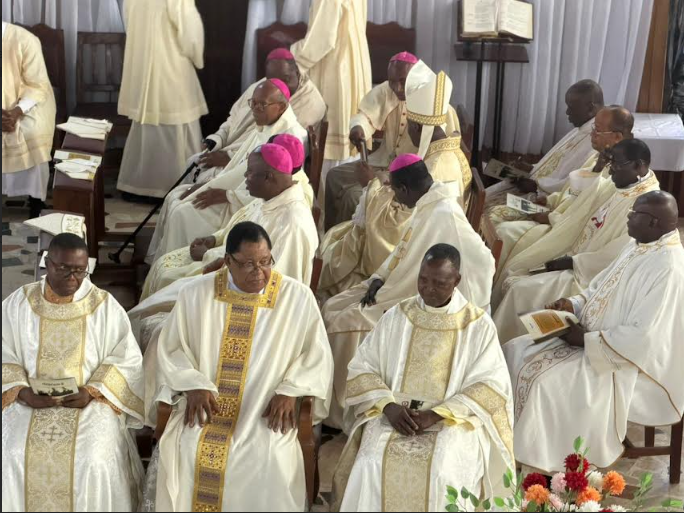
Today, I had the privilege of attending yet another master’s event. Fr. Damian Akpunonu is a master in every sense of the word, and Archbishop Valerian Okeke accorded him the highest honour and respect. From the very arrangement of the liturgy, I learned new and enriching lessons. Although the Archbishop presided as the president of the Mass, Fr. Akpunonu occupied a central place, with the entire celebration beautifully ordered and woven around him.
At the end of Mass, Fr. Daniel Onuorah, the Master of Ceremonies, explained some of the liturgical subtleties, which helped me understand why Archbishop Valerian was seated in what appeared to be a presidential position while the other bishops were seated among the concelebrants. I even had to call Fr. Onuorah afterwards for further clarification on aspects of the liturgy that we do not often encounter. Though he jokingly described himself as more of a Scripture scholar than a liturgist, he had to take charge because the seminary’s liturgist was away to celebrate his own silver jubilee. As he masterfully explained every liturgical detail to me, he spoke with nostalgia about his formation, telling me that he was a student of the famous liturgist, Monsignor Madubuko.
Yes, Fr. Onuorah explained, a bishop can allow a priest to celebrate Mass in a Mass he is present at – a practice called concelebration. As the chief liturgist and owner of the liturgy in his diocese, the bishop has three options: he may preside over the Mass himself with priests concelebrating (which is very common), allow a priest to be the main celebrant while he concelebrates, or attend without concelebrating, such as in choir, depending on pastoral or ceremonial reasons. There is no rule requiring the bishop to always preside; liturgically, he has the fullness of priesthood but may permit another priest to lead, especially in parishes, on special occasions like jubilees, birthdays, or memorials, or when he wishes to honor a priest or community. Canonically and liturgically, this is fully valid, expressing fraternity in the priesthood and respect for the priest’s ministry.
The homily, beautifully delivered by the Bishop of Orlu, Most Rev. Augustine Tochukwu Ukwuoma, vividly highlighted the extraordinary impact of Fr. Akpunonu. He described him affectionately as “my lecturer, my rector, and my friend,” and, in a light-hearted manner, even tried to claim Fr. PO, as he is fondly called, as an Orlu man on account of certain historical connections. Deep down, however, it was clear that this was less about geography and more about illustrating the magnetic pull of his goodness, a word Archbishop Fortunatus Nwachukwu of the Holy See had also used to describe him. Otherwise, if he were Derico, would my Lord have claimed him with the same warmth?
Bishop Ukwuoma rooted his homily in the theme, “You are a priest forever in the order of Melchizedek.” He recalled that Fr. Akpunonu was among the first fifty priests in Eastern Nigeria and noted that his time at Bigard was regarded as the institution’s “glorious era,” one that produced countless priests, bishops, and even archbishops. Carried away by admiration, the Bishop exhausted his vocabulary in praise, calling him “the most famous formator and rector,” “a rector with a difference,” and “a formator who produced an army of priests.”
As the Mass progressed, I noticed the people of Ozubulu , PO’s home town, beaming with satisfaction, their joy reflecting a deep sense of pride and fulfilment. Behind the scenes, Bishop Martin Uzoukwu of Minna and Fr. Theo Udunukwe were quietly coordinating efforts to ensure that everything went smoothly and with dignity. I later learnt that after I had left, Archbishop Jude Thaddeus Okolo also joined the celebration, adding even greater weight to the occasion. Truly, Ozubulu has an enviable record in the history of the Church hierarchy, having produced and nurtured personalities whose influence is felt both within Nigeria and beyond.
Observing the reverence shown to Fr. Akpunonu by priests, bishops, and archbishops, I recalled Cardinal Thomas Wolsey, Lord Chancellor of England under King Henry VIII, whose prestige and power were so great that even kings served him at public ceremonies, including Masses. Fr. Akpunonu is similarly revered—not for political power, but for the magnitude of his priestly ministry. His jubilee Mass was attended by twelve bishops and over one hundred priests, an impressive feat in the second week of January when most clergy are busy in their parishes/ Dioceses.
Toward the end of Mass, Fr. Akpunonu had the opportunity to share a few remarks. Like a true teacher, he spoke about anniversaries and jubilees in a manner only someone with his depth of experience could. He fondly recalled Bishop Godfrey Onah of Nsukka as a comrade with whom he enjoyed philosophical and theological debates. The mutual respect between him and his former students, some of whom are now bishops, was evident- inequality recognized but not abused.
Because of what he said about the etymology of anniversary—from Latin annus, meaning “year,” and versus, meaning “turned” or “to return,” denoting the yearly return of a date—I have marked it as an object for further research. Archbishop Valerian Okeke, one of Fr. Akpunonu’s former students, eulogized him as “a good man, very soft and kind-hearted, compassionate but firm,” using an Italian term to describe his balanced nature and thanking him for making himself available to God’s service. The Archbishop imparted the final blessing in Latin, honoring Fr. Akpunonu’s lifelong dedication to teaching both Latin and Greek. Those present were deeply moved, reflecting on a life devoted not only to scholarship but also to humility, devotion, and the nurturing of generations of priests both in Nigeria and overseas.
In witnessing Fr. Akpunonu’s jubilee, one cannot help but see the embodiment of a life wholly given to God and to the service of His Church. His legacy is not measured merely in years or titles, but in the countless priests, bishops, and scholars whose lives he has shaped and whose ministries continue his work across Nigeria and beyond. He is a living testament to the power of dedication, humility, and wisdom in forming not just clerics, but men of character, faith, and compassion. As the applause faded and the blessings were imparted, it became clear that Fr. Akpunonu’s influence will endure far longer than any celebration—etched permanently in the hearts of those he taught, guided, and inspired. Truly, he is a formator whose life reminds us that the noblest measure of success is not in recognition, but in the lives we shape and the seeds of goodness we leave behind.
Fr. Akpunonu is now 82 years old, ordained at 22, and has been a priest for 60 years, 54 of which were devoted to seminary formation. He is credited with forming more priests than any other priest in Nigerian history.