

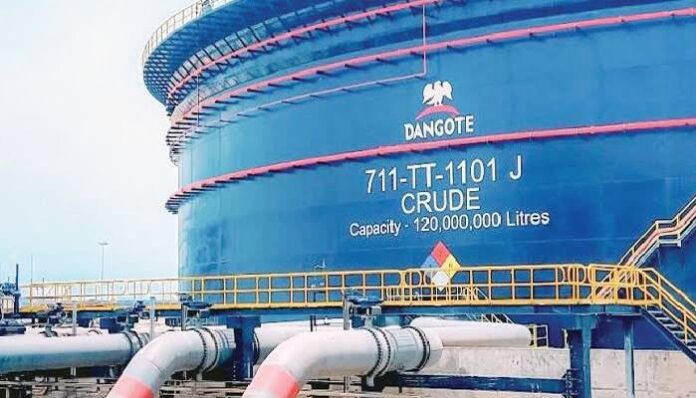

The uncertainty surrounding current legal battle between federal government and Dangote refinery over fuel imports is a cost, borne not by Dangote, not by the marketers, and not by the NNPC, but by the Nigerian consumer waiting at the pump, writes Business Editor, Onu Okorie. Except.
When Africa’s richest man takes his country’s petroleum regulator and its national oil company to court, the stakes are never merely commercial. The latest legal salvo fired by Dangote Petroleum Refinery, a fresh suit filed before the Federal High Court in Lagos seeking to void fuel import licences recently issued to six local marketers and the Nigerian National Petroleum Company Limited, has once again thrust the country’s downstream petroleum sector into a fog of legal uncertainty. At its heart, this battle is about who controls the flow of petrol into Nigeria, on what terms, and at whose expense.
The legal dispute has a history. In 2025, Dangote Petroleum Refinery filed a similar case against the NNPC and other marketers, only to withdraw it following the intervention of the Federal Government. That truce appears to have collapsed. In March this year, the Nigerian Midstream and Downstream Petroleum Regulatory Authority (NMDPRA) eased petrol import restrictions by granting a new batch of licences, totalling 720,000 metric tonnes of Premium Motor Spirit, to six marketers: NIPCO, AA Rano, Matrix, Shafa, Pinnacle, and Bono. The allocations were not trivial: AA Rano and Matrix were each licensed to import 150,000 metric tonnes, NIPCO, Shafa and Pinnacle 120,000MT each, and Bono 60,000MT.
Two months later, Dangote refinery returned to court. The new filing argues that the licences breach an earlier court order to maintain the status quo and contravene the Petroleum Industry Act (PIA), which, the refinery contends, permits fuel imports only when domestic supply falls short of national demand.
From Aliko Dangote’s vantage point, the case for blocking imports is straightforward — and backed by numbers he does not shy away from stating publicly. In a recent interview, Dangote revealed that his refinery is now processing crude at 661,000 barrels per day, exceeding its nameplate capacity. The NMDPRA has itself acknowledged that the Dangote Petroleum Refinery now supplies over 90 per cent of Nigeria’s daily petrol consumption.
Dangote’s argument, therefore, is not merely legalistic. It is economic and nationalist. Why, he has repeatedly asked, should Nigeria continue to spend billions of dollars importing refined petroleum products when a domestic refinery running above capacity can supply the market? The PIA, he insists, anticipated exactly this scenario: imports are a bridge measure, not a permanent feature of the market. Once domestic supply is sufficient, the legal and policy basis for import licences evaporates.
He has been even blunter about who he believes is working against his refinery. Dangote has named what he calls a “Mafia” a network of shippers, commodity traders, and local beneficiaries of the old import-dependent system who, he argues, profited handsomely while Nigeria was spending nearly $10 billion a year on fuel subsidies. “They are the people that did not want us to settle down because they believed that we were coming here to displace them,” Dangote has said. “And of course, that’s what we have done now.”
However, the NMDPRA and the marketers tell a very different story. To them, Dangote’s lawsuit is not a defence of the law, it is a bid for market dominance dressed up in legal language.
The Depot and Petroleum Products Marketers Association of Nigeria (DAPPMAN), which represents many of the affected businesses, was swift in its condemnation of the suit. In a statement issued over the weekend, DAPPMAN argued that the import licences at the centre of the dispute are not administrative courtesies but the legal instruments through which Nigeria’s fuel supply chain actually functions. Stripping those licences would not discipline a market, it would break one.
“A legal action designed to retroactively void those licences does not just affect individual businesses,” DAPPMAN warned, “it introduces uncertainty into the entire downstream supply chain at a moment when Nigeria can least afford it.” The association pointed out that its members had invested billions of naira in depot infrastructure, logistics networks, and compliance systems in reliance on the validity of those licences. Overnight nullification would not merely disrupt their businesses, it would strand capital and potentially crater supply.
The marketers were equally pointed in articulating the principle they believe is at stake. “No private refinery’s commercial interests should supersede the regulator’s responsibility to guarantee adequate fuel supply to Nigerians,” DAPPMAN said. “The downstream sector works because multiple players operate within it. A lawsuit that seeks to reduce that field of players is ultimately a lawsuit against Nigerian consumers.”
The NNPC, for its part, has filed a proposed defence that strikes at the same concern from a different angle. In court documents in public space, the corporation accused Dangote of seeking to restrict competition and expose the country’s fuel market to monopoly control. NNPC warned that granting Dangote’s request would expose Africa’s largest oil producer to supply disruptions, price instability, and risks to national energy security, the very outcomes the PIA was designed to prevent.
The NMDPRA finds itself caught between two powerful forces. The authority has consistently maintained that the import licences were issued under the PIA framework and that they exist to protect supply security, not to disadvantage any single producer. Granting import licences when domestic supply accounts for 90 per cent of consumption, rather than falling short of it — is precisely the kind of judgement call regulators are empowered to make, the authority argues. The refinery’s reading of the law, the NMDPRA implies, is one that would reduce regulatory discretion to a single condition: fill the tanks at Dangote’s refinery first, and only then allow imports.
An official of the NMDPRA, speaking on condition of anonymity, confirmed that the licences were duly issued, signalling that the authority has no intention of backing down without a court order compelling it to do so.
Beneath the corporate jousting and legal manoeuvring lies a question of immediate, practical importance to millions of Nigerians: will petrol be available, and at what price?
Nigeria’s experience with fuel scarcity is not ancient history. For decades, a country sitting on vast crude reserves endured chronic petrol shortages, interminable queues at filling stations, and the economic disruption that comes with them. The removal of the fuel subsidy in 2023 sent pump prices soaring, squeezing household budgets already battered by inflation. In that context, any legal dispute capable of disrupting the supply chain, even temporarily, carries real human costs.
If Dangote wins and imports are restricted or banned, the refinery assumes an enormous responsibility: sole or near-sole supplier to a country of over 200 million people. Any operational disruption, a technical fault, a crude supply shortfall, a logistics breakdown, would have no import buffer to cushion it. DAPPMAN’s warning about “supply disruptions and price instability” is not rhetorical flourish. It reflects the basic economics of single-source dependency.
If Dangote loses, imports continue alongside domestic production. Competition among suppliers could, in theory, exert downward pressure on pump prices. But it also means Nigeria continues to spend foreign exchange on imported fuel even as a domestic refinery of global scale sits in Lagos, a dynamic that Dangote argues is both economically irrational and legally indefensible.
The broader picture is complicated further by Dangote’s stated ambitions. He has announced plans to more than double the refinery’s capacity to 1.4 million barrels per day within the next 30 months. If that expansion proceeds on schedule, the domestic supply argument will become even more powerful, and the question of import licences more politically charged.
In a sense, this lawsuit is also a test of whether Nigeria’s Petroleum Industry Act, hailed when it passed in 2021 as a generational reform of the sector — can deliver on its promise of a well-regulated, competitive downstream market.
The PIA envisioned a sector in which domestic refining would grow, imports would be a supplement rather than the main event, and a capable regulator would make evidence-based decisions about supply adequacy. What the law did not fully anticipate, perhaps, was a single investor building a refinery so large that it could credibly claim to supply the entire country, and then using that claim to challenge the regulator’s authority to license competitors.
How the Federal High Court ultimately rules will shape the legal architecture of Nigeria’s downstream sector for years to come. It will determine whether the PIA’s import provisions function as a trigger mechanism that kicks in at a specific supply threshold, or as a broad enabling power the regulator can exercise in the interests of security and competition.