


By Onu Okorie
For decades, Nigeria lived a paradox that confounded economists and frustrated its citizens: Africa’s largest crude oil producer, yet almost entirely dependent on expensive imported fuel to power its economy. That era, according to a landmark new assessment, is drawing to a close.
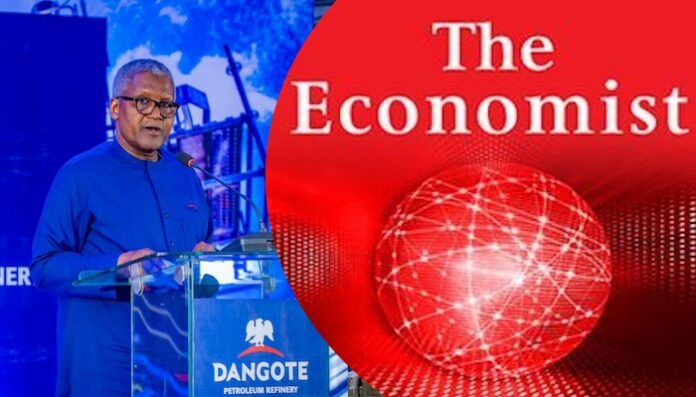
A 2026 report by the Economist Intelligence Unit EIU, the research and analysis arm of The Economist Group in London has confirmed that the Dangote Refinery & Petrochemicals has fundamentally transformed Nigeria’s downstream petroleum sector, significantly reducing the country’s reliance on fuel imports and strengthening its overall economic position.
The EIU’s assessment pulls no punches in describing what Nigeria’s downstream oil sector looked like before the Dangote facility came online. The country’s state-owned refineries had been inoperative for years, leaving a nation producing nearly 1.5 million barrels of crude oil daily unable to refine enough fuel to meet its own needs. The result was a costly, chronic dependence on imported petroleum products a structural vulnerability that drained foreign exchange reserves and left Nigerians exposed to global supply disruptions and exchange rate volatility.
“The country’s main refineries, all state-owned, had been inoperative for years and Nigeria was almost entirely reliant on costly imported fuel,” the report noted.
Since commencing its gradual ramp-up in May 2023, the 650,000-barrel-per-day Dangote Refinery has begun to close that gap with remarkable speed. By April of this year, the facility was meeting nearly 80 per cent of domestic petrol demand, producing sufficient volumes to largely satisfy local consumption requirements as operations approached full capacity.
The EIU stated that the refinery’s emergence has reduced import dependence, improved domestic fuel availability, and strengthened Nigeria’s balance of payments through lower import demand and rising exports of refined petroleum products.
Looking ahead, the report projected that full operational capacity and a planned doubling of output expected around the end of the decade — would further support real GDP growth and foreign exchange earnings in 2026, 2027, and beyond.
Industry analysts say the implications extend well beyond Nigeria’s borders. The refinery is increasingly positioning Nigeria as an emerging refining and export hub, reshaping energy trade flows across the African continent and reducing the vulnerability long associated with fuel import dependence. The development has coincided with sweeping reforms in Nigeria’s downstream sector, most notably the removal of fuel subsidies and the introduction of market-driven pricing mechanisms aligned with the objectives of the Petroleum Industry Act (PIA).