

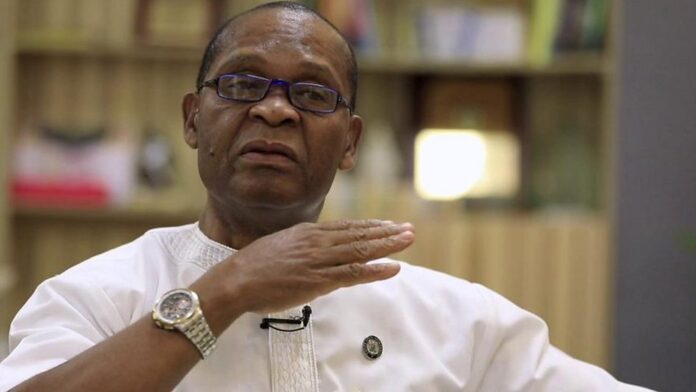

Friday, June 5, 2026, at Ladipo motor spare parts market in Lagos, Joe Igbokwe was reportedly bullied and humiliated by traders of the Igbo extraction. The incidence has once again reopened the difficult conversation around ethnicity, loyalty, politics and patriotism.
Joe Igbokwe is perhaps, one of the most controversial political figures of Igbo extraction in contemporary Nigeria. To his admirers, perhaps, he is bold, loyal, outspoken and unapologetically patriotic toward Lagos and the Yoruba political establishment that gave him relevance. To his critics, especially among many Igbos, he symbolizes political betrayal and ethnic abandonment.
Born in Nnewi, Anambra State, Joe Igbokwe built his political life largely in Lagos. Though of Igbo extraction, he rose politically within the Yoruba-dominated political structure that produced leaders like Bola Ahmed Tinubu and Babajide Sanwo-Olu. Over the years, he became one of the most visible Igbo politicians in Lagos politics, especially within the All Progressives Congress (APC).
He served as the spokesman of the Lagos APC and later became the Special Adviser on Drainage and Water Resources to Governor Babajide Sanwo-Olu. His loud media presence, especially on social media, turned him into both a political asset and a lightning rod for attacks. He consistently defended the Lagos political establishment, often against fierce criticism from fellow Igbos.
Just few days ago, June 12, 2026, precisely, he was enlisted for National Honours by the administration of his Yoruba hegemony.
The political journey of Joe Igbokwe is one that reflects the complicated nature of Nigeria itself. In a country where ethnic identity often shapes political loyalty, Igbokwe has spent decades swimming against the tide of expectations from his own people. The result has been admiration in some quarters, hostility in others, and a life constantly surrounded by controversy.
The latest controversy emerged after reports that Joe Igbokwe was confronted and allegedly insulted at Ladipo motor spare parts market in Lagos by traders believed to be of Igbo origin. The incident quickly spread across social media and became another chapter in the long-running hostility between him and many members of his ethnic group.
The anger against him did not start today. During the #EndSARS protests and the heated debates around the 2023 general elections, Joe Igbokwe openly attacked supporters of Labour Party presidential candidate Peter Obi. Since Peter Obi enjoyed overwhelming support among Igbos, many saw Igbokwe’s comments as direct attacks on his own people.
At different times, he accused some Igbo groups in Lagos of ingratitude and political intolerance. He repeatedly argued that Lagos belongs to all Nigerians but maintained strong support for Yoruba political dominance in the state. Those comments made him deeply unpopular among many Igbo youths who believed he was helping to weaken Igbo political influence in Lagos.
The tension became more dangerous in 2021 when his house in Nnewi was burnt down by unknown attackers. Though no group officially claimed responsibility, many linked the incident to rising political and ethnic tensions in the South-East. The attack generated sympathy across Nigeria, even among some of his critics. Burning down a man’s ancestral home crossed the line from political disagreement into criminal intimidation.
Among many Yoruba political actors, however, Joe Igbokwe enjoys a different reputation. They see him as a courageous bridge-builder who refused to play ethnic politics. To them, he represents the possibility of national integration in a country where many politicians only defend their tribe and region.
Some Yoruba commentators have argued that Igbokwe paid a heavy price simply because he chose independent political thinking over ethnic loyalty. They point out that many politicians freely work outside their ethnic regions without facing the level of hostility directed at him.
Still, critics insist that the problem is not his political affiliation but his style. They accuse him of often speaking harshly against fellow Igbos while appearing eager to defend Yoruba political interests at every turn. In Nigerian politics, perception matters greatly. Many Igbos believe Joe Igbokwe goes beyond normal party loyalty and sometimes appears hostile toward his own ethnic community.
This raises the larger question: what exactly is patriotism in a deeply divided society like Nigeria?
Patriotism should ordinarily mean loyalty to one’s country above tribe, religion or region. But Nigeria’s political reality is more complicated. Ethnic suspicion remains strong. Political appointments are often judged through tribal lenses. Elections are fought with ethnic calculations. In such an environment, anyone who appears too close to another ethnic bloc risks being branded a traitor by his own people.
Joe Igbokwe carries that burden daily.
Joe Igbokwe’s story therefore becomes both personal and national. It is about one man, but it is also about Nigeria’s unfinished struggle with identity and belonging.
Can an Igbo man fully align politically with Yoruba leadership without being called a sellout? Can patriotism survive in a country where ethnic loyalty often determines social acceptance? Can Nigerians disagree politically without resorting to violence, intimidation or destruction of property?
These are difficult questions with no easy answers. But, what is clear, however, is that political intolerance is growing dangerously across Nigeria. The bullying of Joe Igbokwe at the market, as reported, should not be celebrated. Democracy allows disagreement, not harassment. Likewise, burning down his village house was condemnable and criminal. Political differences must never justify violence.
At the same time, political actors like Igbokwe must understand the emotional weight of ethnic identity in Nigeria. Public figures should be careful not to deepen division through provocative language or excessive partisanship.
Nigeria needs bridge-builders, not ethnic warriors. The country cannot move forward if every political disagreement becomes an ethnic battle. Leaders must encourage inclusion, moderation and mutual respect.
Joe Igbokwe may continue to divide opinion for many years. Some will call him courageous. Others will call him controversial. But his experience reveals an uncomfortable truth about Nigeria: patriotism in this country often comes with suspicion, loneliness and heavy personal cost.
Perhaps, the greatest lesson from his story is that Nigeria still has a long journey toward true nationhood. Until citizens are judged more by competence and conviction than by tribe, men like Joe Igbokwe will continue to carry the burden of patriotism alone.
Joe Igbokwe’s challenge today is not merely political; it is emotional, cultural and symbolic. Many Igbos who oppose him do not simply disagree with his politics. They believe he abandoned ethnic solidarity at sensitive moments. Whether that perception is fully fair or not, rebuilding trust will require humility, bridge-building and visible reconciliation efforts.
At the same time, the Igbo community itself must also rethink how it treats dissenting voices. Patriotism and ethnic loyalty should not become prisons where every person must think alike politically.
In the main, Joe Igbokwe cannot be bigger than his Igbo ethnic community. In Igbo cosmology, it is absurd for a man to be referred to as “They”, instead of “He”. It is also said that: If a man cooks for the community, the community will finish it, but if the community cooks for a man, he will not finish it.
WE, at DAILY NEWSCRAFT, on this premise, advise that Joe Igbokwe reconsider his stance, idiosyncracy and ego, and creatively seek peace with his people by adopting the following: Reduce confrontational rhetoric; Reconnect with his grassroots Igbo communities; Defend Igbo interests openly when necessary; Become a bridge rather than a divider.