

By Hosea Parah
The Vice-Chancellor of Baze University, Abuja, Professor Abiodun Adeniyi, has argued that advances in digital communication technologies have transformed the nature of migration and belonging, making it increasingly difficult for people to detach from their ancestral roots regardless of where they live.
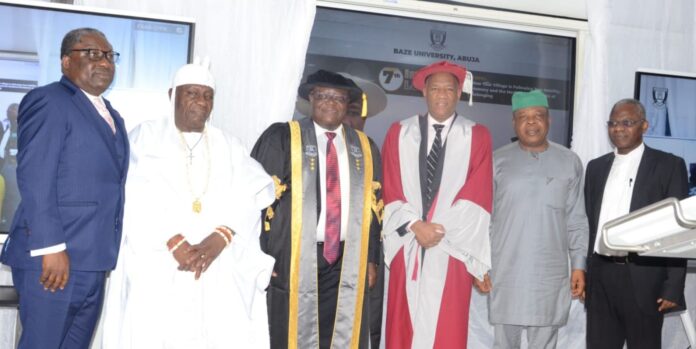
Speaking at Baze University’s 7th Inaugural Lecture, titled ‘How your village is following you: Mobility, memory and the mediated persistence of belonging,’ Adeniyi explored the intersection of migration, memory, communication technologies, and identity in contemporary society.
The communication scholar explained that the ‘village’ in his lecture was not merely a geographical location but a symbolic representation of ancestry, emotional attachment, memory, and belonging.
“The village is the place from which people trace their origins, whether they have lived there or not. It is a site of emotional connection, memory, identity, and imagined return,” he said.
According to the professor, migration no longer signifies complete separation from one’s roots as it once did. Through mobile phones, social media platforms, video calls, voice notes, and messaging applications, migrants remain constantly connected to their communities of origin.
“People move but never fully leave. Technology has reduced the social friction of distance and enabled continuous interaction across locations and generations,” he noted.
Adeniyi described modern communication devices as extensions of the human body, carrying memories, relationships, cultural practices, and family connections across borders. He argued that digital technologies have created what he termed “algorithmic belonging,” where migrants maintain emotional and social ties to their ancestral communities despite physical absence.
Drawing from migration and communication studies, the scholar observed that in earlier times migrants often disappeared from their communities for extended periods because communication channels were limited and expensive. Today, however, family members can maintain daily contact irrespective of geographical separation.
He illustrated this shift with the story of a retired Abuja resident whose prolonged silence on phone calls alerted her mother in the village, eventually leading relatives to discover that she had died alone in her residence.
“The first sign of her absence was noticed by the village through technology, not by neighbours living nearby,” he said, highlighting what he described as a reversal of traditional notions of proximity.
The inaugural lecturer also challenged prevailing global narratives that portray migration as a burden on host societies. Instead, he argued that migration should be viewed as a life-sustaining social process essential to economic growth, innovation, labour supply, and cultural exchange.
Using a biological metaphor, Adeniyi compared migration to the circulation of blood, water, and oxygen in the human body.
“Migration is not an anomaly or disease. It is a systemic rhythm that sustains societies, redistributes knowledge and opportunities, and contributes to development in both sending and receiving countries,” he stated.
He further noted that migrants contribute significantly to their communities of origin through remittances, infrastructure development, knowledge transfer, and community projects, while host nations benefit from labour, skills, and demographic renewal.
The professor warned, however, that the same technologies that sustain belonging can also facilitate misinformation, selective narratives, and emotional manipulation, especially when migrants rely on a limited number of sources for information about their home communities.
Concluding the lecture, Adeniyi maintained that digital technology has fundamentally altered the meaning of distance and identity.
“Before now, we left the village behind. Now the village is with us. We are no longer simply from one place; we are from all the places that remember us,” he said.
The event attracted academics, students, policymakers, communication scholars, university administrators, and members of the public, who gathered to celebrate Adeniyi’s scholarly contributions to migration studies, diaspora communication, and media research.
Adeniyi, a British Chevening Scholar and pioneer Professor of Mass Communication produced by Baze University, is widely recognized for his work in international communication, migration and diaspora studies, development communication, and media ethics.