


By Veronica Iji
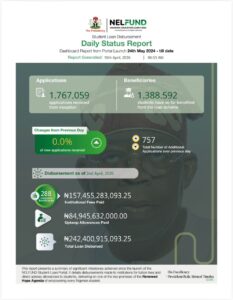
The Nigerian Education Loan Fund NELFUND has disbursed education loans to over 1.3 million students across Nigeria, significantly reducing dropout rates and expanding access to higher education since its launch in May 2024.
Out of approximately 1.7 million applications received, the scheme has reached beneficiaries in more than 400 tertiary institutions nationwide, operating across diverse academic calendars and institutional systems.
Managing Director of the NELFUND, Akintunde Sawyerr, disclosed that the intervention has led to a 15 to 20 per cent reduction in student dropouts, particularly among those who would otherwise have been unable to continue their education due to financial constraints.
He described the initiative as a major presidential intervention introduced by Bola Ahmed Tinubu at the early stage of his administration to address urgent funding challenges in the education sector.
Sawyerr acknowledged that while the programme is delivering tangible benefits, it faces operational challenges, particularly due to the lack of standardized data systems across institutions. According to him, NELFUND relies fully on electronic processing, but varying IT infrastructures among schools complicate data verification and synchronization.
“The scheme is complex, but it is working and making real impact,” he said, noting that efforts are underway to promote best practices in data integration across institutions, although full alignment will take time.
He also highlighted the challenge posed by differing academic calendars, with institutions resuming at various times of the year, which affects the timing of disbursements. This, he explained, often leads to delays perceived by students, despite NELFUND processing applications on a continuous basis.
Under the scheme, tuition fees are paid directly to institutions to ensure proper utilization, while students receive separate stipends for upkeep. Sawyerr stressed that funds meant for school fees are not released directly to students in order to prevent misuse.
Addressing complaints of discrepancies in fee payments, he urged affected students to submit formal reports with verifiable details, including identification and school records, to enable proper investigation. He maintained that there is no evidence of systemic misappropriation but assured that all legitimate concerns would be thoroughly examined.
NELFUND also acknowledged growing student concerns over delays and institutional practices, noting that increased complaints are expected as the number of beneficiaries rises. Sawyerr emphasized that such feedback is critical for improving the system and ensuring accountability.
On loan repayment, he explained that beneficiaries are expected to begin repayment two years after completing the National Youth Service Corps (NYSC), with 10 per cent deductions made from their salaries by employers. The system is designed to be flexible, allowing repayment to pause automatically in the event of job loss.
Describing the repayment structure as one of the most favourable globally, Sawyerr said it balances sustainability with compassion for graduates navigating the job market.
Despite systemic challenges, including fragmented academic calendars and institutional autonomy, the NELFund leadership expressed confidence in the programme’s long-term success. NELFUND reiterated its commitment to transparency, continuous improvement, and collaboration with stakeholders to strengthen delivery and expand impact.
Sawyerr encouraged students and institutions to engage constructively with NELFUND, emphasizing that resolving individual complaints often leads to broader systemic improvements that benefit thousands nationwide.