


By Tony Okafor
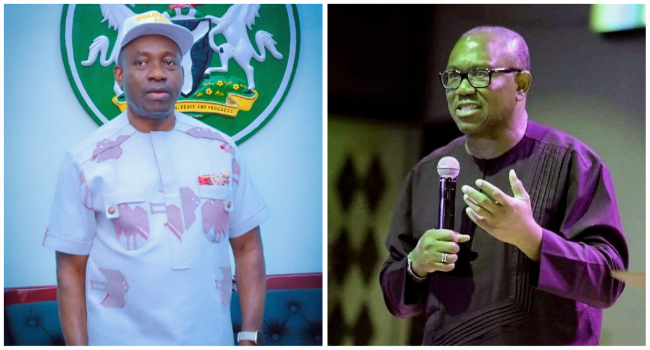
The swearing-in of Prof Chukwuma Soludo for a second term as governor of Anambra State is more than a routine political ceremony. It marks another significant milestone in the political evolution of the state.
For decades, Anambra politics appeared trapped in a peculiar pattern: governors emerged, served their tenure, and exited without securing a second elective mandate. It was a phenomenon many described as a tenure jinx.
Before the emergence of Peter Obi, no civilian governor had successfully returned to office for a second term—not even during the era of the old Anambra State.
After years of military rule, Jim Nwobodo became the first civilian governor of the old Anambra State during Nigeria’s Second Republic, serving from 1979 to 1983.
His administration was cut short politically when the late Chief Christian Chukwuma Onoh defeated him in the fiercely contested 1983 governorship election and was sworn in that same year.
Before Onoh could consolidate power, however, the 1983 Nigerian military coup abruptly terminated the democratic order nationwide.
When the present-day Anambra State was created in 1991, expectations were high that a more stable democratic tradition would take root. During the brief Third Nigerian Republic, Dr Chukwuemeka Ezeife emerged as the first elected civilian governor of the new state, serving from January 1992 until November 1993. Like many democratic experiments of that era, his tenure was cut short by another military coup that swept away civilian administrations across the country.
Nigeria again returned to democratic rule in 1999. In that election, the late Chinwoke Mbadinuju emerged governor of Anambra State on the platform of the Peoples Democratic Party (PDP).
His administration, however, was marked by severe political turbulence and internal party crises. By the time the 2003 governorship election arrived, Mbadinuju failed to secure re-election, becoming the only sitting governor in the country at that time to lose his party’s support and fail in his bid for a second term.
The 2003 election produced Dr Chris Ngige, also of the PDP, as governor. But the legitimacy of that victory was fiercely challenged by Peter Obi of the All Progressives Grand Alliance (APGA), who took the matter to court. After nearly three years of legal battle, the Court of Appeal sitting in Enugu nullified Ngige’s election.
Consequently, on March 17, 2006, Obi was sworn in as governor.
His tenure was anything but smooth. He faced impeachment and intense political hostility. In 2007, the Independent National Electoral Commission (INEC) conducted another governorship election on the grounds that Obi was merely completing Ngige’s tenure.
Obi disagreed and returned to court, insisting that his constitutional tenure began on March 17, 2006—the day he took the oath of office and oath of allegiance.
Despite the pending legal challenge, the election went ahead and Andy Uba was declared winner and sworn in as governor.
But his tenure lasted only 17 days. The Supreme Court of Nigeria ruled in favour of Obi, declaring that INEC had no constitutional basis to conduct that election because Obi’s four-year tenure had just begun in 2006. The landmark judgment became a locus classicus on governorship tenure in Nigeria.
Having secured his constitutional footing, Obi contested the 2010 governorship election and won convincingly, becoming the first governor—both in the old and the new Anambra State—to secure and complete a second term.
When he left office in 2014, he handed power to Willie Obiano, also of APGA. Obiano equally won re-election and served eight uninterrupted years, becoming the second governor to overcome the old jinx.
In 2021, Obiano handed over to Chukwuma Soludo, another APGA candidate and former governor of the Central Bank of Nigeria.
Yet, political speculations soon emerged that Soludo might suffer the same fate that befell many of his predecessors. Some even pointed to his single tenure as governor of the Central Bank as a supposed omen that he might not secure a second term.
Those predictions have now been laid to rest.
Soludo’s victory in the November 8 governorship election and his subsequent swearing-in for another term on March 17 , 2026 firmly place him in the growing list of Anambra governors who have successfully overcome the state’s once-feared tenure jinx.
In doing so, he has reinforced a democratic tradition that began with Obi and was sustained by Obiano—a tradition that suggests Anambra voters are increasingly willing to reward performance with continuity.
For a state once defined by political instability and truncated mandates, the new tradition of continuity is becoming firmly established.
Res ipsa loquitur- The thing speaks for itself.