
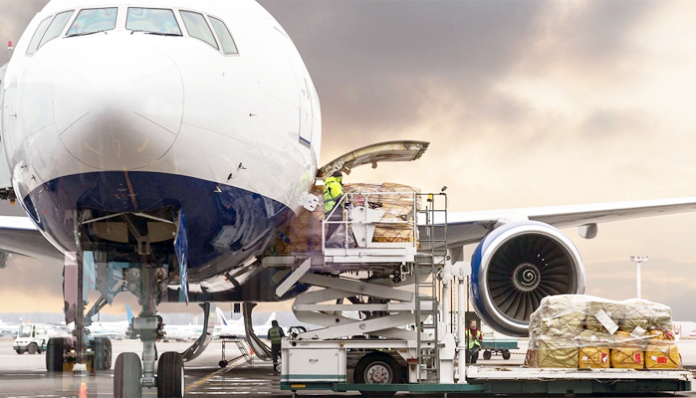

African airlines recorded the strongest growth in air cargo demand globally in October 2025, with volumes rising 16.6% year-on-year.
Capacity on the continent also expanded 20% compared to October 2024, reflecting significant operational expansion to meet rising demand.
The data was captured at the latest report from the International Air Transport Association (IATA) on October 2025 global air cargo markets.
“African airlines saw a 16.6% year-on-year increase in demand for air cargo in October, the strongest rise of all regions. Capacity increased by 20.0% year-on-year,” the report read in part.
Globally, total air cargo demand, measured in cargo tonne-kilometres (CTK), rose 4.1% year-on-year, while available capacity, measured in available cargo tonne-kilometres (ACTK), increased 5.1%, marking the eighth consecutive month of expansion and setting a new monthly record.
The growth is supported by broader trends, including a 3% rise in goods trade and a 3.7% increase in industrial production in September, the fastest pace since March 2025.
Beyond Africa, Asia-Pacific airlines posted an 8.3% increase in demand, with capacity up 7.3%, reflecting strong intra-Asia and Asia–Europe trade.
Middle Eastern carriers recorded a 5.7% rise in demand, with capacity increasing 10%, while European airlines saw a 4.3% increase in both demand and capacity.
In contrast, North American and Latin American carriers experienced weaker performances, with demand declining 2.7% year-on-year in both regions, while capacity increased only 0.1% for North America and 2.8% for Latin America.
Across trade lanes, Europe–Asia posted the strongest growth, followed by gains on Middle East–Asia, Africa–Asia, and intra-Asia routes, while volumes on North America–Asia and within Europe remained flat or contracted slightly.
IATA’s Director General, Willie Walsh, noted that while the Asia–North America trade lane extended its contraction to six months, October saw double-digit or near double-digit growth within Asia, between the Middle East and Europe, and between Europe and Asia, showing how air cargo is enabling global supply chains to adapt to the impact of US tariffs.
He emphasised that this positive development is particularly significant as the air cargo sector enters the peak fourth-quarter shipping season.
The report also noted that jet fuel prices increased 2.5% in October, while global manufacturing sentiment improved slightly, with the PMI rising to 51.45.
New export orders, however, remained below the 50-point expansion threshold at 48.31, reflecting ongoing caution amid tariff uncertainty.