
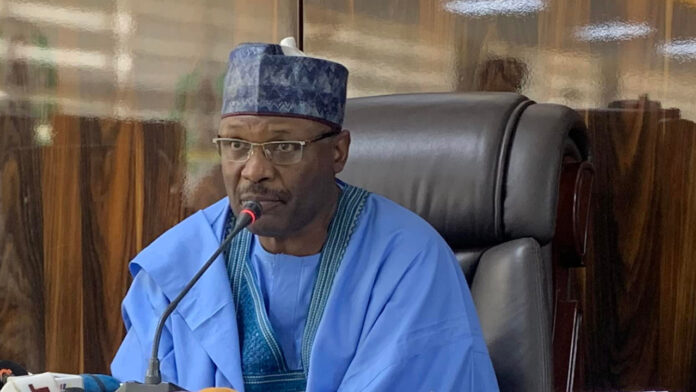

President Bola Tinubu’s appointment of the immediate past Chairman of the Independent National Electoral Commission (INEC), Professor Mahmood Yakubu, has triggered controversy, as major opposition parties have rejected the nomination, describing it as a dangerously insensitive move capable of compromising the outcome of the 2027 general elections.
Professor Yakubu, who completed his second term as INEC Chairman last month, oversaw the 2023 general election, an exercise widely criticised by Nigerians and the international community over alleged flaws in its conduct and result declaration.
While the Peoples Democratic Party (PDP) questioned the inclusion of the former INEC Chairman, the African Democratic Congress (ADC) described the move as embarrassingly insensitive and a dangerous precedent that could compromise the 2027 elections.
In a statement issued by its spokesman, Ini Ememobong, the PDP described the list of 32 ambassadorial nominees as scandalous.
“Specifically, we convey the disappointment of many right-thinking Nigerians on the nomination of Prof. Mahmood Yakubu, the immediate-past Chairman of the Independent National Electoral Commission (INEC), whose administration of our electoral umpire was characterised by countless double-speaks, flip-flops and undelivered promises, which ultimately resulted in the birth of this administration, which is struggling in all areas of governance,” the PDP said on Saturday.
“To offer him an ambassadorial appointment at a time like this is an excellent exemplar of a skewed reward system, which we suspect is designed as an incentive to the new INEC Chairman to also deliver flawed elections in 2027 in expectation of future rewards. This is absolutely scandalous and completely unacceptable,” the opposition party stated.
The PDP further described the list as containing the names of “disgraced propagandists, characterless politicians and public officials who are widely perceived negatively by Nigerians and the global community for their integrity deficit and notable anti-democratic activities.”
According to the PDP, “the list is reprehensible and scandalous; its nominees are a reflection of Tinubu’s values.”
“That it took the President almost three years to produce this list speaks to the paucity of excellent people within his reach,” the party added.
The PDP maintained that Nigeria deserves better representation in the international arena and argued that “appointing and sending ambassadors with tainted political profiles is not only a great disservice to Nigeria but a setup for a diplomatic all-time low.”
“To this end,” the party said, “we demand that President Bola Tinubu withdraw the said list and renominate only those with stellar democratic credentials and high moral standing, capable of commanding global respect for the ambassadorial assignments.”
The African Democratic Congress (ADC) also condemned the nomination of Professor Yakubu, describing it as “embarrassingly insensitive.” The party cautioned that the appointment, if allowed, could set a dangerous precedent that would undermine the neutrality of the country’s electoral system.
In a statement by its National Publicity Secretary, Mallam Bolaji Abdullahi, the ADC faulted the list, noting that it was filled with corruption suspects, political jobbers, and relatives of the President’s associates.
“At the heart of this troubling list lies the nomination of Prof. Mahmood Yakubu, the immediate past Chairman of the Independent National Electoral Commission (INEC), who conducted the election that brought Tinubu in as President of Nigeria.
“The ADC views the appointment of Prof. Yakubu as embarrassingly insensitive, especially coming barely two years after supervising a highly controversial election that ushered in President Tinubu and only a few weeks after leaving office as INEC Chairman.
“This particular appointment blurs what should be a distinct line between players and umpires. If allowed to stand, it would set a dangerous precedent where future INEC chairmen and commissioners may begin to see their positions as stepping stones to future political rewards. Once that mindset enters the bloodstream of our electoral system, neutrality becomes impossible, partisanship becomes inevitable, and elections become transactional.”
The ADC further noted that “a cursory review of the list shows that almost all the nominees fall into three categories: former career diplomats or ambassadors, political supporters or their relatives, and members of the President’s political party. We wonder in which of these three categories Prof. Yakubu belongs. The implication of this is deeply unsettling indeed.”
While acknowledging that Nigerian law does not stipulate a “cooling-off” period before a former INEC chair can assume political appointment, the ADC insisted that ethical standards must be upheld, especially when such decisions undermine democracy’s foundations.
The opposition coalition urged the former INEC boss to reject his nomination in the interest of the commission’s integrity and institutional credibility.
The party said Yakubu’s appointment “raises fundamental ethical concerns and further undermines an electoral body still struggling with public trust.”
It added that the nomination “would lend credence to the widespread allegation that the former INEC chief may not have been a neutral umpire in the 2023 election,” noting that he supervised the highly disputed poll that produced President Tinubu and left INEC in a “major credibility crisis.”
“We therefore call on Prof. Yakubu to do the patriotic thing and reject this appointment for the sake of INEC’s institutional credibility, the integrity of future elections, and the preservation of his own legacy.
“Failing to do so, we call on the Senate to reject his nomination in the interest of our democracy.
“At a time that Nigeria needs a disciplined and credible diplomatic corps, capable of rebuilding the nation’s collapsing credibility on the continent and the rest of the world after two years of thoroughly damaging absence, President Tinubu has surpassed himself by presenting a comic cast of political jobbers, corruption suspects, and a patronage of wives, children, and relatives of his political associates,” the ADC stated.