


By Olawumi Oyehan
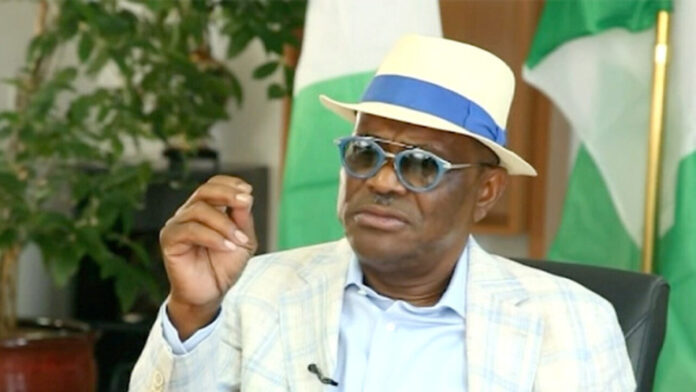
The Minister of the Federal Capital Territory (FCT), Nyesom Wike, has declared that the unprecedented infrastructural revolution currently underway in the nation’s capital was made possible by President Bola Ahmed Tinubu’s bold political will to liberate the FCT Administration (FCTA) from severe financial and administrative bottlenecks.
The Minister stated this during a dinner organised to mark the end of the 31st days marathon of projects commissioning and flagging off within the nation’s capital, Abuja.
Wike revealed that Tinubu explicitly ordered the FCT to exit the Treasury Single Account (TSA) and approved the full implementation of the 2018 FCT Civil Service Commission Law.
According to the Minister, restricting the FCT under the TSA framework was “the worst thing any administration could do,” as it systematically starved the capital city of necessary development capital.
Wike disclosed that upon taking office, President Tinubu identified the bottleneck and immediately authorized the FCT’s exit from the financial framework, effectively allowing the administration to commercialize its independent Internally Generated Revenue (IGR) to secure robust funding from commercial banks.
”There is no government in this world that can achieve massive infrastructural growth without leveraging financial instruments,” Wike stated, adding that commercial banks are now confidently partnering with the FCTA because loans are backed by a structured repayment format directly tied to the territory’s robust IGR.
This financial liberation, Wike noted, is the direct engine driving the rapid delivery of clean water, flyovers, and major arterial roads across Abuja.
On administrative reforms, the Minister explained that before the current dispensation, professional growth within the FCT civil service was completely blocked, forcing career civil servants to retire permanently as directors while external federal permanent secretaries were deployed to head FCT ministries.
Wike recounted approaching the President to implement the 2018 law—originally passed by the National Assembly and assented to by then-Acting President Professor Yemi Osinbajo—to align the FCTA with the ‘Renewed Hope’ agenda.
”It didn’t take Mr President two hours to sign it. He declared that the FCT must have its own Civil Service Commission, and it was done—even though certain individuals at the federal level fought against it,” the Minister noted.
The reform has successfully established permanent secretaries from within the FCT ranks, alongside the creation of an independent Head of Service position to ensure internal career progression.
Wike added that regional inclusivity has been institutionalised, with permanent secretaries now representing all six geopolitical zones.
Defending his administration’s governance model, Wike maintained that treating governance like a business has allowed the FCTA to expand project commissioning cycles from 7 days in the administration’s first year to an unprecedented 31-day marathon.
He challenged political critics to point out any abandoned infrastructure in the territory, revealing that 70 per cent of the projects completed by the current FCTA leadership were inherited from past administrations.
”It is President Tinubu’s core belief that we cannot abandon ongoing initiatives simply because a previous administration started them. These projects were funded with public money,” Wike said.
According to him, among the long-standing inherited projects fully completed by the current administration are the Julius Berger contracts for roads B6 and B12, dating back to 2009, and the ISEX project originally awarded in 2014.