
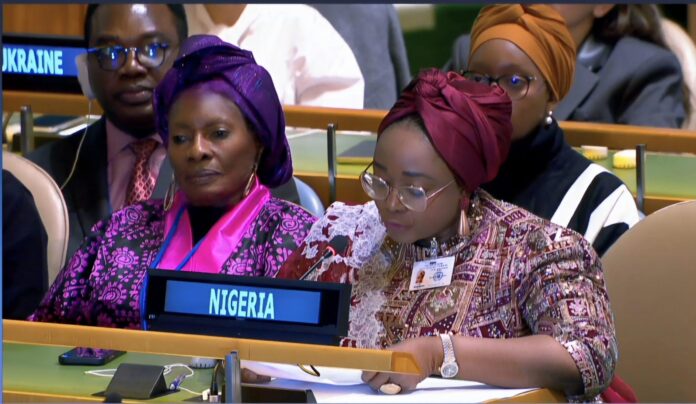

Nigeria has reaffirmed its commitment to advancing gender equality and strengthening the welfare of women and children as the Minister of Women Affairs and Social Development, Imaan Ibrahim Suleiman, led a high-level delegation to the 70th session of the United Nations Commission on the Status of Women currently holding at the United Nations headquarters in New York.
Addressing the global gathering on behalf of Nigeria, the minister outlined several initiatives being implemented by the administration of Bola Ahmed Tinubu aimed at improving the welfare of citizens, particularly women and children.
The head of Press and Public Relations of the ministry, Ahmed Lawan Danbazau in a statement the minister noted that Nigeria aligns with the position of the African Group at the summit and reaffirmed the country’s commitment to gender equality and women’s empowerment as a foundation for inclusive growth, equitable justice, protection of rights and sustainable development.
Suleiman disclosed that President Tinubu has declared 2026 as Nigeria’s Year of Families and Social Development, describing the move as a reflection of the administration’s belief that strong families are essential to empowering women, protecting children and building cohesive communities.
According to her, Nigeria’s social protection system has expanded significantly over the years.
“Under the leadership of our president, Nigeria’s social protection architecture has expanded from fewer than one million households in 2015 to almost 10 million households in 2026, with women constituting over 70 per cent of the primary beneficiaries. This represents one of the most significant social protection expansions in Nigeria’s post-independence history,” she said.
The minister also announced that the government was accelerating the implementation of its flagship programme, Renewed Hope Social Impact Interventions 774 (RHSI774), describing it as the largest locally driven investment for women’s empowerment in Nigeria’s history.
She explained that the programme cuts across livelihood support, clean energy access, financial inclusion, digital empowerment and social protection initiatives aimed at improving the socio-economic status of women across the country.
Suleiman further revealed that the government had launched the Women Digital Harmony Initiative, which includes the “Happy Woman App,” a mobile platform designed as a one-stop hub for information, mentorship and opportunities for women.
The platform, she said, is expected to connect more than 20 million Nigerian women to support networks, training and economic opportunities.
On efforts to combat gender-based violence, the minister said Nigeria was strengthening institutional responses through a comprehensive safeguarding mechanism, including the National Electronic Dashboard for real-time monitoring, coordination and accountability.
She noted that the government was also scaling up prevention strategies and survivor-support systems to address emerging cases of technology-facilitated gender-based violence.
Speaking on economic empowerment, Suleiman highlighted Nigeria’s focus on developing the care economy as a pathway to gender equality and inclusive growth.
According to her, the government is promoting policies that recognise and reduce unpaid care work while expanding childcare, eldercare and social support services that enable women to participate fully in economic activities.
She also pointed to Nigeria’s legal and policy frameworks supporting gender equality, including the Violence Against Persons (Prohibition) Act and the Child Rights Act, which remain critical tools for protecting women and children.