


By Onu Okorie
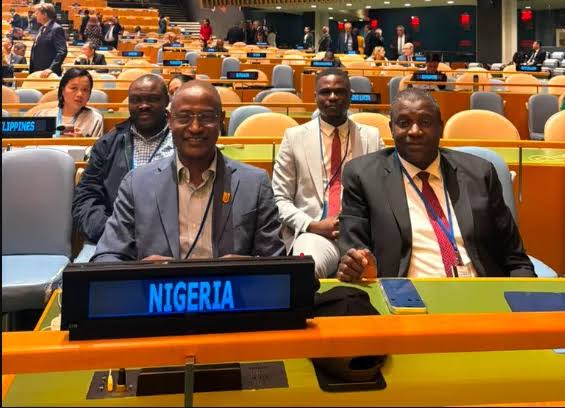
President Bola Ahmed Tinubu has reaffirmed Nigeria’s commitment to improving global road safety at the UN General Assembly Headquarters in New York.
A statement made available to the media explained that President Tinubu made this known through Corps Marshal of the Federal Road Safety Corps FRSC, Shehu Mohammed, who led the country’s delegation to the United Nations High-Level Meeting on Improving Global Road Safety.
The high-level gathering brought together Heads of State, ministers, global policymakers and road safety experts to accelerate commitments aimed at reducing road traffic deaths and injuries by 50 percent by 2030, under the UN Decade of Action for Road Safety.
Presenting Nigeria’s national statement on behalf of President Tinubu during the plenary session, Mohammed reaffirmed the Federal Government’s determination to strengthen road safety governance through sustained political commitment.
With the theme “Scaling Up and Accelerating Implementation of Commitments to Halving Road Traffic Deaths and Injuries by 2030,” the aim was to develop strategic investments, innovation and stronger international partnerships in line with the administration’s Renewed Hope Agenda.
He told delegates that the government had continued strengthening the FRSC’s institutional capacity through strategic reforms, technology-driven enforcement systems, improved emergency response mechanisms and expanded public enlightenment campaigns aimed at reducing road fatalities.
The Corps Marshal also highlighted Nigeria’s growing leadership role in road safety across Africa, citing the recent launch of the Nigeria Road Assessment Programme (NigeriaRAP) in collaboration with the International Road Assessment Programme (iRAP), an initiative designed to improve road infrastructure safety using the globally recognised Safe System Approach.
He noted further that Nigeria hosts the Secretariat of the African Association of Road Safety Lead Agencies (AARSLA), which provides a platform for collaboration, knowledge sharing and institutional strengthening among road safety agencies across the continent.
Mohammed said Nigeria was also aligning its transportation sector with global sustainability goals through the Presidential Initiative on Compressed Natural Gas (CNG) and Electric Vehicles, while developing safety standards for heavy goods vehicles and emerging transport technologies.
Despite this progress, he stressed that stronger international cooperation remained crucial in areas such as intelligent enforcement technologies, road infrastructure safety assessments, institutional capacity development and technology transfer, calling on development partners to deepen technical cooperation and support capacity-building programmes.
Reaffirming Nigeria’s commitment, Mohammed declared road safety a national political priority under Tinubu’s administration. He assured the global community that Nigeria would continue working with international partners to build safer roads, save lives and contribute to the Sustainable Development Goals.