

Valentine Obienyem
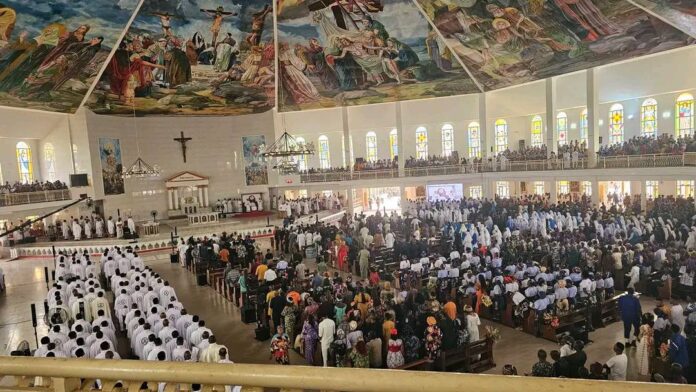
Yesterday was a particularly memorable day for the Catholic Diocese of Nnewi, marking the dedication of their cathedral, Our Lady of Assumption. The occasion was attended by over 300 clergy, including more than 100 bishops. The concelebrated Mass was led by Francis Cardinal Arinze. Most Rev. Jonas Benson Okoye, the diocesan bishop, explained that Arinze’s choice was especially meaningful because his predecessor had started the cathedral, which he continued; Arinze had also ordained his predecessor to the priesthood and confirmed him (Jonas Benson) in faith. He chose the day of his predecessor’s episcopal consecration for his own consecration and, ultimately, for the dedication of the cathedral.
The statement by Bishop Jonas Benson Okoye is dripping with catharsis, reflecting the deep spiritual connection and gratitude shared across generations. The climax was seeing his predecessor shed tears amidst all, a powerful moment of emotional release. By choosing the day of his predecessor’s episcopal consecration for his own dedication Mass, Biahop Benson reinforced continuity and mutual respect, and this emotional moment will surely strengthen the bishop’s relationship with his priests by building trust, deepening bonds, and inspiring loyalty, showing that genuine emotion and reverence have a unifying and motivating effect within the Church. This underlines apostolic succession and the continuity of pastoral leadership.
In his homily, Cardinal Arinze spoke directly and simply to the people about the cathedral being the principal church of the diocese. He explained that the cathedral revolves around two hinges: the Church itself and the seat of the bishop, which symbolizes the teaching authority of the Catholic faith handed down from the apostles.
The homily guided the congregation through the liturgy of dedication, explaining the meaning of each ritual step. The dedication transforms the building into a sacred space for worship through rituals such as the procession and opening prayers asking God to accept the church, sprinkling of the walls and people with holy water as a reminder of baptism and purification, anointing the altar and walls with sacred oil to show that the church is consecrated to God, burning incense to symbolize prayers rising to heaven, lighting candles to represent Christ as the Light of the world, and celebrating the first Mass in the newly dedicated church as the central purpose of the building. Every action carries deep symbolic meaning, reflecting purification, prayer, and the presence of God, and reminds the faithful that a church is not just bricks and mortar but a living space for gathering, teaching, and serving. We enjoyed the old and spiritually gratifying litany of the saints in Latin.
I sincerely thank the diocesan bishop for delivering this magnificent cathedral, arguably the best and the most beautiful in Nigeria, and for honouring his predecessor as well as all who contributed to the project. I am happy he mentioned Uba’s name. I was tempted to join those disappointed it was just in passing, but I asked myself whether I am aware of the depth of others’ contributions, given that Bishop Benson redesigned the entire church. While I am not fully aware of everything, I thank the late Senator Ifeanyi Ubah in a special way for the extent of his contributions visible to us.
Globally, a few major basilicas have fixed universal feast days marking their dedication, including the Archbasilica of St. John Lateran on 9 November, the Basilica of St. Mary Major on 5 August, and the Basilica of St. Paul Outside the Walls on 18 November. I am privileged to have visited all of them. These feasts celebrate the spiritual and historical significance of these churches as central places of worship. At the same time, every diocese and parish can celebrate the anniversary of its own church’s dedication, usually on the day of consecration or a nearby date if unknown. These local celebrations follow the same liturgical structure, emphasising that every church, regardless of size or prominence, is a sacred dwelling of God.
Canon Law further reinforces the sacred nature of churches. If a church is abandoned or deconsecrated, procedures exist to remove its sacred designation before it may be used for secular purposes. Observing rites properly, as Cardinal Arinze consistently demonstrates whenever he leads liturgical services, is a lesson to all of us. I have seen priests who stop Mass halfway to raise funds, those who serve water to VIPs during mass, and those who create their own words during consecration. These are sins against liturgy and divine worship. With older figures like Arinze and the bishops, we do not witness such aberrations, and I hope younger priests who may have forgotten what they were taught in liturgy and sacramental theology are refreshing their knowledge at the feet of the masters.
At 92, Cardinal Arinze’s faculties remain alert; his voice is vibrant, and his Latin impeccable. Those of us who learned Latin are guided on the correct pronunciation of Latin words by listening to him.
As I conclude, I thank the Papal Nuncio, Archbishop Michael Francis Crotty, for coming; his presence was invaluable and, tongue in cheek, balanced by the presence of our own homeboy and nuncio, Archbishop Jude Okeke. I must also acknowledge Archbishop Valerian Okeke, who is the “Oga Kpatakpata” of the province, as well as my own bishop, Dr. Paulinus Ezeokafor. My former government teacher, from whom I first heard names like Fletcher and AV Dicey, Peter Cardinal Okpaleke, was present as well. A special friend among the episcopacy, Bishop Geoffrey Onah, was there too; I cherish him because he has consistently increased my knowledge, always teaching something valuable whenever he speaks. I also thank the retired cardinals, bishops, and priests who, despite the insecurity in the land, came to show the oneness of the Catholic faith – an essential sign of Catholicism.
I thank in a special way my teacher, the Bishop: Dr. Jonas Benson Okoye. He is truly addicted to work, always diligent and disciplined in everything he undertakes. As our teacher in the eighties, he was also the labour master, guiding us not only in academics but in responsibility, discipline, and practical life skills. Expressive and matter-of-fact, he communicates with clarity and authority, yet always inspires respect rather than fear. His dedication has not changed over the years; he remains himself, approachable, and deeply committed to whatever he undertakes. Beyond his work ethic, he is a terror to malfeasance and impatiently doing today what should be done tomorrow. He is rapidly changing the face of the Diocese.
To show how accommodating and forward-thinking he is, the day we visited him at his hospital in Ihiala, he hinted at his plans to establish a specialised university. He even requested that a priest who would play a key role in the project ensure that I would be considered as one of the lecturers when it eventually takes off, reflecting both his openness and his desire for the future.
The low point of the event was a display by a knight. I was amazed by the level of his ignorance. How can a knight tie his faith to God through the Church to show of gratitude he perceived as omitted? In fact, it was good it happened. It is about time that membership of the knighthood is reappraised. It was clear the man in question is clueless in Church matters. He acted like a person propelled by unbelief. Is his faith tied to the actions of his bishop? Is he a reborn Donatist? Was he sleeping in the Church or thinking about “Alobunagu” when Ifeanyi’s name was mentioned? I am sure after the required reflection, he will apologise for his folly. That phrase: “akacha m” sounds ridiculous and every inch un-knightly.
Most importantly, we thank God for His guidance, grace, and providence that have made this historic day possible. We are grateful for the dedication, vision, and service of all those who have contributed to the life of the Diocese—from the clergy and faithful to the generous benefactors. May the Cathedral of Our Lady of Assumption stand not only as a magnificent structure but as a living testimony to faith, unity, and the enduring presence of God among His people. May it inspire generations to come to worship, serve, and grow in holiness, and may the lessons of dedication, perseverance, and spiritual continuity continue to guide the Diocese of Nnewi for many years.