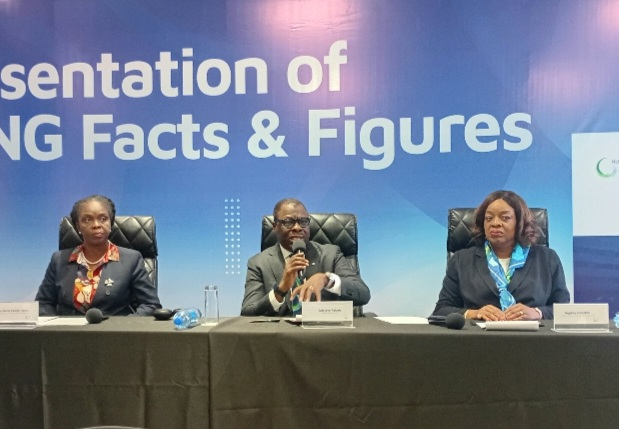

The Managing Director and Chief Executive of the Nigeria LNG Limited, (NLNG), Adeleye Falade, has revealed that the company has generated $149.6 billion in revenue and paid $10.8 billion tax to the Federal Government since 2009 when it commenced operations. in 2009.
Falade presented the figures on Tuesday in Lagos State during the unveiling of Facts and Figures 2026, the company’s annual report of operations, projects, and impact. He described the numbers as evidence of NLNG’s role as “a success story in Nigeria’s energy sector.”
“We have made $149.6 billion in revenue by 2026. $10.8 billion has also been paid in tax to the Federal Government right from the time we became tax compliant,” Falade said.
As reported by Platforms Africa, Falade added that the company has also remitted $47.2 billion in dividends to shareholders, including the Federal Government, which holds the largest stake in the venture.
The NLNG boss said the company currently operates six liquefaction trains with an asset base valued at over $22.9 billion. It has also built a fleet of 20 dedicated LNG ships and has loaded more than 6,285 LNG cargoes for global markets since inception.
On global relevance, Falade noted that NLNG contributes 6% to the world’s total LNG supply pool, positioning Nigeria as a key player in the international gas market despite domestic challenges.
A major highlight of the 2026 report is the progress on Train 7, NLNG’s expansion project on Bonny Island. Falade said the project has now reached 93% completion stage and is on track to become one of Africa’s largest LNG expansions.
“Train 7 will surge our LNG production by 35 per cent. The project will also increase our LPG production by 50 per cent,” he stated.
The additional volumes are expected to strengthen Nigeria’s export earnings and domestic gas supply.
Beyond exports, NLNG is playing a critical role in Nigeria’s domestic energy transition. Falade said the company supplied 500,000 tonnes of cooking gas, Liquified Petroleum Gas (LPG) to the Nigerian market last year alone, helping to deepen access to cleaner cooking fuel.
He linked the company’s operations to a sharp reduction in gas flaring nationwide. According to him, NLNG’s gas gathering and utilization model has helped crash Nigeria’s gas flare rate from 65% to less than 20 per cent.
Falade also highlighted NLNG’s impact on public health and infrastructure. He noted that over 470,000 Nigerians die annually from illnesses linked to firewood and other dirty cooking fuels. The company’s LPG push, he said, is directly addressing that burden.
On Corporate Social Responsibility (CSR) the MD cited the completion of the N120 billion Bonny-Bodo Road as one of Nigeria’s biggest CSR projects. The 40km road, he said, provides the first mainland connection to Bonny Island and has transformed movement and commerce in Rivers State.
Despite the milestones, Falade admitted that gas supply remains NLNG’s biggest challenge.
“One of our great challenges was gas supply. Last year was extremely bad for us,” he said.
He however expressed optimism that supply conditions have improved this year.
Industry analysts say the completion of Train 7 will be critical to locking in new LNG contracts and meeting rising global demand, especially in Europe and Asia. The additional 35 per cent LNG and 50% LPG capacity will also ease domestic shortages.
With over two decades of operations, NLNG remains Nigeria’s flagship gas company and one of the largest single contributors to government revenue outside crude oil. Its model of monetizing associated gas has also been cited as a template for reducing flaring.
As Train 7 nears completion, Falade said NLNG’s focus for the next decade will be on reliability, expansion, and deepening domestic impact.
“The success story continues. Our goal is to deliver more energy, more revenue,
Business, Energy, etc,” he added.