

Valentine Obienyem
Prof. Pat Utomi is a man of remarkable breadth – deeply grounded in economics, ecclesiology, public affairs, and politics. Over the years, I have encountered these different facets of his life and work in diverse ways.
I was once a regular listener of Patito’s Gang. Many years ago, I met him at the Catholic Institute of West Africa, Port Harcort. During his lecture, one of the priests present asked him a question. By the time he concluded his response – replete with copious references to the “Didache” – I was fully convinced of the depth and seriousness of his scholarship. We can justifiably call him a teacher of teachers. Somewhat, he knows this, as he kept referring to himself as a teacher as he presently delivers his welcome address.
In 2023, during the electioneering period, I was part of Mr. Peter Obi’s entourage to the United States, where we met various political and social groups. Everywhere we went, including the White House, we encountered people who already knew Pat Utomi. In each meeting, when he spoke, he drew from their local context, using familiar examples to make his points. It was both instructive and impressive.
At the White House, for example, he made references to many U.S. presidents as he spoke, to the admiration of all present. Watching Mr. Peter Obi, his demeanour silently spoke, suggesting that his hosts saw in the company around him a promise of what his government would be in the fullness of time.
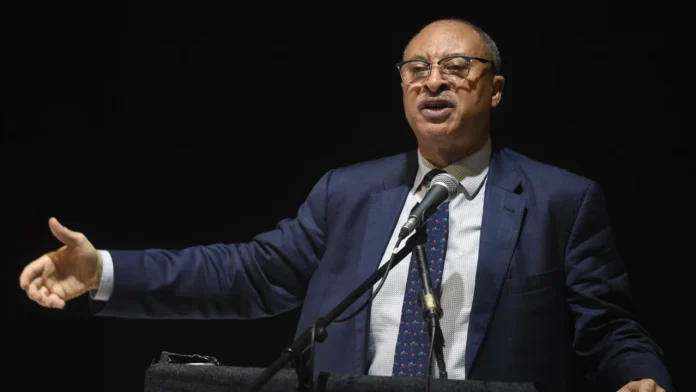
Today, we gathered at the Amadeus Centre in Enugu to honour him as he turned 70. One striking feature of the event was that over 80 percent of those present are university and college undergraduates. That, in itself, is a profound statement. It suggests that even where elders may have failed, hope remains alive. If these young people can be inspired and formed, then the future is assured.
As he spoke, his reflections revolved around gratitude. He reminded us that the purpose of life is the elevation of the dignity of the human person, and that recognizing the gift of creation obliges us to act justly toward everyone. In this, he brought to mind Jainism, which takes this moral imperative with striking literalness.
In its fidelity to justice toward all beings, Jainism stands as one of the most radical ethical systems in human history, carrying the principle of non -violence (ahimsa) to its furthest limit by demanding reverence for every form of life – animals, insects, and even microscopic organisms. Jain monks sweep the ground before walking, strain water before drinking, and wear masks to avoid harming living beings, seeing in this discipline a moral seriousness and consistency rarely equalled by any other religion.
Prof. Utomi recalled, with emotion, a childhood experience in Asaba, where he was lined up among those to be shot during the war, until the intervention of a superior officer saved his life. That moment, no doubt, shaped his lifelong sensitivity to human dignity.
He also spoke of his enduring concern with poverty, especially poverty amid hunger, a concern that has defined much of his research. He described himself simply as a teacher and saw the occasion not as self-glorification, but as a platform and opportunity to share ideas.
He noted that many years ago he became convinced that the best way to celebrate his birthday was not with fanfare, but with serious discussion. He referenced the book by his friend, Prof. Peter Lewis, “Growing Apart.” He reflected on how Indonesians once aspired to become like Nigeria, and how today Nigerians dream of becoming like Indonesians. It was the passion of a man in pain, a pain born of watching Nigeria derail from the path of development.
Even in his politics, one can see how this regret and anguish form the foundation of all that he does. He appears to have devoted the rest of his life to the pursuit of good governance. Even when his health challenges were announced a few years ago, they did not slow down his quest for good governance.
From his on-going speech, it is clear that he has his regrets – for example, that many years of speaking and writing seem not to have had sufficient influence on the nation. He again reminded us of what Dim Chukwuemeka Odumegwu Ojukwu described as the “dialogue of the deaf,” which requires a great deal of gesticulation to be understood.
But Pat quickly consoled himself by recalling how his good friend, Fr. George Ehusani, a purpose-driven priest by all standards, told him that even Socrates was killed for the views he propagated, which the people of his time rejected, yet those same views later became the cornerstone of Western civilization.
Let me join in consoling our big brother, Prof. Pat. If you look behind you, you will see me seated among students of Queen’s Mother Secondary School, Enugu. All of them are with writing materials and are, in fact, taking notes. If our own generation did not listen to you, these children are listening and taking notes. Your struggle will not be in vain.
The keynote address is on, make I listen first…